


Most consumers don't think twice about using a disposable pen and throwing it away when it has expired. Soon people may be able to take that carefree approach toward mobile phones.
Technological hurdles, high production costs and environmental concerns have long hindered the development of phones that would join disposable pens, razors and cameras in the wastebasket after use. But two companies now say they can overcome the barriers, thanks to new flexible circuit board technology and evolving wireless systems that pair "smart" network servers with relatively simple hand-held devices.
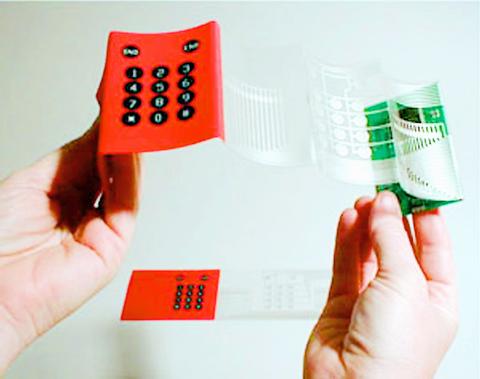
PHOTO: NY TIMES
Those companies are developing disposable wireless phones that they hope to begin selling around the US early next year, although telecommunications experts still question whether they can be made and distributed profitably. Experts have also raised doubts about whether carriers can make money from disposable phones, given the high user turnover that they will have to oversee while selling relatively few minutes per phone.
"Disposable phones are a technological, economic and environmental challenge, probably in that order of difficulty," said Nicholas Negroponte, director of the Media Laboratory at the Massachusetts Institute of Technology. "I am not totally convinced the product is real but would love to be wrong."
Perhaps the company with the most eagerly anticipated product is Dieceland Technologies of Cliffside Park, New Jersey, founded by a toy inventor, Randi Altschul. Among the patents Altschul holds is one for elongating the base layer of a flexible circuit board -- the heart of a cell phone -- and folding it up back on itself so that it becomes the body of the phone. This method, along with existing technology that allows circuitry to be printed with conductive metal ink on thin, pliable surfaces, could allow the manufacture of an ultrathin phone without displays, memory or other sophisticated features.
Dieceland has a trademark on the Phone-Card-Phone, an apt name given that the prototype looks like a credit card with a keypad. A plastic battery case with one AAA cell battery slips over one end and a reusable headset plugs into one corner. The units will be inexpensive, possibly as little as US$10 for a complete phone with 60 minutes of airtime. (The first Phone-Card-Phones are not expected to be refillable, although later models might be.)
Neither display nor keypad
Telespree of San Francisco is developing a semidisposable system relying on a reusable colorful handset and a disposable pack supplying power and airtime that snaps onto the back. The handsets are expected to sell for roughly US$30 and provide an initial 30 minutes of airtime. The disposable cartridge, known as the AirClip, is likely to cost US$0.30 to US$0.50 per minute of use.
Like the Phone-Card-Phone, the AirClip phone does not have a display. It does not even have a keypad, only an on-off button and a 911 emergency button. Calls are voice-activated: the user simply recites the phone number aloud after pushing the main button to gain access to a carrier's network.
Neither the Phone-Card-Phone nor the Telespree model will require a contract for service as conventional wireless phones do. Rather than supplanting durable mobile phones, the disposables will vie with prepaid cards and cards that bill to land-line accounts. Both phones will initially be sold to make outgoing calls only, although models with the capacity for incoming calls are also in the works.
In April, Dieceland entered an agreement with GE Capital to have its GE Prepaid operation market and distribute the phone, Altschul said. The wireless carriers that would supply airtime for the phones have not been announced, but she described them as "major players" in the industry. Dieceland and GE plan to test-market the Phone-Card-Phone in a few cities around the US this fall, pending approval from the Federal Communications Commission. Then the product will be marketed nationwide, probably in late winter. Telespree also plans to roll out its phone in the first quarter of next year.
Although Altschul's elongation and roll-up concepts are innovations, flexible circuit boards have been used since the early 1900s, when the telephone exchange brought a new complexity to wiring systems. "The first circuits were flexible circuits because if you're replacing wires, wires bend, so the circuits should bend," explained Ken Gilleo, general technologist for Cookson Electronics and the author of the Handbook of Flexible Circuits.
Today flexible circuits are also commonly found in disk drives, keyboards and disposable medical equipment as well as in durable wireless phones.
The idea of using them for disposable phones has been floating around for a while. "We've had potential customers talking about it for at least 18 months," said Nicholas Brathwaite, chief technology officer of Flextronics, a company that designs and manufactures electronic components.
Cost questions
Yet flexible circuits are relatively expensive to produce, and many telecommunications experts are skeptical that any company, including Dieceland, can make phones that are inexpensive enough to be thrown away after limited use. Philip Marshall, a senior analyst for wireless technologies with the Yankee Group, a consulting firm, questions whether the technology has become cheap enough. "I'm not sure that we're really there yet," he said.
Altschul maintains that Dieceland can make the phone at a low cost because it is an unusually simple one. "We don't have all the functionality of the cell phone," she said. "We just have basic telephonic functionality. It's a toy phone, because I'm a toy inventor."
Doubts have also been raised about whether carriers, which will be responsible for managing the airtime and phone numbers, can make money on temporary users. "There's an inherent cost associated with signing up a new subscriber," Marshall said. (Although the phone is not assigned to a specific user, the carrier has to track its airtime allotment until it is used up.)
But there are signs that if cost concerns can be conquered, the call of the disposable wireless is ready to be received. Carriers, which have traditionally subsidized the cost of cell phones to make their networks accessible to the greatest number of consumers, are looking to reduce equipment costs. Several obvious markets for the phone exist, including travelers, children and consumers who now use calling cardse. For them, owning a throwaway would be akin to having a pay phone in their pockets.
The phone may also appeal to people who need a wireless one only for safety. "Disposable phones could serve a real purpose as emergency and rarely used devices, kept in cars, on boats and in remote places," said Negroponte. "Car rental companies would be foolish not to include them for emergency road service."
expanding market
Another positive sign for disposable phone makers is the rapid growth of the prepaid wireless market. Prepaid services allow consumers to buy blocks of airtime for their mobile phones, with minutes used up and replenished as gas is in an automobile.
Long favored in Europe and quickly expanding in Latin America, this model is just beginning to catch on in the US. The Yankee Group expects that the number of prepaid wireless users in the US will more than double over the next few years, from 11 million subscribers now to 23 million in 2005. Growth is driven largely by consumers with credit problems, those who cannot afford the more common service plans and those who shy away from the long-term commitment of a contract. Disposables sold with a limited amount of airtime could benefit from consumers' increasing familiarity with the prepaid model.
Of course, both phones share the drawback of generating significant waste because batteries, conductive metals or casing materials will be tossed after airtime is used up. Conventional wireless phones have a limited shelf life as well, but Bill Machrone, editor in chief of the ExtremeTech Web site, argues that this does not make the disposables any more acceptable.
"Regular cell phones only last two or three years," Machrone said. "But just putting the idea in consumers' heads that you could use a phone for two or three weeks and throw it away -- it just strikes me as incredibly wasteful."
Gilleo of Cookson Electronics agreed. "Do you really want to throw that silver away?" he said. "There's only so much silver in the world, and the less there is, the higher the price goes up. Let's design this stuff so we can keep using those materials over and over again."
Still, it is likely that the potential for profit will trump environmental concerns and the disposable phone will hit the market, and landfills, before long.

‘NO SECURITY RISK’: The Railway Bureau reassured the public that the technicians’ activities were limited to technical guidance and did not involve sensitive systems The Railway Bureau yesterday said it had invited eight Chinese technicians to assist with an airport MRT construction project. The bureau issued the confirmation after an Internet user said Chinese nationals had entered the construction zone of Taiwan Taoyuan International Airport’s Terminal 3 project. They asked why “individuals from an enemy state” were allowed access to such a major national infrastructure project, which raised serious concerns over Taiwan’s industrial safety, sensitive systems and information security. The bureau’s Northern Region Engineering Branch Office said subcontractor Taiwan Handle Industrial Co (台灣手把工業) of the Taoyuan airport MRT’s “Contract No. CU05 Project A14 Station Civil, MEP &

Taiwan is still in the process of assessing the possibility of recruiting workers from Eswatini, the Ministry of Foreign Affairs said yesterday, adding that its goal is to help Eswatini upgrade its vocational training centers. If there are plans to recruit workers from Eswatini, safeguarding national security, protecting public health and ensuring the employment rights of Taiwanese would be prerequisites, Department of West Asian and African Affairs Director-General Yen Chia-liang (顏嘉良) told a news conference. Key considerations would also include filling labor shortages in specific industries, and fostering bilateral professional and technical exchanges, he said. Yen was asked about the progress of labor

A US uncrewed surface vessel (USV) encountered multiple Chinese warships during an autonomous transit of the Taiwan Strait, US defense company Seasats said in a statement on Wednesday. Seasats announced that a Lightfish USV had completed the first autonomous transit of the Taiwan Strait. Over five days, the USV traversed the entire length of the Strait while constantly monitoring surface vessel traffic, the company said. The Lightfish encountered multiple Chinese warships, one of which was a Chinese People’s Liberation Army Navy (PLAN) Type 056 corvette, it said. The Chinese vessels were operating “well within Taiwan’s exclusive economic zone without transmitting their identity via the
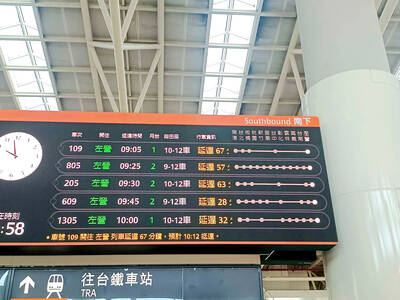
The nation’s usually punctual high-speed rail system yesterday was hit by major disruptions after all scheduled services were canceled and replaced with three hourly trains offering only non-reserved seating, affecting more than 200,000 passengers. Preliminary findings indicate the disruption was caused by a faulty power module in a track switch control cabinet, Taiwan High-Speed Rail Corp (THSRC) said, adding that as a full system inspection could only be conducted after operations end for the day, a decision on whether normal service would resume today would be announced before the first train departs. During a routine inspection early yesterday, a switch signal abnormality


 RSS
RSS