

As the world grapples with wars, economic woe, pandemics and artificial intelligence (AI) strife, the organization created to address humankind’s biggest challenges is paralyzed by division and faces the prospect of a leaderless next chapter.
There is a real chance for the first time in the UN’s history that the secretary-general will finish his term on New Year’s Eve with no successor in place, experts warn.
“It is a credible contingency, although a late agreement remains possible and UN officials are preparing contingency plans,” said Thibault Camelli, a former diplomat at the UN and now a researcher at New York University’s Center on International Cooperation.
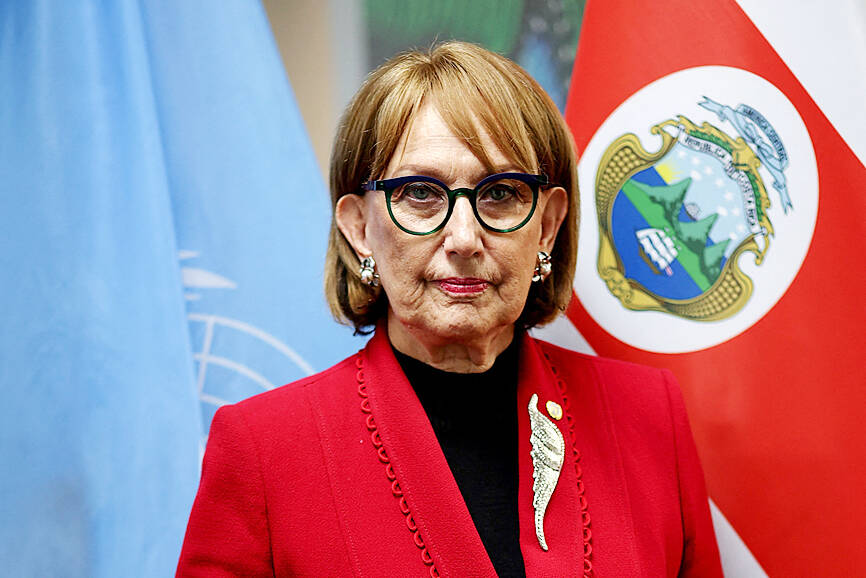
Photo: Reuters
Since July, the UN Security Council, charged with picking UN Secretary-General Antonio Guterres’ replacement, has held nine rounds of its opaque selection process known as straw polling.
Former Costa Rican vice president Rebeca Grynspan, a former head of the UN Conference on Trade and Development, has come first in eight of them, but her elevation is far from assured.
Grynspan, along with all the other candidates, has attracted negative signals from permanent members of the council, which would have the power to veto her appointment.
“Divisions between the Security Council’s permanent members — in particular China, Russia and the US — are responsible for the murky state of the secretary-general race,” said Daniel Forti of the International Crisis Group.
The major world powers are unable to compromise on much of the UN’s work to resolve conflicts in Sudan, Gaza and Ukraine, and the appointment of the organization’s new leader is no different, Forti said.
The US has pushed “America first” policies that strike at the heart of the UN’s multilateral founding ideals.
“We have to reform, and we have to clean house. We have to make this place work better,” US Ambassador to the UN Mike Waltz said previously, making him far more vocal than his fellow permanent Security Council envoys.
“It can’t be so bloated and bureaucratic,” Waltz said.
There are fears among some in the UN system that Grynspan “is too much of an insider to make change,” former US assistant secretary of state Esther Brimmer said.
Camelli said it is widely believed that Washington is opposed to Grynspan — as is Moscow.
Late entrant to the race Emirati Lana Nusseibeh, widely seen as Washington’s likely favorite, has struggled to build momentum. Others could still join the race.
The lack of consensus, combined with “the enormous political and financial pressures facing the organization make the job of secretary-general a far less attractive post than in years past,” Forti said.
Pointing to swinging budget cuts and the organization’s sidelining by the US, the head of one UN agency said “morale has been pretty low for a while now.”
“People are hoping that the new secretary-general is going to be someone that brings renewal and some fresh thinking, but I think that is only to be expected after 10 years,” two full terms as leader, they said.

The US Department of Agriculture and the FBI were breached by hackers in cyberattacks, US media reported on Friday, as concerns deepened over the recent spate of tech outages at key US institutions. The incidents were first reported by NBC News and CNN respectively, and it remained unclear whether they were related and who was responsible. Major outages over the past few weeks have disrupted travel, communications and e-commerce for countless users across the US, even affecting a top-secret network at the US National Security Agency. US President Donald Trump has sought to calm the public and urged people to

Japan must “correct its wrong words” on Taiwan and change its “attitude,” China said yesterday, after Chinese President Xi Jinping (習近平) snubbed Japanese Prime Minister Sanae Takaichi at a regional meeting in Shenzhen, China. “For the Japanese side, the most urgent task is to correct its wrong words and actions on the Taiwan issue as soon as possible,” Chinese Ministry of Foreign Affairs spokesman Guo Jiakun (郭嘉昆) told a briefing. “The important thing is to adopt a correct attitude on historical issues, and fundamentally, truly achieve an objective and rational understanding of China.” Takaichi’s China trip this week was her first since

Denmark’s oldest person has been the subject of a book and a reality TV show, but her publisher on Thursday said that the woman’s biography was being pulled from sale due to revelations about her Nazi past. Kirsten Schwalbe’s book We’re Going to Have Something to Laugh About was released last month, but Danish media revealed that she had not mentioned her membership of the Danish Nazi party. Announcing that the memoir was being withdrawn, Mette Korsgaard, one of the directors of the Gyldendal publishing house, said: “We cannot uphold a work of non-fiction in which a central chapter of

UNIQUE HERITAGE: ‘Kanginas,’ which involve preserving grapes inside two discs that are sealed with mud and placed in a dark room, has been around for centuries On the outskirts of Afghanistan’s frenetic capital Kabul, farmer Muhammad Saber Shojaei is carrying out a centuries-old task of preserving fistfuls of grapes to be eaten when winter bites. Crouched in front of dozens of kanginas, clay-and-straw discs containing grapes, Shojaei recalls his father, who taught him the technique. “I remember the old days, when we sat together around the sandal [stove], eating kangina grapes and enjoying those happy moments,” he said. Carefully putting a bunch of grapes in one of the discs, Shojaei added a second disc on top and sealed the kangina with mud before placing it in a dark storage


 RSS