

US President Donald Trump yesterday arrived in Manila, where thousands of people protested his attendance at a regional summit he would seek to dominate after bruising election losses back home.
The president was greeted by a marching band and honor guard on the tarmac.
About 13km away, 2,000 demonstrators faced off with police while carrying banners reading “Trump out now” and “Reject Pax Silica,” a reference to a US supply chain initiative that has divided opinions in the Philippines.
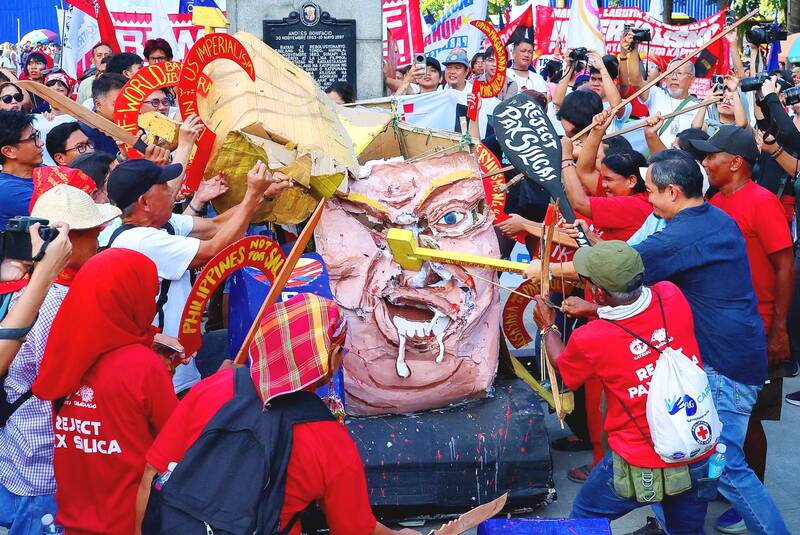
Photo: Reuters
The US president was to be immediately flown by helicopter to a meeting of the so-called Quad security alliance, with Indian Prime Minister Narendra Modi, Japanese Prime Minister Sanae Takaichi and Australia Prime Minister Anthony Albanese.
The gathering on the sidelines of the 11-member ASEAN summit is the Quad leaders’ first since Trump returned to power in January last year, and comes after his Republican Party took a drubbing in this month’s midterm elections.
While the Quad — broadly aimed at counterbalancing China’s regional influence — has quietly progressed in deepening coordination, the short time allotted for yesterday’s meeting meant it was unlikely to extend beyond pleasantries, Ryan Hass of the Brookings Institution said.
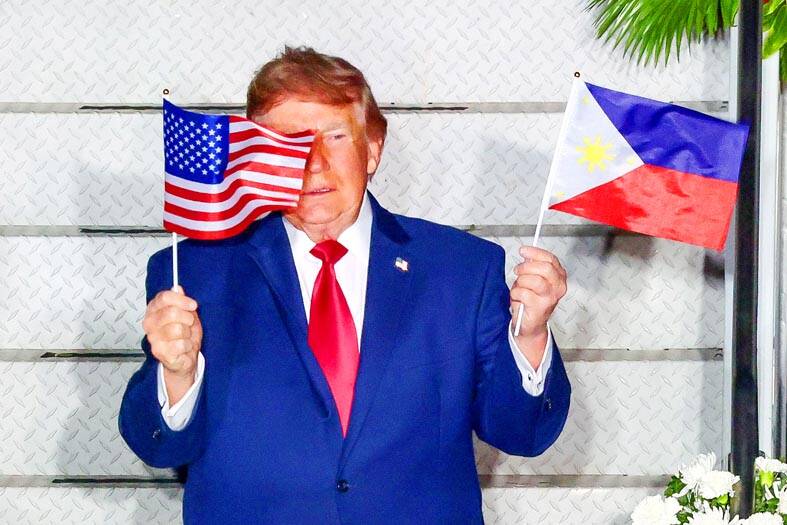
Photo: AFP
The timing, however, carried significance, he said, given the historic meeting Trump would attend with Chinese President Xi Jinping (習近平) and Russian President Vladimir Putin in just two days.
“It’s a way of inoculating Trump against criticism of caving to authoritarians when he meets with Xi and Putin in Shenzhen,” Hass said.
This would be the first ever three-way meeting between the three leaders.
Hayley Channer, economic security director at the Sydney-based US Studies Centre, said Trump’s decision to include ASEAN on his travel agenda was noteworthy, as “Southeast Asia has never been a high priority for the United States.”
The Japanese Ministry of Foreign Affairs said the Quad agenda would include discussions of the East and South China seas — areas where multiple parties have overlapping claims with China.
Trump was later to attend a meeting with ASEAN heads of state before going to a gala dinner.
While ASEAN leaders have spent three days grappling with a raft of regional issues, the specter of Trump’s ongoing tariff blitz has loomed large.
Chinese Premier Li Qiang (李強) on Monday slammed what he called a “countercurrent of unilateralism and protectionism” while touting Beijing’s own expanding trade with the bloc.
Brazilian President Luiz Inacio Lula da Silva and Canadian Prime Minister Mark Carney sang a similar tune on trade, with both explicitly citing a need to wean themselves off dependence on the US market.
Trump’s arrival comes on the heels of an announced US rules shift on the transfer of advanced AI chips, a move that could potentially rankle ASEAN members.
Companies shipping high-end chips to Singapore, Malaysia, Thailand and Indonesia would now require a special license, as the nations were said to represent a “higher-than-normal risk of diversion”.
Trump is set to meet with Philippine President Ferdinand Marcos Jr at the presidential palace today before heading to Shenzhen, China.
Channer said the Manila visit was “likely because the US is trying to further its Pax Silica initiative, to build a complete mine-to-chip supply chain.”
Aimed at countering China’s dominance in semiconductors and rare earths, the initiative has been the focus of months of protests in the Philippines, as its flagship 1,620-hectare artificial intelligence manufacturing hub north of Manila threatens to displace indigenous families.
“We are gathered here today to call for the stop of Pax Silica and to save the lands of the Filipino people,” Mariposa, a 21-year-old drag queen, said at yesterday’s protest while wearing a long black cape emblazoned with the words “Pax Silica Sashay Away!”
US Ambassador to the Philippines Lee Lipton last week said that a long-rumored deal signing for the site would not take place during the president’s visit.

A Chinese university with deep ties to the People’s Liberation Army bought Nvidia’s powerful H200 AI chips last month despite being on a US export blacklist, procurement records show, highlighting gaps in Washington’s efforts to curb China’s access to advanced technology. The findings come as Nvidia and its CEO Jensen Huang face mounting scrutiny in Washington over his lobbying for looser restrictions on sales of AI chips to China, following reports alleging he was targeted by a Chinese spying operation. Huang has argued that continued US sales to China would preserve American technological leadership and keep Chinese customers reliant on US technology.
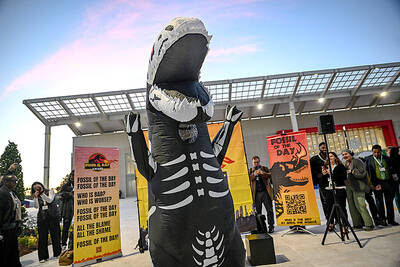
World leaders yesterday took the stage at COP31 in Antalya, Turkey, but some prominent names are missing from this year’s annual UN climate summit even as global warming intensifies. The two-week conference started earlier this week in the Mediterranean resort city of Antalya, with governments under pressure to tackle the climate crisis after a year of heat waves in Europe, deadly floods in Nepal and major wildfires in Indonesia. Dozens of leaders are expected to speak during the “high-level segment” taking place yesterday and today, including Turkish President Recep Tayyip Erdogan, Brazilian President Luiz Inacio Lula da Silva and Iranian

A student pilot was alone in the cockpit on his first solo cross-country flight when an air traffic controller delivered an instruction he never expected to hear: A nationwide ground stop was in effect and he needed to land. “Ma’am, I’m a student pilot. Honestly, this is my first time doing solo cross-country, and I don’t know what to do,” he told the controller. The exchange over Texas on Friday offered a glimpse of the confusion in the skies after a communications network failure, which officials blamed on routine maintenance gone awry, prompted the Federal Aviation Administration (FAA) to halt departures across
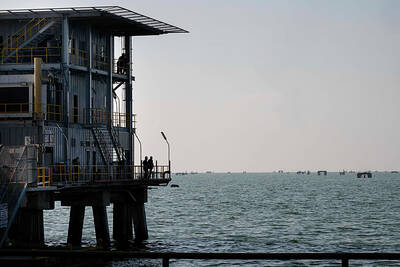
SAVING NEGLECTED MACHINERY: NABEP is repairing dozens of gas compression and power generation units abroad and refurbishing a power generation barge The company at the heart of a multi-billion-dollar oil deal between Washington and Caracas is keen to show off renovations at Venezuela’s Lake Maracaibo, one of the world’s richest reserves. The interim government authorized North American Blue Energy Partners (NABEP) to operate 17 oil fields via a deal with the US, which is set to receive 20 percent of Venezuelan reserves. The Barbados-based firm is the second-largest private oil company in Venezuela and will operate 100-year concessions for 17 oil fields with proven reserves of about 65 billion barrels. The company’s workspace in the northwestern town of Bachaquero overflows with new, mostly US-imported


 RSS