

Lethal autonomous weapons powered by artificial intelligence (AI) are set to revolutionize warfare, but there is no proper regulatory or legal framework governing the new technology.
A conference starting tomorrow at the UN in Geneva would discuss how to establish curbs and prohibitions on such weapons, called killer robots by some.
However, some analysts doubt the discussions at the Convention on Certain Conventional Weapons will keep pace with the fast-changing weapons.
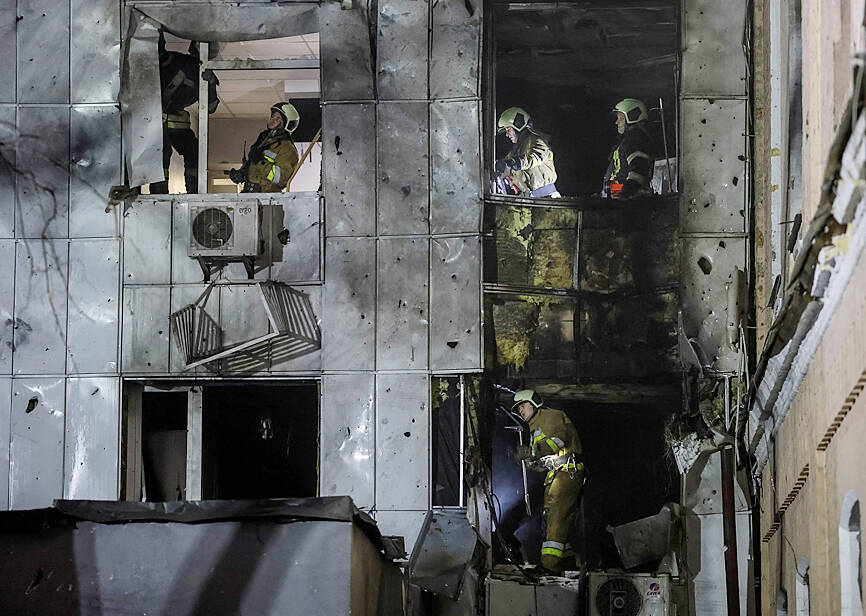
Photo: Reuters
Lethal autonomous weapons systems (LAWS) “can identify, select, and engage a target without the intervention of a human operator in the execution of these tasks,” Geneva Centre for Security Policy global and emerging risks head Jean-Marc Rickli said.
The critical issue for potential regulators lies in determining the level of human control over the decision to employ such a weapon.
The US refers to an “appropriate levels of human judgement” in the use of autonomous weapons. France maintains that a human must remain in the decisionmaking loop and bans LAWS, but permits “partially autonomous” systems known as PLAWS.
“The human role is always ensured through what is termed ‘appropriate control’ by a military commander — a concept that varies in scope depending on the system’s criticality and the operational context,” said Rear Admiral Vincent Sebastien, deputy director of the French Ministry of Defense’s Agency for Defence Artificial Intelligence.
“We are now dangerously close to crossing a moral red line: the autonomous targeting of humans by machines,” UN Secretary-General Antonio Guterres and International Committee of the Red Cross president Mirjana Spoljaric said in a joint statement in August.
Analysts said the Geneva discussions, while important, will touch only part of the issue.
Today, the diminishing role of humans is being driven by the growing use of AI in analysis and targeting.
The scope of the agenda in Geneva is “very narrow,” Rickli said, adding: “It fails to encompass the full range of issues surrounding AI on the battlefield.”
This was seen in the US-Israeli war against Iran this year “where the Americans engaged as many as 1,000 targets per day” inside Iran, he added.
“There are a host of problems and unacceptable risks associated with targeting and decision-support systems,” Laure de Roucy-Rochegonde of the Centre for Geopolitics of Technology at the French Institute of International Relations said. “What kind of human supervision is required to ensure that the operator is genuinely exercising their own judgement rather than simply providing a rubber stamp for the machine’s recommendations?”
The autonomous weapons to be discussed in Geneva are not yet in widespread use, although analysts said they have been deployed by Russia in its invasion of Ukraine as well as US attacks in Iran.
However, the spread is inevitable.
“Autonomy will very quickly become a reality on the battlefield,” Sebastien said.
“Autonomous weapon systems are not part of a distant future — a race toward greater autonomy in weapons systems is already well underway,” Guterres and Spoljaric said in their statement.
Significant doubts and dangers remain, Anthropic cofounder Dario Amodei said.
“Today, frontier AI systems are simply not reliable enough to power fully autonomous weapons,” he added.
Ultimately, the incentive for major powers is too strong.
Swarms of autonomous drones — which “aim to neutralize an adversary through saturation” — would be highly effective, and some states view them as a crucial strategic advantage, Rickli said.

‘CARELESS’: After years of advocating to sell more AI chips to China, Jensen Huang’s links to the country would come under greater scrutiny than ever before At the heart of the biggest controversy to confront Nvidia Corp in its three-decade history is a former television journalist who became a semiconductor power broker renting advanced chips to China’s top firms. Huang Le (黃樂), also known as Alice Huang, has been identified in a series of reports as a spy who was recruited by Beijing to target Nvidia CEO Jensen Huang (黃仁勳). She came into his orbit after founding Megaspeed International, the largest buyer of Nvidia’s chips in Southeast Asia — a major route for smuggling the firm’s advanced hardware into China. The CEO previously said there was nothing inappropriate
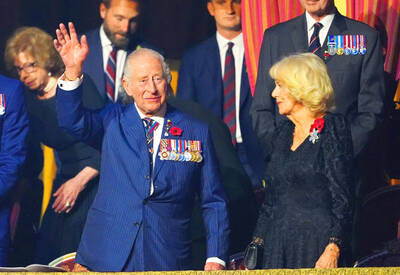
A British monarch has only ever made one state visit to China: Queen Elizabeth II four decades ago. King Charles III would consider undertaking the second, an aide has said. “If the government said, ‘Will the king go to China?’ I think, you know we think about it very carefully,” a senior palace aide told reporters this week. The late queen, Charles’ mother, visited China with her husband, Prince Philip, in October 1986. It came two years after the signing of the Sino-British Joint Declaration setting out the terms for the return of Hong Kong, which improved relations between the two countries. “This

A Chinese university with deep ties to the People’s Liberation Army bought Nvidia’s powerful H200 AI chips last month despite being on a US export blacklist, procurement records show, highlighting gaps in Washington’s efforts to curb China’s access to advanced technology. The findings come as Nvidia and its CEO Jensen Huang face mounting scrutiny in Washington over his lobbying for looser restrictions on sales of AI chips to China, following reports alleging he was targeted by a Chinese spying operation. Huang has argued that continued US sales to China would preserve American technological leadership and keep Chinese customers reliant on US technology.
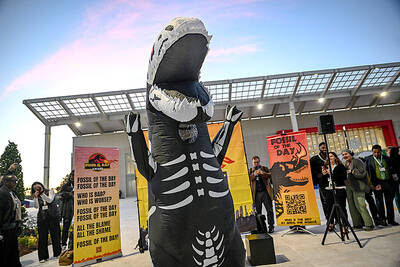
World leaders yesterday took the stage at COP31 in Antalya, Turkey, but some prominent names are missing from this year’s annual UN climate summit even as global warming intensifies. The two-week conference started earlier this week in the Mediterranean resort city of Antalya, with governments under pressure to tackle the climate crisis after a year of heat waves in Europe, deadly floods in Nepal and major wildfires in Indonesia. Dozens of leaders are expected to speak during the “high-level segment” taking place yesterday and today, including Turkish President Recep Tayyip Erdogan, Brazilian President Luiz Inacio Lula da Silva and Iranian


 RSS