

A Japanese spacecraft was yesterday on its way to one of Mars’ moons on a world-first mission to retrieve samples, potentially helping unlock the origins of the Solar System and life on Earth.
The flagship H3 rocket carrying the uncrewed Martian Moons eXploration (MMX) probe blasted off into a pitch black sky from the Tanegashima Space Center at 4:41am, a live stream broadcast by the Japan Aerospace Exploration Agency (JAXA) showed.
More than an hour later, JAXA announced via the live broadcast that the probe had successfully separated from the H3 and was “beginning its journey toward the Martian system.”
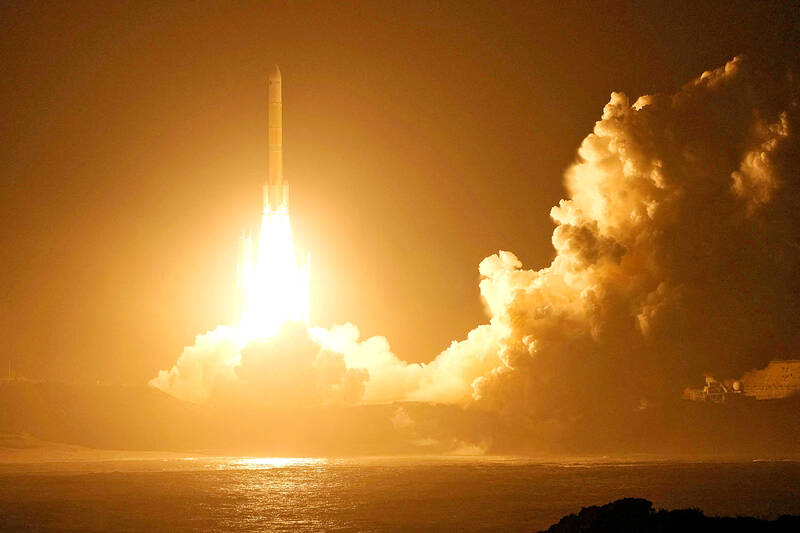
Photo: Kyodo via Reuters
“I’d dreamt of this day, so I’m incredibly happy,” JAXA scientist Mari Aida said. “Right now I feel really relieved.”
Following the separation, JAXA said it received signals from the spacecraft as expected, confirming it was operating normally.
Despite the early hour in Japan, thousands of people tuned into the live stream, posting messages of encouragement.
The spacecraft is due to arrive near Mars around August next year, where it would orbit one of its moons, Phobos.
A French-German rover dubbed Idefix — the French name for the comic hero Asterix’s dog — would be the first vehicle to travel across Phobos, conducting surface observations aimed at ensuring a safe landing.
Once MMX arrives on Phobos, it would collect at least 10g of material from the surface during its planned three years in the Red Planet’s vicinity.
The mission — which aims to be the first round trip to the Martian region — is a collaboration with US and European space agencies, as well as numerous universities and tech companies.
Scientists hope it would help lay the groundwork for eventual human exploration.
“The samples from MMX will bring forth paradigm-shifting science on the Mars system for generations to come, especially as NASA prepares to send the first humans to Mars,” Nicky Fox, administrator of NASA Science Mission Directorate, said in a message broadcast on the JAXA live stream.
JAXA hopes the mission would reveal how Mars and its two moons formed, a key piece of knowledge in working out how the Solar System was born.
One theory for the origin of the moons — the “giant impact” hypothesis — is that they formed after a celestial body collided with Mars.
Meanwhile, the “capture” hypothesis postulates that the moons are asteroids pulled in by Mars’ gravity.
Determining which theory is correct could help reveal “how a habitable environment for life might have arisen on the terrestrial planets,” JAXA said, referring to the four rocky worlds closest to the Sun — Mercury, Venus, Earth and Mars.
JAXA said the mission would also explore the possibility of using Phobos as a “natural space station” by establishing the requirements for a round trip — something “essential for crewed Mars exploration.”
It would also observe the planet’s other moon, Deimos, although it will not land on it.
US and Chinese space agencies have also been vying to be the first to return rock samples from the surface of Mars back to Earth.
NASA’s Perseverance rover, which has been roaming across Mars since 2021, has already collected samples.
However, the return mission was effectively canceled by the administration of US President Donald Trump following a vote by US Congress in January.
China’s Tianwen-3 spacecraft is scheduled for launch around 2028 and hopes to return Mars samples to Earth as early as 2031 — potentially before the Japanese mission’s return.

Former British prime minister Rishi Sunak on Wednesday urged so-called middle powers to become a “poisonous shrimp” to carve out strategic economic leverage in a more turbulent global environment. Sunak drew from a metaphor by former Singaporean prime minister Lee Kuan Yew (李光耀): A big fish will eat a smaller fish, and the smaller fish will eat the shrimp. Lee made the point a year after the Asian nation’s independence in 1966 that the city-state needed to build up its defense mechanisms — like a shrimp that stings — so it would be left alone by predators. “He was thinking about what Singapore’s

A 16-year-old on Thursday shot his way through locked doors to get into an elementary school in Bend, Oregon, killing three children and a teacher. He was then shot by a person at the scene who followed him inside, authorities said. The suspect was found dead inside the school minutes after the shooting was first reported, Bend Police Chief Mike Krantz said. The three children killed were aged 5, 8 and 11. Another child, 7, and a teacher, 54, were injured and taken to the hospital in critical condition, he said. The first 911 call came just before 1pm from a person in

A University of Wyoming microbiology graduate student from China has been arrested on accusations she poisoned the tea of a colleague who had pending patents and with whom she did not get along, then tried to flee the country after police questioned her. Wang Aili, 32, was arrested on Tuesday last week at Los Angeles International Airport, where prosecutors allege she sought to return to China. With her were laptops, electronic storage devices and documents now in the possession of police, who allege Wang was seen on surveillance video rummaging through the desk of the victim who specialized in technology for disease

DATA SHARING: The mission includes keeping New Zealand safe, and the wider Pacific region open, stable and resilient, the NZ Security Intelligence Service said Fiji is enlisting New Zealand’s intelligence agency to help overhaul its fragmented security sector, Suva said on Wednesday, as US warnings of suspected China-linked cyberintrusions highlight concerns about vulnerabilities in the nation. The Fijian Cabinet approved a six-month partnership with the New Zealand Security Intelligence Service (NZSIS), funded by Wellington, to assess Fiji’s intelligence structure and recommend reforms, Fiji’s government said in a statement. The review is designed to improve information-sharing and coordination across agencies, and reforms would create a more sustainable intelligence framework with clearer roles and improved support for security decisionmaking, the statement said. Fiji did not identify a specific threat


 RSS