

Cuba was plunged into its seventh massive blackout of the year on Friday as fuel shortages wear on the US-blockaded island.
Just five percent of residents in the Cuban capital Havana had power on Friday evening.
“A total disconnection of the electrical system has occurred,” Cuba’s Ministry of Energy and Mines wrote on X.
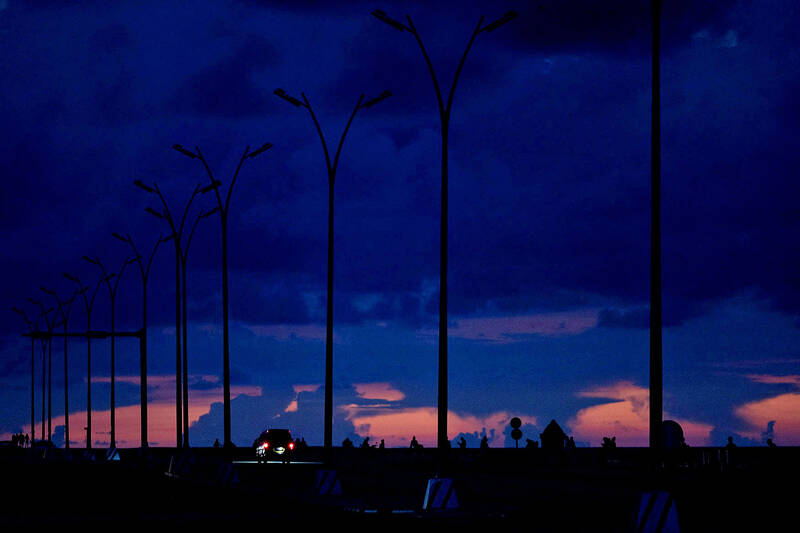
Photo: Reuters
The nationwide blackout, the 12th since late 2024, occurred after a failure “in the transmission lines” paired with “unstable weather conditions,” state-run utility UNE said.
The island of more than 9 million people endures constant power cuts due to the poor state of its aging thermoelectric plants, but the situation has worsened significantly since January, when Washington imposed a de facto energy blockade on the island in a bid to pressure Havana’s communist government.
A severe lack of fuel makes it difficult to supply Cuba’s power plants and backup generators, which typically run on imported diesel.
“It’s one thing after another: no water, no gas for cooking, no electricity,” schoolteacher Lidia Fernandez said. “Honestly, I don’t know how we haven’t gone crazy.”
Over the past few weeks, blackouts have lasted more than 30 hours in the capital, while in provinces, they have sometimes stretched past 60 hours.
Retiree Francisco Rodriguez said his home had already gone without power for 28 hours on Friday.
“I thought they might at least turn the electricity back on for a few hours soon, but now... I think we won’t have light for several days,” he said.
The cuts have also affected the island’s water supply and mobile phone network, and general living conditions are extremely tough for residents.
“It’s no longer just the electricity. We’re having problems with water and gas as well,” Lazaro Reyes said.
Havana blames the crisis on an array of US-imposed punitive measures, while Washington attributes the hardship to poor internal management.
Another retiree, Zunilda Garcia, took the latest blackout in stride, stepping outside to charge a small lamp with solar energy.
“We have to wait and stay calm,” Garcia said. “We can’t lose hope.”

US President Donald Trump on Wednesday threatened to take action against the EU if it moves forward with European Commission President Ursula von der Leyen’s proposal to make Canada the bloc’s first associate member. “If they do that, if I think it’s at all a hostile act; I will put very serious tariffs or stop trading with Europe on many things,” Trump told reporters en route to an event in North Carolina, calling the proposal “laughable.” “If it’s a good intention, that’s fine. If it’s a bad intention, we’ll put very heavy tariffs on Europe,” he said. Von der Leyen made the proposal
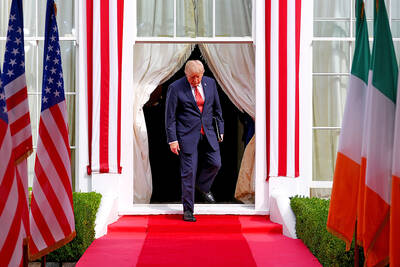
FROSTY RECEPTION: ‘I conveyed the strong view of the Irish people that the normalization of war and genocide can never be accepted,’ the Irish president said US President Donald Trump on Saturday said that he would “love to see” a united Ireland, wading into a politically sensitive subject as he embarked on a two-day Irish visit that blurs the lines between his presidency and personal business interests. After meeting Irish Prime Minister Micheal Martin in Dublin, Trump said reunification of the Republic of Ireland and Northern Ireland — split for more than a century — would be “a fantastic thing.” “It’s going to happen eventually. It may as well happen now,” he told reporters, adding that “the UK will have something to say about it, obviously.”
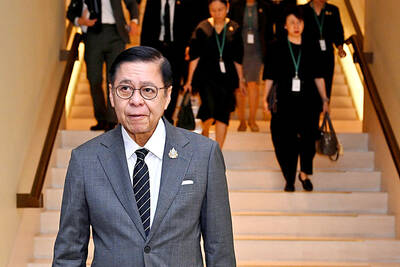
SEEKING AN AGREEMENT: The Cambodian foreign minister said Phnom Penh aimed to build trust through the mediation process, not further escalate tensions Thailand yesterday said that Cambodia was playing the victim in a dispute over maritime resources, as the Southeast Asian neighbors took their feud to international mediators a year after deadly clashes over their land border. Cambodia, which initiated the case before the Permanent Court of Arbitration (PCA) in Singapore, said it hoped the hearings would yield a peaceful resolution for both countries. In May, Thailand unilaterally pulled out of a bilateral framework agreement that aimed to resolve overlapping maritime border claims, but denied any link to their land dispute. Cambodia subsequently initiated a UN-backed conciliation process at the PCA, saying it hoped to

French President Emmanuel Macron today embarks on a rare and symbolic visit to a remote French territory in the North Atlantic, hosting Canadian Prime Minister Mark Carney at a time of growing tensions with Washington. The three-day visit to Saint Pierre and Miquelon, a three-island archipelago of less than 6,000 people just 25km off Newfoundland, would be the first by a French president in more than a decade. The trip to France’s only remaining possession in North America, a vestige of the huge territories Paris once controlled in what is now Canada and the US, carries immense symbolic resonance. Macron insists that US


 RSS
RSS