

At a city block-sized market in the Philippine capital, a platoon of plastic Santa Claus figures parachute from the ceiling of a shop already stacked high with Christmas decor, despite the holiday being fully four months away.
The site is a familiar one in the Philippines, where Sept. 1 means radio stations playing Christmas carols, homeowners putting up lights, and the country’s giant shopping malls unleashing their most impressive displays.
Welcome to the “ber months” — September, October, November, December — a months-long countdown to the most anticipated holiday on the calendar in the deeply Catholic country.
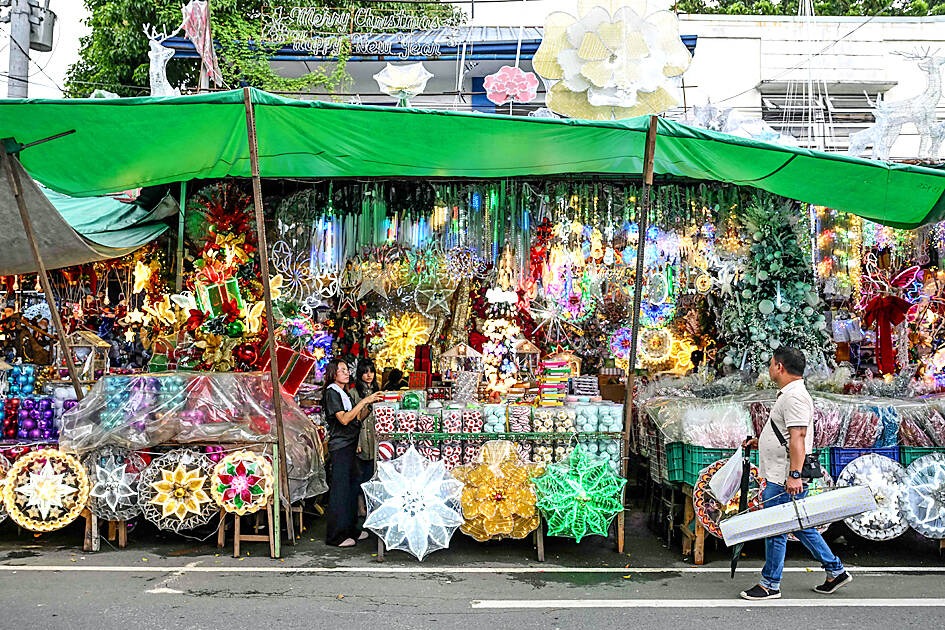
Photo: AFP
“We can smell it coming,” sales clerk Cora Lansangan, 73, said during a reporter’s visit to a Christmas shop that began stacking its shelves on July 31.
The store was already packed with shoppers buzzing around displays of Christmas trees, ornaments, plastic reindeer, mangers and festive lanterns.
“Even though life is hard, the mere sight of a Christmas tree brings us relief,” Manila real-estate agent Kathlene Santidad, 33, said, as she hunted for tinsel and baubles for her own tree, armed with a 10,000-peso (US$160) budget.
She said she shopped for decorations early because “I hate crowds” and wanted to take her time picking specific items from shops crammed with everything from tiny 300-peso tinsel to an 8,000-peso Christmas tree.
Coming toward the end of a rainy season typically marred by destructive typhoons and floods, the Christmas countdown is a marker of better things ahead, said Mark Godwin Villareal, a sociologist at Manila’s University of Santo Tomas.
“It provides a kind of continuity and stability in our social life, despite these economic, political, or even personal challenges that we are facing as a community or society,” he said.
The “ber months” had a rhythm, Villareal said.
September was for decorating, while October was time to start saving money for gifts and food for reunions with friends and relatives and the all-important midnight meal on Christmas Eve.
More than 100,000 of the country’s crucial overseas workforce, dubbed OFWs (overseas Filipino workers), can typically be counted on to rush home in time for the main event.
The extended season drives foot traffic and sales for the country’s giant shopping malls, many of which AFP journalists saw were already heavily decked out.
“For Filipinos, Christmas symbolizes belonging, faith, hope and joy,” said Christian Mathay, senior assistant vice president for SM Supermalls, a chain of 90 shopping malls that began setting up Christmas ornaments in August.
“Starting early gives shoppers more time to enjoy that experience,” he said.
In Pampanga province, north of Manila, weeks of flooding that stranded thousands of commuters failed to dampen the enthusiasm of manufacturers of star-shaped holiday lanterns known as parol, the single must-have Christmas decoration in a Filipino home.
“Water seeped into the showroom, so we had to clean up instead of working ... the thing with lanterns is, they’re waterproof,” said fifth-generation lantern-maker Angelica David, 26.
“We all need to recover from the floods. After that, people should start buying lanterns,” she said.
The decorations will only come down on Jan. 6, marked in the Philippines as the day when the magi brought gifts for the infant Jesus.
School superintendent Ricky Angeles, on a Christmas shopping trip to Manila, said he preferred to leave his lantern hanging all year round in a window of his home in the northern city of Cabanatuan, along with blinking strings of lights in his garden.
“We need a lengthy display period” to justify their cost, the 51-year-old said with a smile.
Then he ducked into a store to buy some more.
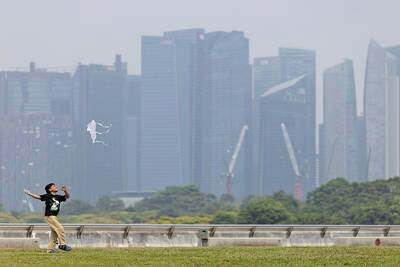
Singapore’s air quality hit an unhealthy level yesterday, as haze from forest fires raging in Indonesia continued to spread across swathes of Southeast Asia. The city-state is currently one of the 10 most-polluted major cities in the world, coming in at third in IQAir’s ranking. Kuching, in the Malaysian part of the island of Borneo, was No. 1. A government taskforce has “activated haze response plans” for schools, workplaces and community centers, Singaporean Minister for Sustainability and the Environment Grace Fu (傅海) said in a video message on Facebook. Most people could continue essential daily activities, but the elderly or vulnerable should
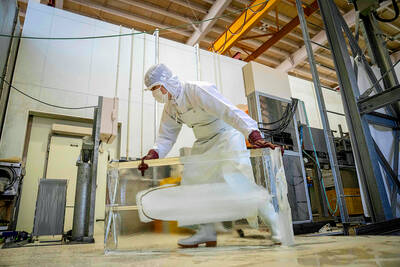
PAINSTAKING PROCESS: Ice makers freeze water for up to 72 hours, replace tainted water with a fresh batch once freezing begins, and are constantly stirring In the historic Japanese city of Kanazawa, craftsmen painstakingly shape and slice blocks of ice destined to chill negronis in some of the world’s trendiest bars. The men work for Kuramoto Ice, a century-old company in Ishikawa on the Sea of Japan coast and one of dozens of Japanese firms producing ultra-clear, premium ice. This luxury product, believed by those in the industry to melt more slowly than regular blocks, is a staple of Japan’s cocktail culture, but its popularity is also spilling over to bars abroad, from the US to Australia, who pay as much as ¥200 (US$1.28) per cube. Kuramoto Ice
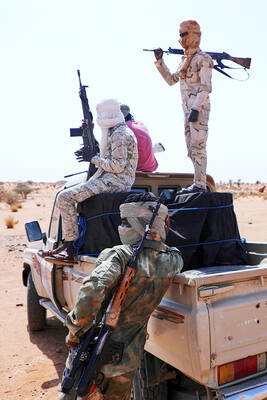
WAR CRIMES? An investigation found that a network of countries are supplying Sudan’s RSF with weapons, including drone blamed for large civilian casualties Foreign weapons, military technology, fighters and logistical networks are helping sustain Sudan’s conflict and expanding the warring parties’ ability to strike deep into civilian areas, a UN fact-finding mission said in a report published yesterday, warning that some attacks might amount to war crimes. Sudan’s war erupted in April 2023 following a power struggle between Sudan’s military and the Rapid Support Forces (RSF) ahead of a planned transition to civilian rule. The conflict has devastated the country, displaced more than 14 million people and created what the UN has described as one of the world’s worst humanitarian crises. The UN mission said

‘BYE BYE’: Judge William Tam said after hearing arguments for a leniency that a sentence would be given as soon as possible in Joshua Wong’s second prosecution Hong Kong democracy advocate Joshua Wong (黃之鋒) yesterday pleaded guilty to conspiracy to collude with foreign forces to endanger national security under a Beijing-imposed law. It was the second prosecution of Wong, a former student leader in the democracy movement in the territory and one of its most recognizable faces, under the National Security Law introduced in Hong Kong in 2020 to quell massive anti-government protests the year before. Wong, 29, who wore a blue shirt, appeared thinner as he entered his plea. After hearing his lawyer’s arguments for a lesser prison term, Judge William Tam (譚耀豪) said that a sentence would be


 RSS
RSS