

Australia has proposed legislation that would allow social media users to opt out of platforms’ algorithms, a potentially far-reaching step that deepens regulatory efforts worldwide to rein in Big Tech and limit online harm.
Under the Labor government’s draft Digital Duty of Care bill released yesterday, social media users would be able to block content suggested by algorithms, and instead choose the material they want in their feeds.
The proposal opens up a new domestic battleground with Instagram and Facebook-owner Meta Platforms Inc, TikTok and other platform operators. The country’s world-first social media ban for under-16s — which went into effect late last year — was quickly followed by governments around the world adopting similar restrictions.
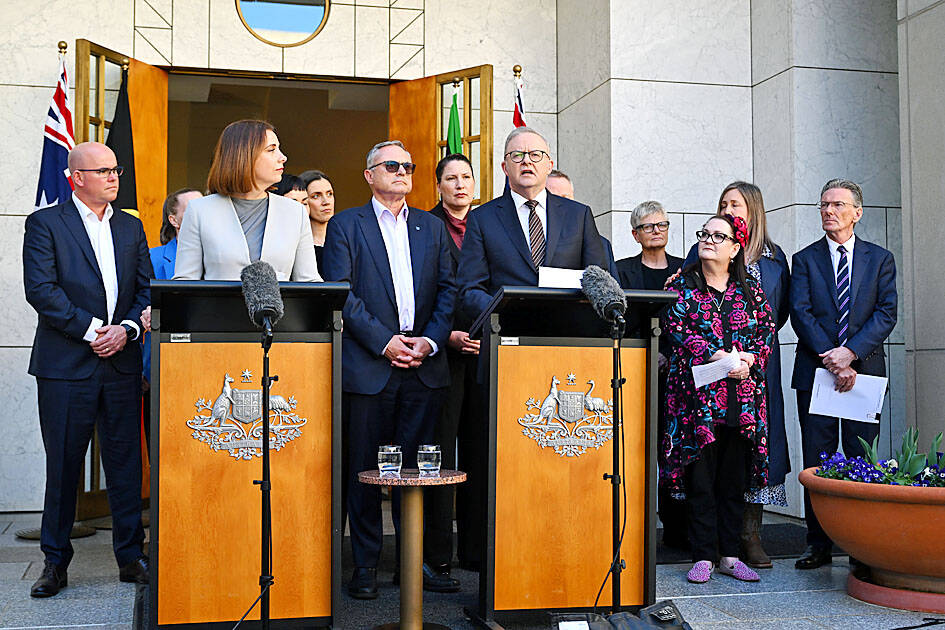
Photo: EPA
Meta declined to comment on Australia’s proposal, while representatives for TikTok and Snap Inc did not immediately reply to e-mails.
Regulators are increasingly targeting what they perceive as the addictive design of the platforms. Last month, Meta agreed to pay up to US$18 billion in landmark settlements to resolve social media claims from US states.
Key parts of that deal require the company to put new guardrails on its platforms, including restricting how much time young people can scroll and preventing them from switching off certain safety settings without parental consent.
“There’s been some seismic cases in the past few weeks,” Australian Minister for Communications Anika Wells said at a press conference yesterday.
“This is our contribution,” she said.
The duty-of-care approach aims to force technology companies to make their products safe by design, imposing fresh burdens on the operating models of major platforms. Breaches of Australia’s proposed law could be penalized by up to A$109.2 million (US$79 million), the government said.
The EU has been investigating claims that Meta’s products are addictive to children, as the bloc increases regulatory pressure on the US social media company.
While details on implementation are still unclear and will be critical in assessing the potential impact, Australia’s move appears to be “a continuation of a trend rather than a completely novel innovation,” said Ewan Lusty, a Singapore-based partner at political and regulatory consultancy Flint Global.
“There is a global shift toward governments seeking to empower users and provide them with more control over how they interact with digital services, including the option to restrict personalization elements,” he said. “Digital services are also taking important steps and providing users with more granular controls over their experience.”
Australia’s draft legislation requires platform owners to send a notification to new and existing users offering them a choice over their default feed.
Other features of the Digital Duty of Care include: Digital services like online games, apps and AI chatbots would be required to protect under-18s from design features that have negative behavioral impacts, such as addictive features or those that can have an effect on a young person’s self-esteem
Such services will also be required to protect under-18s from: content that promotes, encourages or accelerates eating disorders; content that promotes hostile ideas about women and gender equality; pornography; content that glorifies crime or life-endangering stunts; and content that causes serious mental distress, including abuse and bullying
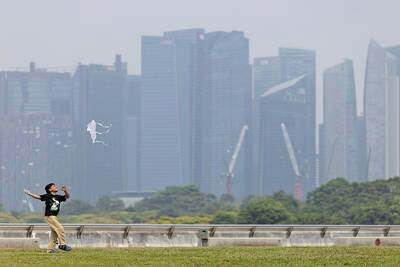
Singapore’s air quality hit an unhealthy level yesterday, as haze from forest fires raging in Indonesia continued to spread across swathes of Southeast Asia. The city-state is currently one of the 10 most-polluted major cities in the world, coming in at third in IQAir’s ranking. Kuching, in the Malaysian part of the island of Borneo, was No. 1. A government taskforce has “activated haze response plans” for schools, workplaces and community centers, Singaporean Minister for Sustainability and the Environment Grace Fu (傅海) said in a video message on Facebook. Most people could continue essential daily activities, but the elderly or vulnerable should

PAINSTAKING PROCESS: Ice makers freeze water for up to 72 hours, replace tainted water with a fresh batch once freezing begins, and are constantly stirring In the historic Japanese city of Kanazawa, craftsmen painstakingly shape and slice blocks of ice destined to chill negronis in some of the world’s trendiest bars. The men work for Kuramoto Ice, a century-old company in Ishikawa on the Sea of Japan coast and one of dozens of Japanese firms producing ultra-clear, premium ice. This luxury product, believed by those in the industry to melt more slowly than regular blocks, is a staple of Japan’s cocktail culture, but its popularity is also spilling over to bars abroad, from the US to Australia, who pay as much as ¥200 (US$1.28) per cube. Kuramoto Ice

WAR CRIMES? An investigation found that a network of countries are supplying Sudan’s RSF with weapons, including drone blamed for large civilian casualties Foreign weapons, military technology, fighters and logistical networks are helping sustain Sudan’s conflict and expanding the warring parties’ ability to strike deep into civilian areas, a UN fact-finding mission said in a report published yesterday, warning that some attacks might amount to war crimes. Sudan’s war erupted in April 2023 following a power struggle between Sudan’s military and the Rapid Support Forces (RSF) ahead of a planned transition to civilian rule. The conflict has devastated the country, displaced more than 14 million people and created what the UN has described as one of the world’s worst humanitarian crises. The UN mission said

‘BYE BYE’: Judge William Tam said after hearing arguments for a leniency that a sentence would be given as soon as possible in Joshua Wong’s second prosecution Hong Kong democracy advocate Joshua Wong (黃之鋒) yesterday pleaded guilty to conspiracy to collude with foreign forces to endanger national security under a Beijing-imposed law. It was the second prosecution of Wong, a former student leader in the democracy movement in the territory and one of its most recognizable faces, under the National Security Law introduced in Hong Kong in 2020 to quell massive anti-government protests the year before. Wong, 29, who wore a blue shirt, appeared thinner as he entered his plea. After hearing his lawyer’s arguments for a lesser prison term, Judge William Tam (譚耀豪) said that a sentence would be


 RSS
RSS