

Rescue teams were working to reach more than 900 people thought to be trapped in the tunnels and underground areas of half a dozen hydropower projects in Nepal following the devastating flash floods, ?the National Disaster Risk Reduction and Management Authority said yesterday.
The death toll from the unprecedented deluge of ice, rock, mud ?and debris that crashed through valleys of Nepal on Wednesday last week has risen to 903 people, with 16 more dead reported on the Tibet side of the border. More than 4,000 are missing in Nepal, with another 500 in Tibet.
Hundreds of bodies, many unidentified, have been buried in shallow graves on the plains of the Himalayan region after being swept down the mountains by the torrent.
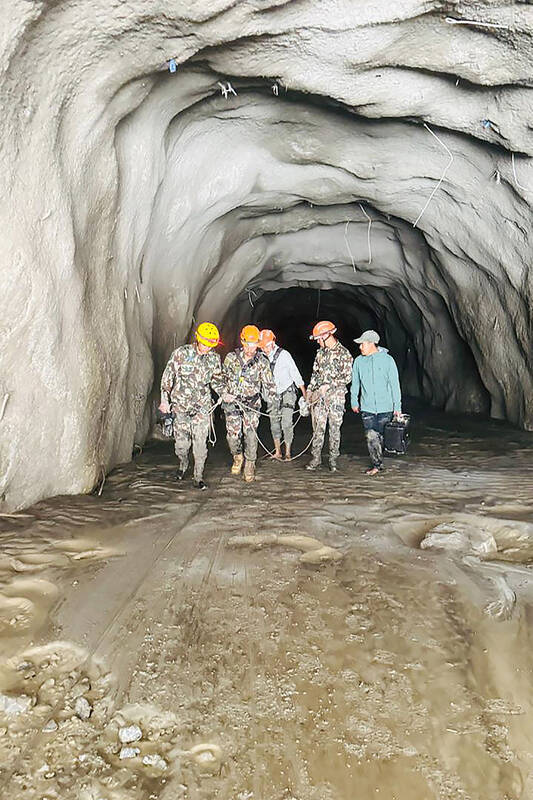
Photo: Prime Minister Secretariat, Nepal / AFP
Nepali officials yesterday said the focus was on reaching the 933 people missing from hydropower projects in the flood-hit region.
Pictures and videos shared by rescue teams showed earth-moving equipment digging and shoveling mud to try to access the tunnels.
“A large amount of debris has been deposited and that is posing us a big challenge to open the tunnels,” Nepalese army spokesperson Raja Ram Basnet.
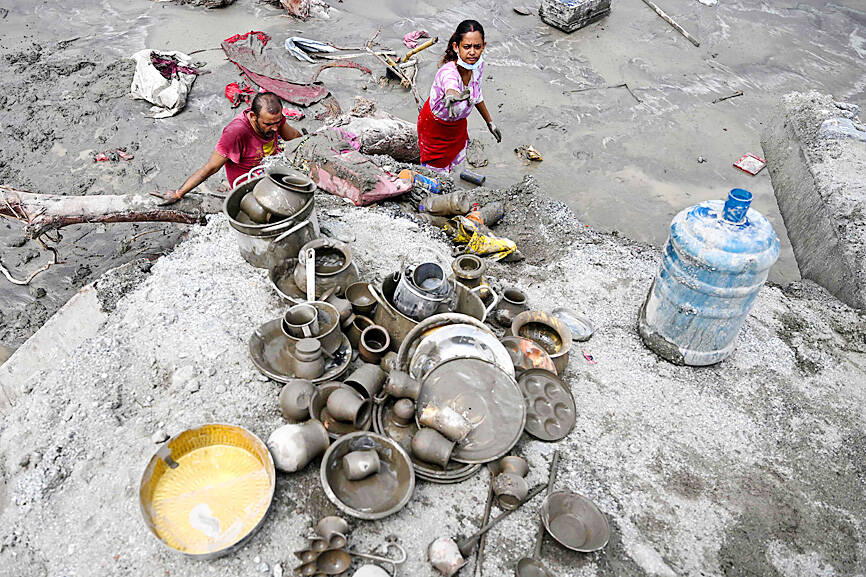
Photo: AFP
Ashish Gurung, who normally works as a guide, was among the rescuers.
“There is just mud everywhere,” he said. “Inside the tunnel it was worse. It’s so difficult to move, the mud is so deep.”
On Sunday his team was trying to access Chilime Hydropower in Ruswana, in the worst-hit area.
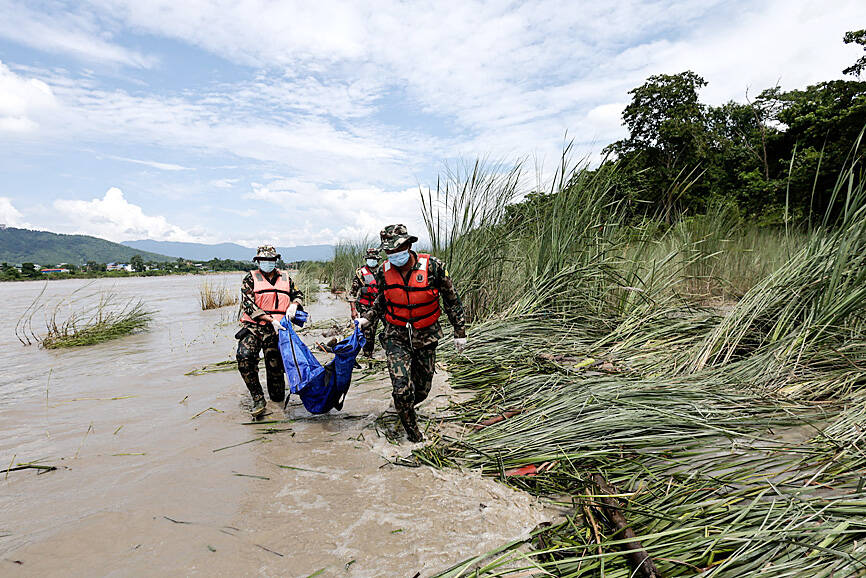
Photo: Reuters
Mountaineers improvised by grabbing planks of wood to check the depth of the mud, before using them as a makeshift bridge, along with a system of ropes to keep themselves safe, he said.
“Walking in it is very difficult; at one point it was up to our chests,” Gurung said. “We got close to the first station, about 130 meters in. Inside that far, you could [see further in]; it looked like it was just bodies.”
The hydro company had given his team a map and it looked like there was a chance people in the tunnels could have survived by staying inside the internal infrastructure.
“They have a safe area inside,” he said. “Some of them could potentially be alive. I am hoping they are alive.”
The Red Cross has estimated that more than 90,000 people are likely to have been affected by the disaster, which China and some experts linked to the effects of the climate crisis.
Nepalese Prime Minister Balendra Shah said the flood was an “unprecedented and devastating natural disaster” and it remained challenging to compile a complete assessment of the damage.
“Despite the adverse weather, difficult terrain and continuing risks, we are moving forward with determination to save the lives of our citizens,” he wrote on Facebook late on Sunday.
Almost 21,000 security personnel were involved in the rescue operations, besides civilian workers and volunteers, he added.
Nepal’s disaster agency yesterday said that 903 deaths had been counted there, with 4,247 people, including 592 foreigners, missing.
As of Sunday, Chinese authorities reported 16 deaths and 546 missing, and Chinese state media said 261 of the missing were foreigners, including more than 100 Nepalese.
China’s state-run CCTV reported that Beijing had mobilized more than 2,100 rescue workers and allocated at least ?220 million yuan (US$32.7 million) to support relief efforts and had been airdropping equipment and supplies to frontline rescuers, while its soldiers used life-detection equipment to look for the missing.
Nepal has said it does not need foreign help in general search-and-rescue operations, but it has leaned on neighbors India and China for their expertise in tunnel rescues.
Rescue operations have been suspended several times since Friday because of bad weather and concerns that a lake formed across the Nepal-China border by the disaster could trigger fresh flooding after it began overflowing into Nepal’s rivers.
However, the weather was good yesterday and rescue work continued to pick up pace, said Narendra Pariyar, the district administrator of Rasuwa, one of the two hard-hit districts.
In the holy ?town of Devighat, on the banks of the Trishuli River that ?flooded, residents walked around the shells of what had once been ?homes, trying to salvage their belongings from the debris.
The flood was “caused by glacier instability under the long-term effects of global warming,” CCTV reported, saying ?it was a “new and prominent feature of cryosphere disasters” on the Tibetan plateau.
Two ?Nepalese officials told Reuters that China had ?not shared much information on glacier risks and water levels following a meeting to strengthen cooperation earlier this year, and they feared that a lack of data sharing could hamper future disaster preparedness.
The Chinese Ministry of Foreign Affairs did not respond to a request for comment on the meeting.
With Reuters and AFP

PLENARY SESSION: Although the SCO says it is ‘not an alliance directed against other states,’ Putin and Xi have repeatedly made anti-Western speeches during its summits Russian President Vladimir Putin and Chinese President Xi Jinping (習近平) are expected tomorrow in Kyrgyzstan for a two-day summit, also attended by Iran’s and India’s leaders, of a regional bloc seeking to be a counter-influence to the West. Around a dozen heads of states would head to the Kyrgyz capital, Bishkek, to mark 25 years of the Shanghai Cooperation Group (SCO). The group brings together Russia, China, India, Pakistan, Iran, four Central Asian countries and Moscow-allied Belarus. Putin and Xi have previously used SCO summits to promote their vision of a multipolar world and present a united front against the

A swarm of about 700 artificial intelligence (AI) agents created by OpenAI carried out last month’s hack of the open-source platform Hugging Face and in many cases tried to cover their tracks, a pair of reports into the breach said on Wednesday. The coordinated activity by AI agents — programs that run with minimal human supervision — and their attempts to hide it raise questions about how closely AI companies are monitoring tests of increasingly powerful models, and could add fuel to calls for tighter oversight. While some of the rogue behavior has been disclosed or alluded to previously, the two reports
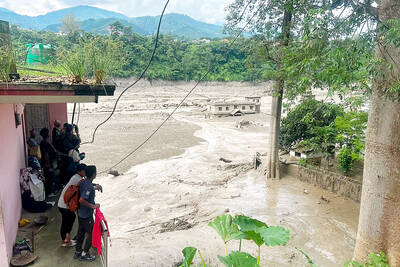
Nepal yesterday deployed helicopters after a massive flash flood swept away villages in the Himalayan nation, killing eight and damaging roads, bridges and power projects in areas near Tibet, authorities said. Across the border, Tibet reported “major casualties” with some missing in neighboring Gyirong County after a mudslide hit a land crossing between China and Nepal, Xinhua news agency said. The waters were too high for helicopters to land in Nepal’s affected areas of Syapru Besi and Timure in the mountainous Rasuwa District, with a population of about 50,000, officials said, while flagging the risk of casualties. “There could be heavy casualties or
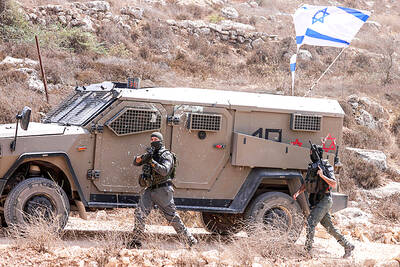
Dozens of Israeli settlers on Saturday attacked the Palestinian village of Qusra in the northern occupied West Bank after nearly three weeks of tension in the area, drawing rare condemnation from Israeli Prime Minister Benjamin Netanyahu. Earlier this month, a group of settlers began blocking supplies from entering Palestinian houses on the outskirts of the village near Nablus, trapping residents inside and drawing unusually strong criticism from the US ambassador. Weeks later, Israeli forces continue to operate in the area while settlers still roam the surrounding hills. On Saturday, Qusra residents and dozens of settlers had descended on the village,


 RSS
RSS