

Hungarian lawmakers were yesterday expected to elect former Supreme Court chief Andras Baka, who was fired under former prime minister Viktor Orban, as the nation’s next head of state.
The post became vacant following the contested removal last month of the previous president, an Orban ally, as pro-EU conservative Hungarian Prime Minister Peter Magyar pushes to loosen his predecessor’s lingering hold over state institutions.
Magyar’s ruling Tisza party on Saturday nominated Baka — who served 17 years as a judge on the European Court of Human Rights (ECHR) — for the largely ceremonial role.
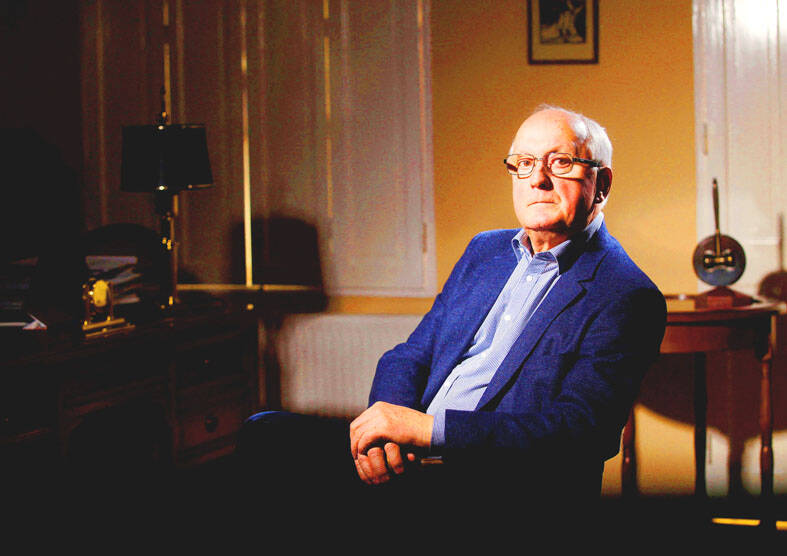
Photo: AFP
Magyar said Baka’s life served “as an example of commitment to the democratic rule of law and constitutional principles,” as the central European country needs to be “guided back onto the path of the rule of law and constitutional governance.”
Tisza has the two-thirds parliamentary majority required to elect Baka, 73, on the first round without any opposition support.
The vote in parliament was due to star at 2pm.
The previous president, Tamas Sulyok, saw his mandate cut short by a constitutional amendment, adopted as part of Magyar’s reform push.
Magyar’s party won the elections in April, ending nationalist Orban’s 16 years in power and promising “system change.”
However, rights watchdogs criticized Sulyok’s removal, comparing the tinkering to the methods Orban used to build his self-styled “illiberal” system.
Orban’s Fidesz party, along with its ally KDNP, said they would boycott the parliamentary vote, saying Sulyok’s ouster was “tyrannical” and “illegitimate.”
Baka has not been critical of Sulyok’s removal, although he was terminated with a similar legislative act.
“In a country governed by the rule of law, such extraordinary measures cannot be used, but Hungary became a captured state under Orban,” he said last month.
State officials like the president “were appointed not to restrain the government’s power, but to ensure the political survival of the former system even after an electoral defeat,” Baka added.
Installing Baka as president signals a “guarantee that the restoration of liberal democracy will proceed along a clearly defined path,” said Bulcsu Zsiga, from the Center for Fair Political Analysis.
Besides a brief stint as a lawmaker, elected from the conservative Hungarian Democratic Forum’s party list in 1990, after the democratic transition, Baka did not hold any political positions.
He was a judge at the Strasbourg-based European Court of Human Rights from 1991 to 2008.
In 2009, he was nominated as the head of the Supreme Court, but was ousted in 2012 after he condemned a move under Orban to reduce the age of mandatory retirement for judges from 70 to 62, calling it a judicial purge.
The EU and the US called the age-limit reduction illegal, and in 2016 the ECHR ruled that Baka’s dismissal amounted to a violation of his freedom of expression.
“His nomination also carries a symbolic meaning, given that Baka went all the way to prove that what happened to him was not really in line with European Union norms,” Zsiga said.
Last month, Magyar offered the nomination as president to chess legend Judit Polgar, but she declined after the prime minister faced mounting outrage for not consulting the public as promised.
Magyar has indicated the new president would only serve part of his term, until the completion of a process to replace the Orban-era Basic Law with a constitution drafted through wide public participation.
Magyar has estimated rewriting the constitution would take one or one-and-a-half years, promising to launch consultations on it next month.

Beijing has quietly confirmed the deaths of two Chinese sailors in a collision in the contested South China Sea, according to government statements nearly a year after the incident. In August last year, a China Coast Guard ship collided bow first with a Chinese naval destroyer while chasing a Philippine patrol boat near the disputed Scarborough Shoal (Huangyan Island, 黃岩島), video footage released by Manila showed. A China Coast Guard spokesperson confirmed at the time that there had been a confrontation, but did not mention the collision, nor injuries or deaths. The Chinese People’s Armed Police Force said on social media on Wednesday

South Korean police yesterday raided the Starbucks national headquarters, the chain’s local operator told reporters, following allegations that an advertising campaign defamed activists slain in 1980 pro-democracy protests. Seoul-based Starbucks Korea caused an uproar this year when it launched a “Tank Day” promotion on May 18, touting a new line of capacious tumblers for its coffee beverages. The date marked the anniversary of the 1980 Gwangju pro-democracy uprising, when at least 165 civilians were killed as a military dictatorship rolled tanks out onto the streets. The chain was accused of trivializing the nation’s landmark protest movement and insulting the dead, remembered as martyrs
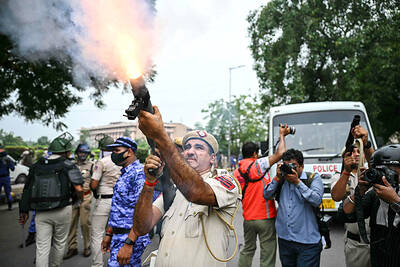
‘COCKROACH’ PARTY: The youth-led movement said it plans to travel across the nation to gather ideas for reforms directly from the public, but will not join elections The Cockroach Janta Party (CJP), which spearheaded one of India’s biggest student protests, yesterday accused authorities of violating an agreement by pursuing participants and reiterated that it would remain a pressure group rather than enter electoral politics. Police continue to investigate cases against some students who took part in the New Delhi protests last month, despite a government agreement to withdraw legal action, CJP spokesperson Ashutosh Ranka told Bloomberg Television’s Menaka Doshi. The group had called off the protests after the agreement was reached. “There were clear instances where this agreement was reneged,” Ranka said, citing cases that remained active in several
US President Donald Trump on Thursday said that he was once more trying to limit the number of people who are born in the country who can become American citizens, in a sign that even after his first attempt at limiting birthright citizenship was rejected by the Supreme Court, he was ready to try again. Trump said he was signing two executive actions on immigration, including one limiting the number of people eligible for American citizenship after being born in the US. The written executive order released later on Thursday was narrower in scope than the previous one shot down by the


 RSS
RSS