

The US Senate on Friday passed a sweeping sanctions package targeting Russia’s energy revenues.
The legislation now heads to the US House of Representatives, although a vote there would not take place until at least early next month due to the congressional summer recess.
“This could finally bring Russia to the negotiating table and end this conflict” between Russia and Ukraine, said Republican US Senator Jim Risch, who also chairs the US Senate Foreign Relations Committee.
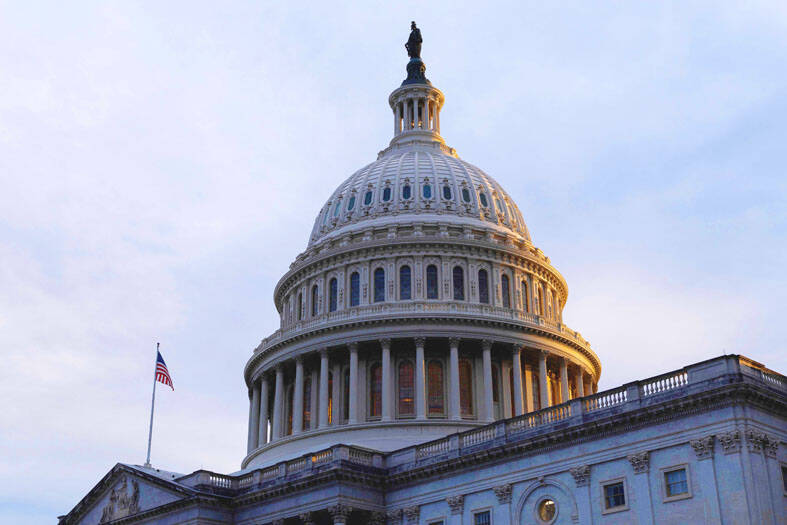
Photo: Getty Images via AFP
“It will make a decisive impact that goes beyond what can be achieved on the battlefield. It will cut off the flow of cash that powers Putin’s war machine,” he said.
The bill aims to target the Russian energy sector by imposing tariffs of up to 500 percent on imports from Russia, including gas and oil.
It also includes 100 percent tariffs on the five main importing countries of Russian gas and oil, including China and India. New sanctions against Russian President Vladimir Putin and other high-ranking officials are also to be imposed. For the first time, the US is also targeting Russia’s shadow fleet, a clandestine network of ships used by Moscow to circumvent Western embargoes since the 2022 invasion of Ukraine.
The bill was named in honor of the late US Republican senator Lindsey Graham, who died on July 11 and had strongly advocated for new sanctions against Moscow, because of its invasion of Ukraine. The day before his death, Graham, along with other Republican and Democratic senators, announced that they had secured the White House’s approval to pass new sanctions on Russian hydrocarbons, measures that had previously been blocked by US President Donald Trump.
His sister, Darline Graham, who succeeded him in the Senate, said the bill “hits Putin where it hurts.”
Democratic US Senator Jeanne Shaheen, a member of the Foreign Affairs Committee, said the bill sent “Vladimir Putin an unambiguous and bipartisan message in the only language he understands: pressure.”
Democratic US Senator Raphael Warnock said US Trade Representative Jamieson Greer finally gave assurances that countries among the top five buyers of Russian oil and gas would no longer be penalized if they dropped in the rankings to sixth or lower.
Several US House of Representatives members nevertheless expressed reservations about the bill, suggesting that passage in the lower chamber could be more difficult than in the Senate.
These new tariff powers could be used without restraint by Trump, Democratic US representatives Gregory Meeks and Don Beyer stated in a joint statement, calling the version adopted on Friday “unacceptable.”
European Commission President Ursula von der Leyen welcomed the passage of the bill.
“Together, let us drain Russia’s means to continue a war it cannot win,” she wrote on X.
The Russian embassy in Washington last month condemned the legislation.
Given the war in Iran, “with an impending energy crisis and rising gas prices on the eve of the midterm elections, sanctioning Russia and its trading partners... would be extremely counterproductive for the United States,” the embassy said in a statement.

Japan has started its first nationwide survey of animal cafes amid concerns over animal welfare, hygiene and public health, a government official said, bringing greater scrutiny to the popular but lightly regulated sector. The desktop survey, which began this month, will examine the number of facilities, the types of animals they house and the conditions they are held in, and how visitors interact with the animals. Exotic animal cafes, where visitors can interact with species ranging from otters to owls and marmots, have become popular attractions for Japanese and foreign tourists. However, researchers say some facilities keep threatened species, raising
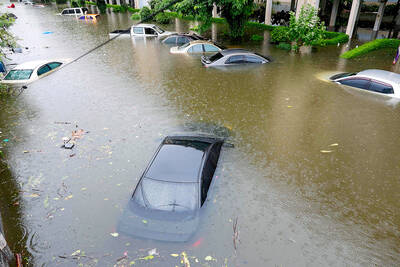
Several areas of Thailand’s capital city Bangkok were inundated by continuous rain from Thursday afternoon to yesterday morning that has disrupted traffic and forced some residents to evacuate. Major canals in Bangkok filled with accumulated rainfall exceeding 20cm, officials said yesterday. Floodwaters spread across the city, particularly in the central and eastern parts, blocking roads and stopping traffic. The Thai Meteorological Department warned that the heavy rain would continue in most parts of the country through today, citing a strong low-pressure system over the central region and strengthening southwest monsoon conditions. More than 84,000 people in 21 provinces nationwide were

Yemen’s Saudi-led coalition early yesterday said it had intercepted two ballistic missiles and two drones launched by the Iran-backed Houthis toward the kingdom. The coalition said in posts on social media that the missiles were headed towards Khamis Mushait and the drones toward the capital, Riyadh, adding that it was monitoring the missile threat and drones launched at the kingdom, without providing further details. The Saudi Civil Defense had sent alerts overnight for Khamis Mushait and Abha, but not for Riyadh. The Houthis, who control the most populous parts of Yemen and much of the north, have been launching attacks

OLD WOUNDS: Protestant marchers seized on an overturned injunction to stage a march, which drew thousands of counterprotesters to block the road in Portadown UK leaders called for calm as a tense standoff with residents seeking to halt a pro-British Protestant march through a primarily Catholic area stretched into the night on Sunday, in one of the worst crises for Northern Ireland in the past few years. The tensions were triggered after a Belfast appeal court overturned a High Court injunction in the early hours of Sunday to clear the march by the Orange Order to go ahead for the first time since 1997. The Parades Commission, Northern Ireland’s independent body regulating contentious processions, had authorized 35 Orangemen to march silently along Garvaghy Road in Portadown,


 RSS