

For many birdwatchers, recording a species outside its normal range is the holy grail. In the UK, the discoveries often make national headlines. The western reef heron, for example, usually found in Africa and southern Europe, was spotted in a seaside town in north Wales last month, and widely celebrated on birding forums.
However, a new scourge is threatening to disrupt the fun: artificial intelligence (AI) slop.
Scientists are appealing to birders to limit their use of AI when editing images over fears that it could undermine the credibility of popular citizen science platforms such as iNaturalist and Macaulay Library, which are routinely used in scientific research to monitor species’ habitat range.
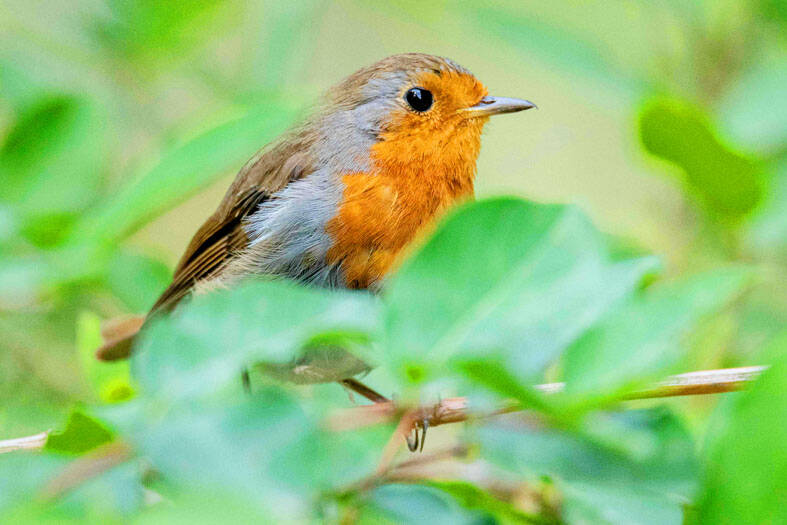
Photo: AFP
The rise of generative AI platforms such as ChatGPT and Google Gemini has led to a sharp increase in fake and enhanced images of rare and celebrated birds across wildlife photography forums. Users can create high-quality fake images in seconds — or enhance a photograph by asking the AI to remove a branch or leaf that might be obscuring part of the subject, which can inadvertently introduce significant changes.
In a recent commentary in the science journal Nature, researchers warned that hundreds of fake images have already been discovered on popular databases for recording species. They said that the true scale of the issue is unknown — as many could go undetected — and could contaminate records collected by the public.
“My experience of looking at Facebook these days is that a huge volume of wildlife photos now are simply AI-generated imagery,” said Alexander Lees, an ecologist at Manchester Metropolitan University who authored the journal article. “The idea that we could maybe use those photos to help us understand where species are in space and time is very difficult.”
Outright hoaxes remain rare and are often easy to spot, said Lees — nobody is falling for a toucan sighting in Siberia — but added that birders often use AI to edit and improve an image, and the algorithm can then introduce parts from different bird species to create the new image.
Lees points to the example of a false sighting of a red-winged blackbird in central Brazil, which is usually found in North America and had never been seen in this area of Brazil until the reported sighting. The bird was, in fact, an epaulet oriole — a common new world bird species — but the photographer had asked an AI platform to make the picture “look better,” which is when parts of the red-winged blackbird were added, resulting in the false sighting.
“Wildlife photographers can be quite obsessed with getting a beautiful photo, but there’s a risk that the image might actually cause problems down the line when AI has been used to edit it,” Lees said.
Citizen science organizations are still working to understand the scale of the issue. On iNaturalist, a social network where nature enthusiasts can record sightings of plants and animals, just 1,400 of the more than 610 million images on the platform have been flagged for AI use.
From monitoring how plants and animals move in response to climate breakdown to recording new behavior in species, dozens of discoveries have been made using citizen science.
Tony Iwane, iNaturalist’s director of community support, who was a coauthor on the Nature paper, said most of these cases were unlikely to be malicious, but appealed to users to be vigilant.
“On platforms like ours, regular people are posting information that a scientist could probably never get at scale. It is also almost like a sensor of what is happening on Earth in real time: Are plants flowering early? Are species moving north as the climate warms? The more we know about where species are, the better informed we can be as conservationists. But the information needs to be accurate,” he said.

INVESTMENT: The train project was significantly more expensive than other conventional services, but costs are expected to fall as the technology matures, an official said India yesterday launched its first hydrogen-powered train, joining a small group of nations testing the technology as part of efforts to decarbonize rail transport and cut dependence on fossil fuels. The project is part of a broader push to modernize one of the world’s largest rail networks while reducing carbon emissions. The 10-coach train runs along an 89km route between Jind and Sonipat in Haryana, powered by a 1,200-kilowatt hydrogen fuel cell propulsion system. The system is the world’s most powerful for a train, officials said. Hydrogen trains use fuel cells to generate electricity by combining hydrogen and oxygen, emitting only water and steam. “This

KEY REVENUE SOURCE: An agreement to freeze the bloc’s floating price cap on Russian oil also appeared elusive, despite a looming deadline today to reset the limit The EU on Monday failed to endorse a 21st sanctions package against Russia, putting the bloc at risk of undermining one of its key tools to restrict the Kremlin’s oil revenue. The main points of contention were restrictions on the transport of Russian liquefied natural gas (LNG) and measures regarding Austria’s Raiffeisen Bank International AG, said people familiar with the matter who spoke anonymously to describe the private talks. An agreement to freeze the bloc’s floating price cap on Russian oil — a central element of the package — was also elusive, despite a looming deadline today to reset the limit. Without

‘WRONGFULLY DETAINED’: A security expert said that China wants to use Chen Youlin’s expertise to improve its ability to conceal underground nuclear weapons tests A Chinese-born American seismologist who has published US-funded work on detecting North Korean nuclear tests has been detained in China for nearly two years and faces trial on spying charges, his wife, US lawmakers and two hostage advocacy groups said. The case of Chen Youlin (陳有林) adds an irritant to the tense relationship between the nuclear-armed rivals and comes as US President Donald Trump seeks to keep the relationship steady following last year’s trade war. US Secretary of State Marco Rubio on March 19 designated Chen, 54, as “wrongfully detained,” making his release a top US priority. The Trump administration has withheld
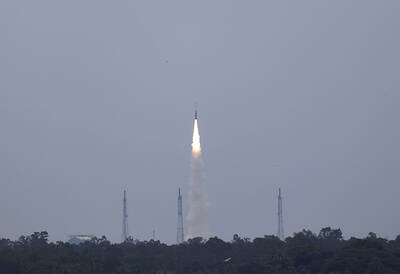
‘DEFINING MOMENT’: Indian Prime Minister Narendra Modi touted the achievement, saying that it would encourage the youth to ‘dream bigger and innovate fearlessly’ India’s first privately built orbital rocket took its maiden flight yesterday, Skyroot Aerospace said, marking a significant step for the South Asian giant as it eyes a bigger slice of the global space economy. The Vikram-1 rocket, designed to carry small satellites into low Earth orbit, took off from the Satish Dhawan Space Center in Sriharikota amid loud cheers. “Hello space, we have arrived!” Skyroot Aerospace wrote on X. “Vikram-1’s Test Flight-1 has completed its mission. The first ever Indian private sector launch has been successfully completed.” Vikram-1 is about as tall as a seven-story building and capable of carrying payloads weighing


 RSS
RSS