


Lawmakers from more than a dozen African countries have pledged to push new bills restricting LGBT rights, after a conference in Ghana that brought together self-described “pro-family” activists from across Africa and Europe, participants said.
The African Inter-Parliamentary Conference on Family Values and Sovereignty took place in Accra on June 3 to 6, a week after Ghana’s parliament passed one of the continent’s toughest anti-LGBT measures, a bill criminalizing LGBT promotion.
The gathering reflects a broader shift toward more restrictive laws targeting LGBT people in parts of Africa that participants said was being encouraged by conservative figures in the US and Europe, and has gained new momentum since Donald Trump returned to the White House.
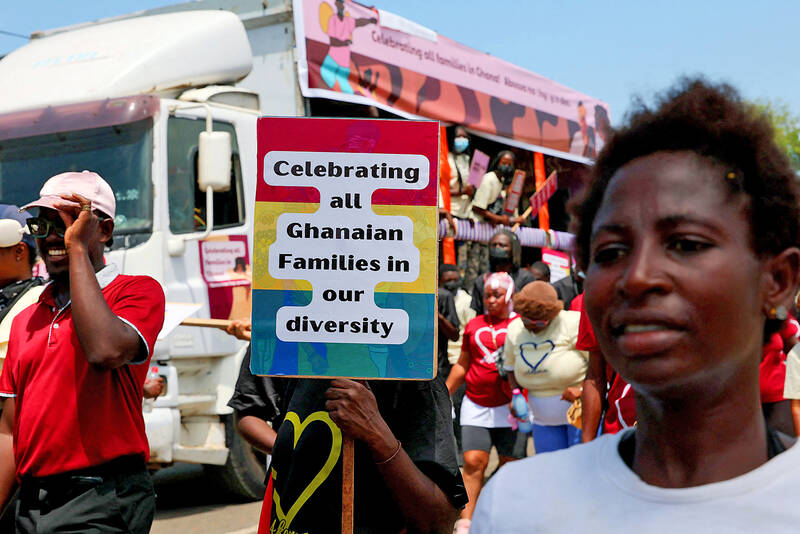
Photo: Reuters
Some attendees said they saw an opportunity to promote their agendas under Trump, whose administration — unlike those of former US presidents Barack Obama and Joe Biden — does not promote LGBT rights as part of its foreign policy.
“When you return to your respective capitals, let the resolutions we adopt here not gather dust in the archives of our secretariats. Let them be translated into active bills, robust budgetary allocations and rigorous oversight,” Ghanaian Speaker of Parliament Alban Bagbin said in his opening remarks.
“Go home and tell your people that their representatives have resolved to protect the sanctuaries of their homes, the heritage of their ancestors, and the sovereignty of their nations,” he said.
More than half of Africa’s 54 countries criminalize same-sex sexual acts. Several countries, including Uganda and Senegal, have recently gone a step further, adopting laws that criminalize LGBT “promotion” — something Ghana’s lawmakers approved late last month.
WESTERN INFLUENCE
Organizers said lawmakers from 20 countries attended the conference held at Ghana’s parliament. It was unclear how many intend to introduce new legislation based on the discussions.
Reuters spoke to five participants and reviewed more than 100 pages of presentations given at the conference. It could not determine the role of foreign activists in shaping the agenda, nor find evidence of foreign funding.
Sharon Slater, president of the US-based conservative group Family Watch International, has attended previous editions of the conference in Uganda. She told Reuters she was invited this year, but chose not to attend.
Speakers included Henk Jan van Schothorst, the Dutch executive director of the advocacy group Christian Council International. He urged African governments to resist pressure to ban so-called conversion therapy, which aims to make gay people straight.
“These policies are not only reserved for the Netherlands and for Europe. They are coming to Africa,” he said of the bans, describing them as “ideological colonization” by Western powers.
In another presentation, Kenyan doctor Wahome Ngare defined homosexual as “the young man sexually molested by the father” and transgender as “the young lady sexually molested by strangers.”
The conference concluded with lawmakers approving an “African Charter on Family, Sovereignty and Values,” drafted at earlier meetings in Uganda.
The 32-page document urges governments to withdraw from treaties or agreements — including at the UN and with foreign donors — seen as promoting “the LGBT agenda,” abortion or sex education that is not abstinence-focused.
The charter also says signatories should work to enact national laws that “safeguard African culture and cultural values.” Lawmakers from 18 of the 20 represented countries approved the charter.
HEALTH IMPACT
Health officials have highlighted the public health implications of anti-LGBT laws, which can push LGBT people into hiding, including men who have sex with men who face higher HIV prevalence than the general population.
Reuters reported in April that fewer HIV patients were visiting treatment centers in Senegal amid a wave of arrests coinciding with the debate over that country’s new law.
For LGBT people in Ghana, the same debate has already heightened fear.
“I constantly self-censor, hide, watch my back. That’s not safety, that’s survival,” said an African photographer and longtime resident of Accra. “So yes, leaving has crossed my mind. That breaks my heart because Ghana is my hme.”
Reuters reported in March that the “pro-family” US group MassResistance had been in contact with activists in Ghana backing the bill, as well as Senegal’s new law.
Ghana’s bill is awaiting sign-off by President John Dramani Mahama, who has previously said he would sign such a measure into law, but recently said there were procedural issues.
A coalition of more than 100 African civil society groups has urged Mahama to reject the bill, saying the government risked allowing “external actors with resources and reach to shape its domestic legislation.”
The US Department of State has said Trump’s approach to foreign assistance ensures taxpayer dollars are not “wasted on divisive social and gender issues.”
At the Accra conference, Ugandan former lawmaker Sarah Opendi welcomed the shift.
“Let us first thank the American people for voting for President Trump. The conversation in America today is different,” she said.

Voters in Switzerland yesterday cast their ballots on an initiative championed by the top right-wing party to cap the Alpine country’s population at 10 million. As of press time last night, early results showed that Swiss voters were leaning against it. The populist Swiss People’s Party, which has the most seats in parliament, has stirred up and fostered anti-migration sentiment over the years, notably about an influx of workers from the neighboring EU. Critics called the bid a self-inflicted wound, saying the boom in migration over the past generation has brought foreign labor and skills to sectors such as healthcare, finance, pharmaceuticals
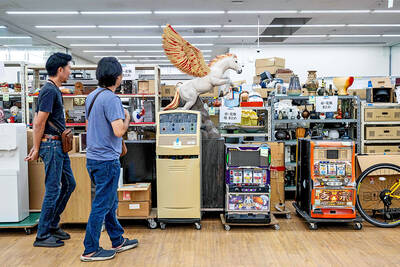
YUCK OR YUM? While it is difficult to sell second-hand goods that are more than seven years old in Japan, they are still popular in foreign markets, an executive said Under a scorching sun in a Bangkok suburb, a whistle blew, and shouts filled the air as dozens of shoppers rushed into a warehouse bearing the sign “Japanese Second-Hand Store.” From bags and bicycles to surfboards and suitcases, the Japanese second-hand market is booming, with quality-conscious buyers in other Asian countries increasingly tapping into the circular economy trend. “What is considered garbage for them can still be useful in Thailand,” said 36-year-old Lookpoo Sathitpanyapon, who runs an online store selling toy keychains. “That bag, that bag,” one shopper shouted while racing through the warehouse, filled with everything from colorful toys
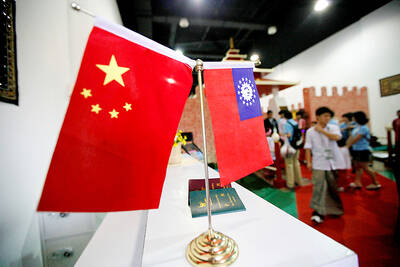
FOREIGN POLICY-FOCUSED: Academic Min Zin founded ISP Myanmar, which writes about China-Myanmar trade and is involved in exchanges with Chinese think tanks A US academic who writes about Myanmar and Chinese foreign policy was arrested by authorities in China on suspicion of spying, China’s Ministry of Foreign Affairs said on Friday. The academic, Min Zin, was suspected of “engaging in espionage activities that endanger China’s national security,” ministry spokesman Lin Jian (林劍) said. It is uncommon for Beijing to arrest a US citizen on national security allegations. The case comes just a month after US President Donald Trump met with Chinese President Xi Jinping (習近平) in Beijing as the two countries aim to reset a tumultuous relationship. A Burmese activist who knows Min Zin said
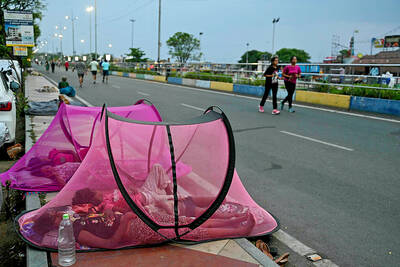
Growing up in Tahiti, Anna-Bella Failloux saw first-hand the threat posed by mosquitoes: Nearly one-third of adults on the picturesque island once had swollen limbs from elephantiasis caused by their bites. She has since dedicated her life to studying mosquitoes and the diseases they transmit — a concern that looms ever larger as climate change expands the area where the insects roam. “You have to accept being bitten by a mosquito from time to time,” the 63-year-old entomologist at France’s Pasteur Institute said. “But we have to avoid too many people getting sick and dying from the infections,” Failloux said, as she observed


 RSS
RSS