


Police in Vietnam rescued more than 400 cats in a major bust of a cat meat crime ring last week in Ho Chi Minh City, and at least 40 of them have been reunited with their owners.
However, several of the cats died because of the harsh conditions they were found in, animal welfare groups said.
Since the operation, veterinarians and volunteers have flocked to care for the cats at a temporary rescue center set up at a facility run by the Ho Chi Minh City Criminal Police Division.
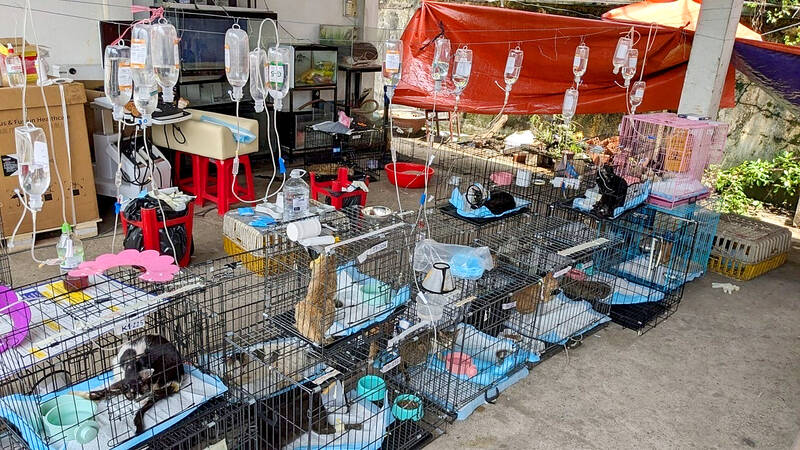
Photo: Vietnam Cat Welfare via AP
“People who lost their cats can come to the police station to identify their pets and help the police with the investigation,” police official Nguyen The Bao said.
This operation is “a sobering reminder of the enormous scale of Viet Nam’s cat meat trade,” said Karanvir Kukreja, who leads a campaign against dog and cat meat consumption for the international nonprofit Humane World for Animals.
Local media also reported that the Ho Chi Minh City police investigation into a spate of pet thefts resulted in the arrest of nine people.
During the operation, police raided a yard and uncovered 45 cages containing about 400 live cats and four ice-filled foam containers holding about 80 dead cats.
About 20 live cats were also recovered at a separate location, the police added.
One kilogram of cat meat sold for about 70,000 Vietnamese dong (US$2.66), they said.
The suspects admitted to trapping and collecting cats across south Vietnam over the past three years, the police said.
“The sad truth about this trade is that thousands of cats every month are being stolen, trafficked and slaughtered for meat across the country,” Humane World for Animals Vietnam director Phuong Pham said. “Thankfully, these survivors escaped.”
Several of the rescued cats were pregnant, leading to kittens being born in police custody this week, she said.
Vietnam Cat Welfare representative Chris Gindelhumer said he “saw quite a lot of tears in the last few days.”
“It’s really beautiful to see how many Vietnamese families are coming, looking for their cats,” he said. “But it’s also heartbreaking because many families were looking for their cats and didn’t find them.”
Many veterinarians and volunteers are working around the clock for the cats, Gindelhumer added.
Consumption of dog and cat meat is legal in Vietnam. Vendors must have permits to validate the animals’ origins, but certain cities such as Hoi An are working with global animal welfare groups to stop dog and cat meat consumption in the city.
“This event surprised a lot of people and has raised awareness among many to stop consuming cat meat,” cat lover An Pham said.

Voters in Switzerland yesterday cast their ballots on an initiative championed by the top right-wing party to cap the Alpine country’s population at 10 million. As of press time last night, early results showed that Swiss voters were leaning against it. The populist Swiss People’s Party, which has the most seats in parliament, has stirred up and fostered anti-migration sentiment over the years, notably about an influx of workers from the neighboring EU. Critics called the bid a self-inflicted wound, saying the boom in migration over the past generation has brought foreign labor and skills to sectors such as healthcare, finance, pharmaceuticals

FOREIGN POLICY-FOCUSED: Academic Min Zin founded ISP Myanmar, which writes about China-Myanmar trade and is involved in exchanges with Chinese think tanks A US academic who writes about Myanmar and Chinese foreign policy was arrested by authorities in China on suspicion of spying, China’s Ministry of Foreign Affairs said on Friday. The academic, Min Zin, was suspected of “engaging in espionage activities that endanger China’s national security,” ministry spokesman Lin Jian (林劍) said. It is uncommon for Beijing to arrest a US citizen on national security allegations. The case comes just a month after US President Donald Trump met with Chinese President Xi Jinping (習近平) in Beijing as the two countries aim to reset a tumultuous relationship. A Burmese activist who knows Min Zin said

Kazakhstan signed accords with the start-up Firebird Inc on computing projects involving Nvidia Corp that could bring as much as US$10 billion in investment, as the Central Asian energy producer looks to position itself as an artificial intelligence (AI) hub. The pacts include a strategic cooperation agreement on developing AI infrastructure and terms for a planned large-scale project known as Data Center Valley in the country’s northeast, the Kazakh Ministry of Artificial Intelligence and Digital Development said in a statement. The plan envisages US$5 billion in investments in phase one — including US$1 billion provided by state-run Kazakhtelecom — with commercial operations

Growing up in Tahiti, Anna-Bella Failloux saw first-hand the threat posed by mosquitoes: Nearly one-third of adults on the picturesque island once had swollen limbs from elephantiasis caused by their bites. She has since dedicated her life to studying mosquitoes and the diseases they transmit — a concern that looms ever larger as climate change expands the area where the insects roam. “You have to accept being bitten by a mosquito from time to time,” the 63-year-old entomologist at France’s Pasteur Institute said. “But we have to avoid too many people getting sick and dying from the infections,” Failloux said, as she observed


 RSS
RSS