

The EU has moved forward with a vast overhaul of its migration policy, aiming to ramp up deportations and ink controversial deals to build detention centers abroad, in what rights groups compare to the aggressive immigration policies of US President Donald Trump’s administration.
“The new regulation will speed up the return process and increase returns of persons who have no legal right to stay in the EU,” said Nicholas Ioannides, deputy migration minister for Cyprus, which holds the rotating presidency of the 27-nation bloc.
The deal was struck between the EU’s three main institutions — the European Commission, the European Council and European Parliament — during a so-called “trilogue” on Monday evening.

Photo: AFP
Critics compared the regulation to the immigration strategy of the Trump administration, which has struck a series of secretive agreements with nations around the world to deport thousands of people to countries that are not their own. The UK also planned to deport migrants to Rwanda, but the plan was bogged down in legal red tape and the new government dropped the plan as soon as it came into power.
“The Regulation is going to create a draconian detention and deportation machine,” said Silvia Carter, spokesperson for the Brussels-based Platform for International Cooperation on Undocumented Migrants.
“Across the Atlantic, we see the violence and fear created by ICE’s brutal immigration enforcement. Europe should be learning from the harms of that model, not building its own version of it,” she said, referring to the US Immigration and Customs Enforcement.
The provisional agreement will now head to the EU lawmakers and heads of state, where approval is likely to be swift.
EU member nations will soon be able to set up bilateral deals with countries outside the bloc to build deportation centers. At least five EU nations — Germany, Austria, the Netherlands, Denmark and Greece — are already in talks with third countries, mostly in Africa, to host “return hubs” on the model of Italy’s detention deal with Albania.
The EU has continually tightened migration policies after right-wing parties took power in some countries in 2024. European Commission President Ursula von der Leyen, from the center-right European People’s Party coalition, has said that the new measures would prevent a repeat of the 2015 crisis caused by Syria’s civil war, when about 1 million people arrived to seek asylum.
Fueled by people fleeing conflict and poverty across Africa and the Middle East, the 2015 refugee crisis and successive years of irregular migration to Europe have driven a rightward shift in the bloc’s politics not unlike the anti-immigrant sentiment that buoyed a “ red wave ” in the 2024 election in the US.
Center-right political groups allied with the far-right to overcome opposition from centrist and left-wing parties, said Melissa Camara, a French lawmaker and member of the Greens who called the deal “a historic setback” for human rights in the bloc.
“The legalization of return hubs outside the EU, the green light for the detention of minors, home visits inspired by ICE practices: The legal arsenal serving a xenophobic ideology is now complete,” she said.
Activist groups warned the legislation would cut deep into the protections granted by the EU fundamental charter on human rights and expose people to risks outside the bloc.
“This deal will give governments much broader powers to detain and deport people,” International Rescue Committee spokesperson Marta Welander said. “It looks set to normalize immigration raids, expand the use of detention in prison-like facilities outside EU territory that are essentially legal black holes, and increase the risk of people being deported to countries where they could face persecution, torture or worse.”

ON THE MOVE: Trump unexpectedly cut short a trip to return to the White House, while the State Department warned Americans to avoid travel to the Middle East The US on Saturday warned that hostilities between Saudi Arabia and Iran-backed Houthis could “escalate rapidly” after a missile attack targeted Riyadh for the first time since the Yemen conflict resumed. US President Donald Trump on Saturday cut short a weekend at Camp David, a secluded presidential complex in rural Maryland, to return unexpectedly to the White House. The White House gave no explanation for the early return, which comes as a new threshold was crossed in the conflict between Saudi Arabia and the Houthis, who control a large part of Yemen and are fighting government forces backed by a coalition led
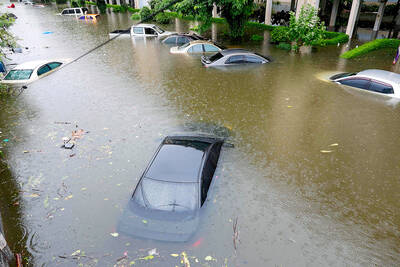
Several areas of Thailand’s capital city Bangkok were inundated by continuous rain from Thursday afternoon to yesterday morning that has disrupted traffic and forced some residents to evacuate. Major canals in Bangkok filled with accumulated rainfall exceeding 20cm, officials said yesterday. Floodwaters spread across the city, particularly in the central and eastern parts, blocking roads and stopping traffic. The Thai Meteorological Department warned that the heavy rain would continue in most parts of the country through today, citing a strong low-pressure system over the central region and strengthening southwest monsoon conditions. More than 84,000 people in 21 provinces nationwide were

World leaders gather in New York this week for the UN General Assembly, bracing for US President Donald Trump’s return to the rostrum for a second year running, with talks centering on the widening conflicts in the Middle East and Ukraine and the risks of artificial intelligence (AI). Nearly 130 heads of state meet with the post-World War II order under strain and with the UN itself struggling to remain relevant and weathering attacks from Trump, who has slashed the US’ contributions and withdrawn from dozens of UN bodies. Chinese President Xi Jinping (習近平), who last addressed the diplomatic jamboree via video
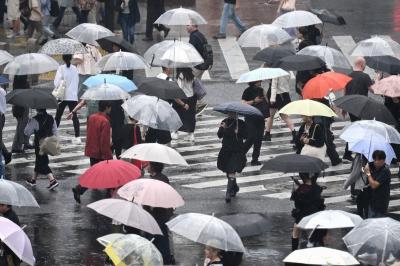
Typhoon Dujuan forced the cancellation of at least 275 flights in Japan today and prompted warnings of potentially record-breaking rainfall as the storm nears Tokyo. The typhoon, which is accompanied by high winds, has also led to the early closure in Tokyo of one the world’s biggest video game trade fairs and knocked out power for thousands. The Japan Meteorological Agency (JMA) warned yesterday that rain and winds were expected to intensify even before the typhoon’s arrival. “The total rainfall through Tuesday could exceed the average monthly rainfall for September, resulting in record-breaking heavy rain,” the agency said. The typhoon’s wind speeds were at


 RSS
RSS