

Last month, over 80,000 lesbian, gay, bisexual and transgender (LGBT) people and their supporters marched in the 13th Taiwan LGBT Pride Parade (台灣同志遊行). Turnout was historic, as the parade has become the second largest LGBT event in Asia and the Middle East, after the Tel Aviv Gay Pride Parade.
A number of events were also held last month to celebrate LGBT pride, including the Taiwan International Queer Film Festival (台灣國際酷兒影展), the Hand in Hand Asian LGBT Choral Festival, which featured over 150 vocalists from around the world, and the ILGA-Asia Conference, the largest of its kind in Asia with 300 activists from over 30 countries.
In the past, most foreign participants were from neighboring countries. But this year, many hailed from the West. According to the Taiwan LGBT Pride (台灣同志遊行聯盟), organizer of the parade, over 5,000 foreign participants took part in the parade and related international events. And thanks to the foreign media’s coverage, the parade successfully boosted the global visibility of Taiwan’s LGBT community.
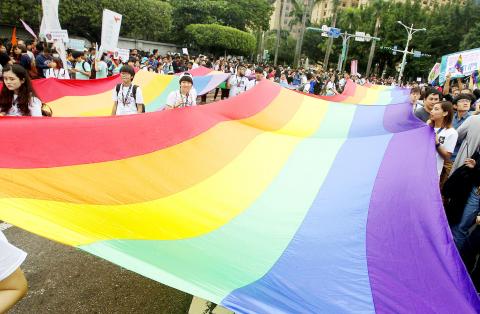
Photo: REUTERS
“The Taiwan LGBT Pride Parade is a famous international event. I want to be part of it to show support,” said Father Silas of the Romanian Orthodox Church during his visit to Taipei. Silas posed nude for the Orthodox Calendar this year to protest homophobia and show his support for the LGBT community.
Meanwhile, some presidential and legislative candidates promised to protect LGBT rights should they be elected.
OVERWHELMING SUPPORT
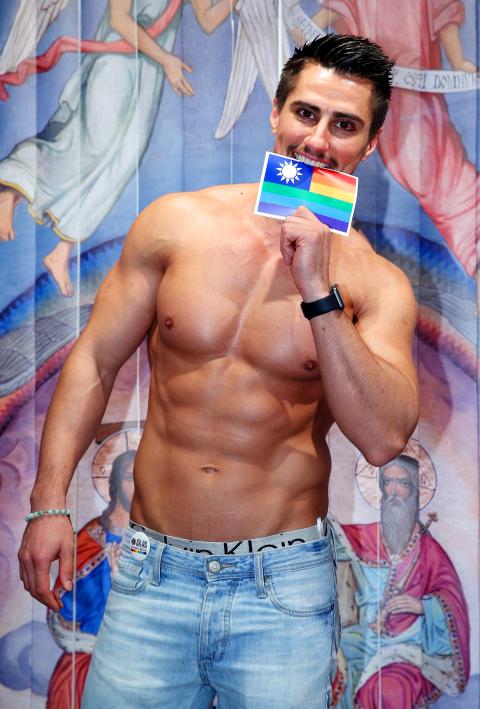
Photo: CNA
On the day of the parade, the Ministry of Justice completed the nation’s largest online vote to date on same-sex marriage, which will serve as a reference for policymaking. More than 310,000 people participated in the three-month vote, which was held between Aug. 3 and Oct. 31 on the government’s Public Policy Network Participation Platform (公共政策網路參與平台).
The poll revealed that 59 percent support legal protection for same-sex couples, 71 percent support a same-sex marriage act and 45 percent support a same-sex partnership act, where gay couples are offered certain rights enjoyed by married couples, instead of full marriage rights.
These figures clearly show that support for same-sex marriage has surged to a new high compared with a 2013 poll.
TIME TO ACT
For that poll, the ministry commissioned the Police Research Association (中華警政研究學會) to conduct a study on the feasibility of same-sex marriage legislation. The results showed that 53.7 percent of respondents agreed that same-sex couples should be allowed to marry, and 61.1 percent said that married same-sex couples should be allowed to adopt children.
In response, the association recommended that the ministry push for marriage equality legislation.
However, when the legislature commenced discussion of the draft bill for marriage equality last year, not only did the ministry ignore the association’s recommendations, it also called same-sex marriage “an ethical violation of human relations” in its report to the legislature.
With the results of this new poll showing support for marriage equality increasing from 53.7 percent to 71 percent within a few years, will the ministry continue to groundlessly criticize it while ignoring public opinion?
Some politicians and officials claim that Taiwanese are not ready for same-sex marriage. But the results of the ministry’s own polls clearly show that the majority of Taiwanese are. It’s about time our politicians faced up to this reality.
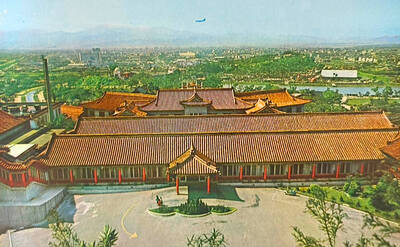
Sept. 21 to Sept. 27 When the Shah of Iran became the Grand Hotel’s (圓山大飯店) first head-of-state guest in 1958, it was hardly the landmark it is known as today. A Chinese-style, two-story structure with just 36 rooms built on the former site of the Taipei Shinto Shrine, the hotel was still referred to as its original name, the Taiwan Hotel (台灣大飯店), in an official newsreel detailing Mohammad Reza Pahlavi’s visit. The video lavished praise on the hotel, pointing out its “beautiful architecture and magnificent appearance” and noting that it had just been renovated. After being greeted personally by then-president
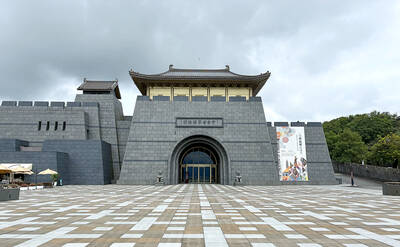
The one-day trip begins at the geographical center of Taiwan: Puli Township’s (埔里) Hutou Mountain Geographic Center of Taiwan Monument (臺灣地理中心碑), embedded at the foot of Nantou County’s dense forested slopes. It sits entrenched in forest vegetation amid the tall, spindly bodies and spiky heads of the betel nut trees; the air is cool, and its surroundings are mostly silent save the sounds of late-season cicadas. Roughly two minutes from the first destination, and after a bend in Yongfeng Road (永豐路), there’s a glimpse of a resplendent golden dome on the horizon. It’s the cap of the 135m-tall main building of the
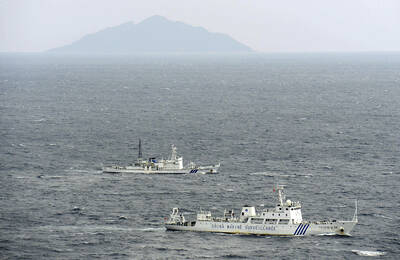
For a small nation, Taiwan has an unusually long list of territorial disputes. In part or in whole, it has disputes over the Spratly Islands (Nansha Islands, 南沙群島) with Vietnam, the Philippines, Malaysia and Brunei. It also has another territorial dispute with Vietnam over the Paracel Islands, and with Japan over the Senkaku Islands (Diaoyutai Islands, 釣魚台). Of course, the biggest territorial disputes are with the People’s Republic of China (PRC), which not only claims all of the above, but also Pratas Island (Dongsha, 東沙島), Kinmen, Penghu and all of Taiwan itself. This creates considerable headaches politically for the government, especially
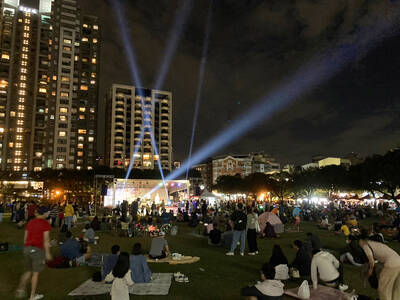
Two years ago, the music came to an abrupt halt at one of Taiwan’s largest independent music festivals. The problem: a single noise complaint. The DJ’s high-energy tunes had exceeded the allowed sound limit. As per regulation, the performance took a several-minute pause and then continued, this time at a slightly lower decibel. And then last year, the same event, Compass Taichung International Food and Music Festival, was unexpectedly canceled due to sponsorship issues. Such are the woes of trying to organize outdoor music festivals these days. “It makes it so much harder to put on a festival,” said Courtney Donovan Smith, co-publisher


 RSS
RSS