


For Jaromir Cervenka, the Hermes boat anchored in Prague and accommodating the Czech capital’s homeless has become more than a temporary home.
The 49-year-old ended up on the street after a divorce more than two decades ago, sleeping on benches or in dormitories.
He moved to the Hermes when it opened in February 2007, and has recently become its paid captain and maintenance worker with his own cabin.
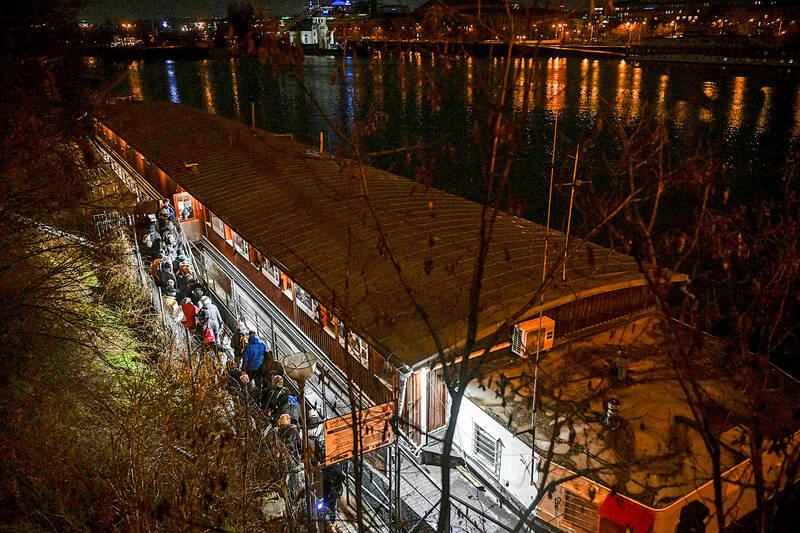
Photo: AFP
“It’s cool to have a place to stay that is warm and where you can wash,” said Cervenka, who is a trained blacksmith.
The Hermes is one of several safe havens for the growing number of homeless people in Prague.
Statistics are scarce, but the Organisation for Economic Cooperation and Development put Czech homelessness at 104,818 people in a 2024 report.
The Czech Statistical Office in 2024 said 154,000 Czechs were affected by “acute housing crisis,” including 61,000 children living in dormitories.
Jan Frantisek Krupa, who heads the Czech branch of Salvation Army, put the number of homeless Czechs “somewhere between 30,000 and 70,000.”
“But I’m not counting those who live in non-standard housing, dormitories or flats with a short-term contract. If we included them, we’d be over 100,000,” he said.
The Hermes opens at 7:30pm and closes at 6:30am all year long, accommodating 180 people, with 30 beds for women and 150 for men.
Dozens of people clutching plastic bags queued before the opening outside the long, low boat on a freezing January evening as a cold snap sent temperatures way below zero.
“Bed occupancy is naturally lower in the summer when it’s under 100 people, while before winter... the boat is full with 160 to 180 people,” Hermes social services head Katerina Prochazkova said.
Clients must be sober and able to navigate a rather steep staircase leading to the boat financed by Prague city hall.
After registering, they can take a shower and have a cup of tea. Cooking is prohibited in the wooden interior.
The boat had transported dry material such as sand and gravel on the Elbe river before being revamped into the shelter, Prochazkova said.
“It is the largest dormitory for the homeless in the country,” she added.
The Czech parliament last year passed a long-awaited law on housing support which would offer assistance to home seekers from September this year.
A social inclusion strategy for 2021-2030 vows preventive steps and social aid, but the new government does not tackle homelessness at all in its policy statement.
To involve fellow citizens in tackling homelessness, the Salvation Army, which charges fees for stays, launched a unique project a decade ago.
Czechs could buy virtual “lodging vouchers” for 100 Czech koruna (US$54.86) apiece to help the homeless with costs that are not covered by the state, such as meals.
Krupa said the Salvation Army has sold 25,000 vouchers this season because of a severe winter.
“Many people, especially in large cities and on freezing nights, come over without any money and we want to make sure that this will not prevent them from sleeping at a Salvation Army dormitory,” Krupa added.

ROCKY RELATIONS: The figures on residents come as Chinese tourist numbers drop following Beijing’s warnings to avoid traveling to Japan The number of Chinese residents in Japan has continued to rise, even as ties between the two countries have become increasingly fractious, data released on Friday showed. As of the end of December last year, the number of Chinese residents had increased by 6.5 percent from the previous year to 930,428. Chinese people accounted for 22.6 percent of all foreign residents in Japan, making them by far the largest group, Japanese Ministry of Justice data showed. Beijing has criticized Tokyo in increasingly strident terms since Japanese Prime Minister Sanae Takaichi last year suggested that a military conflict around Taiwan could

Germany is considering Australia’s Ghost Bat robot fighter as it looks to select a combat drone to modernize its air force, German Minister of Defense Boris Pistorius said yesterday. Germany has said it wants to field hundreds of uncrewed fighter jets by 2029, and would make a decision soon as it considers a range of German, European and US projects developing so-called “collaborative combat aircraft.” Australia has said it will integrate the Ghost Bat, jointly developed by Boeing Australia and the Royal Australian Air Force, into its military after a successful weapons test last year. After inspecting the Ghost Bat in Queensland yesterday,

A pro-Iran hacking group claimed to breach FBI Director Kash Patel’s personal e-mail inbox and posted some of the contents online. The e-mails provided by the hacking group include travel details, correspondence with leasing agents in Washington and global entry, and loyalty account numbers. The e-mail address the hackers claim to have compromised has been previously tied to Patel’s personal details, and the leaked e-mails contain photos of Patel and others, in addition to correspondence with family members and colleagues. “The FBI is aware of malicious actors targeting Director Patel’s personal email information,” the agency said in a statement on

RIVALRY: ‘We know that these are merely symbolic investigations initiated by China, which is in fact the world’s most profligate disrupter of supply chains,’ a US official said China has started a pair of investigations into US trade practices, retaliating against similar probes by US President Donald Trump’s administration as the superpowers stake out positions before an expected presidential summit in May. The move, announced by the Chinese Ministry of Commerce on Friday, is a direct mirror of steps Trump took to revive his tariff agenda after the US Supreme Court last month struck down some of his duties. “China expresses its strong dissatisfaction and firm opposition to these actions,” a ministry spokesperson said in a statement, referring to the so-called Section 301 investigations initiated on March 11.


 RSS
RSS