


Myanmar’s pro-military party has a decisive lead in the first phase of junta-run elections, with the Union Solidarity and Development Party (USDP) winning 90 percent of the lower house seats announced so far, official results published in state media showed.
The military grabbed power in a 2021 putsch that triggered civil war, pitting pro-democracy rebels against junta forces for control of the country.
Myanmar’s junta opened voting in the phased month-long election a week ago, with its leaders pledging the poll would bring on democracy. However, rights advocates and Western diplomats have condemned it as a sham and a rebranding of martial rule.
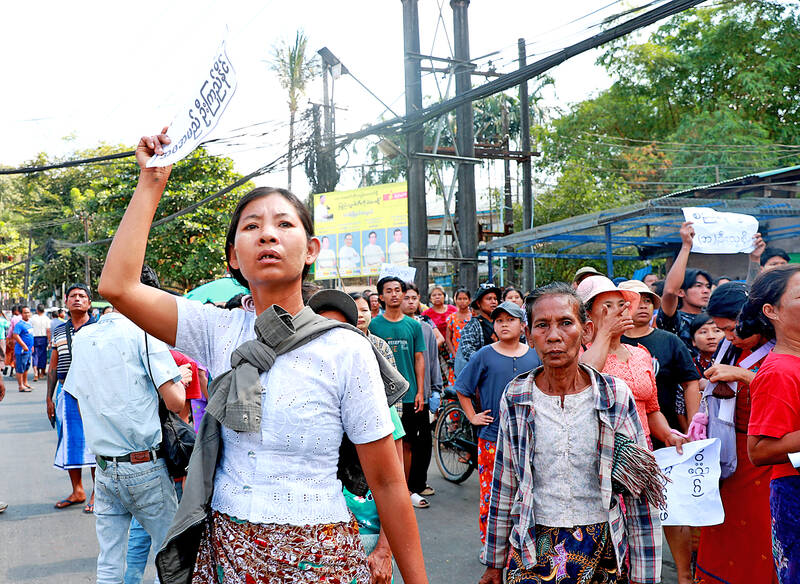
Photo: EPA
The dominant pro-military USDP won 87 of the 96 lower house seats announced, according to partial results from the Burmese Union Election Commission (UEC) released over the weekend in state media.
Six ethnic minority parties picked up nine seats.
The winners of six more townships have yet to be announced in the first phase of voting. Two more phases are scheduled for Sunday and Jan. 25.
The USDP — which many analysts describe as a civilian proxy of the military — claimed an overwhelming victory in the first phase last week.
The massively popular but dissolved National League for Democracy (NLD) of democratic figurehead Aung San Suu Kyi did not appear on ballots, and she has been jailed since the coup.
The military overturned the results of the last poll in 2020 after the NLD defeated the USDP by a landslide.
The military and USDP then alleged massive voter fraud, claims that international monitors say were unfounded.
The USDP also won 14 of the 15 regional and state constituency seats announced in the first phase, according to UEC results published in the state-run Global New Light of Myanmar newspaper.
The junta has said turnout in the first phase exceeded 50 percent of eligible voters, below the 2020 participation rate of around 70 percent.
Meanwhile, Myanmar’s military government yesterday granted amnesty to more than 6,100 prisoners and reduced other inmates’ sentences to mark the 78th anniversary of the country’s independence from the UK.
It was not immediately clear whether those released include the thousands of political detainees imprisoned for opposing military rule.
State-run MRTV television reported that Min Aung Hlaing, the head of the military government, pardoned 6,134 prisoners.
A separate statement said 52 foreigners would also be released and deported from Myanmar. No comprehensive list of those freed is available.
Other prisoners received reduced sentences, except for those convicted of serious charges such as murder and rape or those jailed on charges under various other security acts.
The release terms warn that if the freed detainees violate the law again, they would have to serve the remainder of their original sentences in addition to any new sentence.
The prisoner releases, common on holidays and other significant occasions in Myanmar, began yesterday and are expected to take several days to complete.
At Yangon’s Insein Prison, which is notorious for housing political detainees, relatives of prisoners gathered at the gates early in the morning.
However, there was no sign that the prisoner release would include the ousted Suu Kyi.
The takeover was met with massive nonviolent resistance, which has since become a widespread armed struggle.
According to the Assistance Association for Political Prisoners, an independent organization that keeps detailed tallies of arrests and casualties linked to the nation’s political conflicts, more than 22,000 political detainees, including Suu Kyi, were in detention as of last Tuesday.
Many political detainees had been held on a charge of incitement, a catch-all offense widely used to arrest critics of the government or military and punishable by up to three years in prison.
Myanmar became a British colony in the late 19th century and regained its independence on Jan. 4, 1948.
The anniversary was marked in the capital, Naypyitaw, with a flag-raising ceremony at City Hall yesterday.
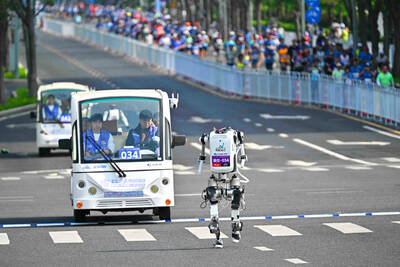
A humanoid robot that won a half-marathon race for robots in Beijing on Sunday ran faster than the human world record in a show of China’s technological leaps. The winner from Honor, a Chinese smartphone maker, completed the 21km race in 50 minutes and 26 seconds, said a WeChat post by the Beijing Economic-Technological Development Area, also known as Beijing E-Town, where the race began. That was faster than the human world record holder, Ugandan Jacob Kiplimo, who finished the same distance in about 57 minutes in March at the Lisbon road race. The performance by the robot marked a significant step forward

Four contenders are squaring up to succeed Antonio Guterres as secretary-general of the UN, which faces unprecedented global instability, wars and its own crushing budget crisis. Chile’s Michelle Bachelet, Argentina’s Rafael Grossi, Costa Rica’s Rebeca Grynspan and Senegal’s Macky Sall are each to face grillings by 193 member states and non-governmental organizations for three hours today and tomorrow. It is only the second time the UN has held a public question-and-answer, a format created in 2016 to boost transparency. Ultimately the five permanent members of the UN’s top body, the Security Council, hold the power, wielding vetoes over who leads the
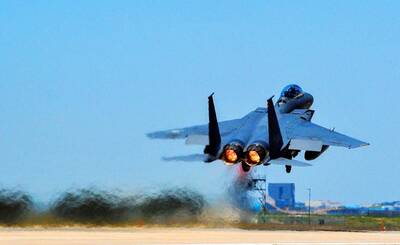
South Korea’s air force yesterday apologized for a 2021 midair collision involving two fighter jets, a day after auditors said the pilots were taking selfies and filming during the flight and held them responsible for the accident. “We sincerely apologize to the public for the concern caused by the accident that occurred in 2021,” an air force spokesman told a news conference, adding that one of the pilots involved had been suspended from flying duties, received severe disciplinary action and has since left the military. The apology followed a report released on Wednesday by the South Korean Board of Audit and Inspection,
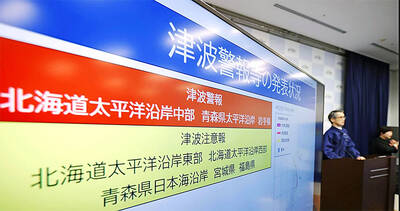
An earthquake registering a preliminary magnitude of 7.7 off northern Japan on Monday prompted a short-lived tsunami alert and the advisory of a higher risk of a possible mega-quake for coastal areas there. The Cabinet Office and the Japan Meteorological Agency said there was a 1% chance for a mega-quake, compared to a 0.1% chance during normal times, in the next week or so following the powerful quake near the Chishima and Japan trenches. Officials said the advisory was not a quake prediction but urged residents in 182 towns along the northeastern coasts to raise their preparedness while continuing their daily lives. Prime


 RSS
RSS