


The UN yesterday unveiled its largest-ever scientific assessment on the dire state of the environment, but a crucial summary of its findings was torpedoed as nations feuded over fossil fuels.
The dispute over the Global Environment Outlook echoes a growing trend in consensus-based negotiations where oil-producing countries in particular are frustrating efforts to address pollution from fossil fuels and plastic.
The UN Environment Programme (UNEP) said it was the first time that countries had failed to produce a politically negotiated summary of the mammoth report, which is published roughly every five years and involves hundreds of scientists.
Photo: Bloomberg
“It’s regrettable,” UNEP executive director Inger Andersen said, but added that “the integrity of the report” remained above question.
Since first being published in 1997, UNEP’s flagship outlook reports have been accompanied by a summary for policymakers: a political statement, negotiated line by line, that distils the science into plain language for governments.
Under UN rules, this can only be approved by consensus, as it serves as a collective understanding of the latest science in a way policy leaders can act upon.
However, at a five-day meeting in late October to approve the summary, sharp divisions over the text made consensus impossible. Major oil producers Saudi Arabia and the US opposed references to phasing out fossil fuels, which are used to make plastic, and when burned are the primary driver of climate change, according to minutes of the meeting seen by AFP.
Other countries disagreed with language on gender, conflict and environmentally harmful subsidies, among other flashpoint issues, the minutes showed.
In a joint statement read as the negotiations closed, the EU, the UK and several other nations criticized “diversion attempts” during the talks, but did not name any country by name.
“It’s always the same story,” a French diplomat said of the “difficult discussions” that took place at UNEP headquarters in Nairobi.
Andersen said several countries “had significant disagreements,” but defended their right to dissent.
The US “actually was quite quiet and only spoke at the very end” to indicate their opposition, she added.
“That is what makes the United Nations the United Nations, and so we arrived where we did. But we certainly would like to hope that that doesn’t set a precedence for other processes,” she said.
The report, “A Future We Choose,” spans more than 1,200 pages and makes the case that investing in a cleaner planet could deliver trillions of dollars each year in additional economic growth.
Key to this would be “a total transformation of our energy system,” said report co-chair Robert Watson, who has helmed the UN’s expert scientific panels on climate change and biodiversity.
“We clearly have to eliminate the use of fossil fuels over the coming decades,” the British scientist told reporters.
However, this issue has stalled politically since countries agreed at the UN climate summit in Dubai in 2023 to move away from coal, gas and oil.
In October, pressure from the US helped delay a vote on an emissions price on global shipping, while negotiations for a world-first plastic treaty collapsed in August under opposition from oil-producing nations.
Last month’s UN COP30 climate summit ended with a watered-down deal after dozens of countries, including Saudi Arabia and coal producer India, opposed calls to advance a fossil fuel phaseout.
Watson said the world was “not moving fast enough by any stretch of the imagination to become sustainable” and progressive governments would need to take the lead.
“As our report says, the cost of action is less than the cost of inaction. But I have to say at this moment in time, multilateralism does seem to be in trouble,” he said.


Through the noise of rushing papers and whirring belts at a print factory in Kyoto, two creators watch their photo essay come to life in broadsheet form — part of an effort to win new audiences in the age of artificial intelligence (AI). Despite the decline of the publishing industry, self-publication and handmade “zine” magazines are growing in popularity in Japan, reflecting the nation’s enduring love of paper in the digital era. While speaking to Agence France-Presse at the plant, his hands black with ink, one of the creators, Kazuma Obara, said: “I think [paper] is a medium that engages all five
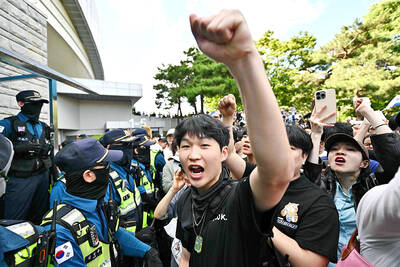
‘ABSURD MISTAKE’: The election commission said that there had been a failure to anticipate turnout after 14 polling stations ran short of ballot papers South Korean riot police yesterday cleared protesters from a Seoul polling station after a 35-hour blockade sparked by a shortage of ballot papers during local elections earlier this week. Wednesday’s election was the first nationwide vote since South Korean President Lee Jae-myung took office following the ouster of Yoon Suk-yeol over his short-lived martial law declaration. Lee’s ruling Democratic Party swept most races, but failed to flip the crucial Seoul mayoral seat. The South Korean National Election Commission apologized, blaming a failure to anticipate turnout after 14 polling stations in Seoul ran short of ballot papers. Some polling stations stayed open until 10pm to

France experienced its hottest spring on record, the French weather service said on Tuesday, after an exceptional early heat wave that also broke highs for the season in England and Wales. Meteo-France said the average nationwide temperature over March to May was 13.8°C — about 1.7°C above the norm, and surpassing records set in 2011 and 2020. “The warmest spring since records began in 1900,” it said in a bulletin. All three months were warmer than average, but the onset of an “unprecedented heatwave” late last month pushed the mercury to highs typically seen at the height of the summer. “Our country had never

A Sherpa guide was found crawling to base camp on Mount Everest a week after he went missing and was reunited with his family, who had given up hope he would return. Dawa Sherpa was last seen on Friday last week descending the mountain, but he did not reach base camp even though his client did. The pair were among the last climbers on the mountain as the climbing season came to an end and the route was dismantled. Dawa was located by a cleaning crew on Thursday morning as he was crawling down the snowy slopes around the Khumbu Icefall, just above


 RSS
RSS