


A senior North Korean diplomat on Monday reiterated at the UN that his country would not give up its nuclear weapons despite numerous international demands to do so, calling them crucial to keeping a “balance of power” with South Korea.
“We will never walk away from this position,” he said.
Under the spotlight of the UN General Assembly annual meeting of world leaders, North Korean Vice Minister of Foreign Affairs Kim Son-gyong amplified his nation’s longstanding complaints about US-led military exercises with South Korea and Japan.
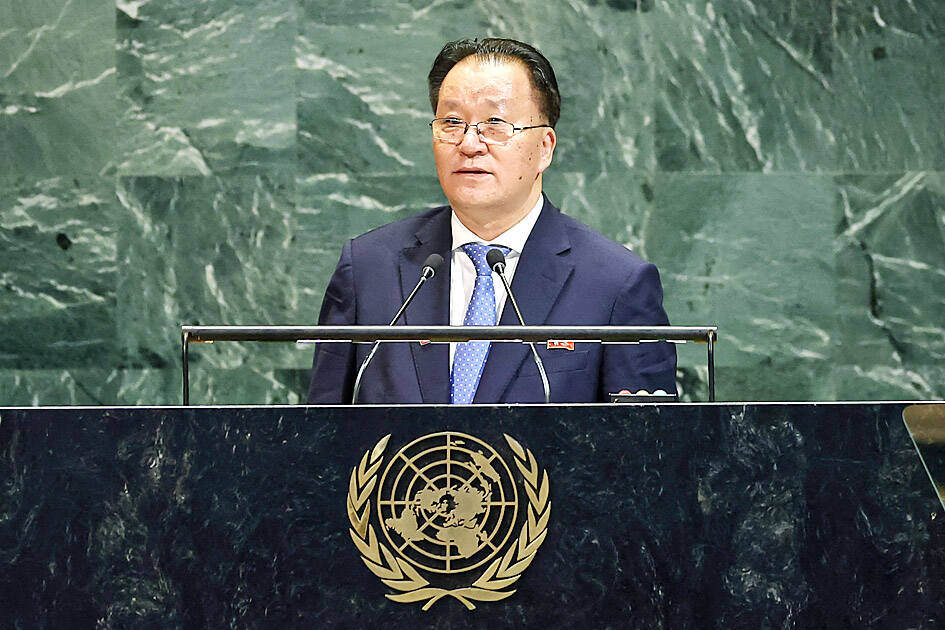
Photo: AFP
Complaining that the US and its allies are mounting a “growing threat of aggression,” he portrayed his own country’s arsenal as the reason “the balance of power on the Korean Peninsula is ensured.”
Still, his address was more tempered, especially toward the US, than many of his nation’s prior remarks on the world stage and elsewhere.
While Kim lambasted — without naming names — “hegemonic forces” and an “indiscriminate tariff war,” there were no direct references to US President Donald Trump or personal insults, and there was more sternness than over-the-top bellicosity.
Kim vowed that “we will never give up nuclear,” adding that North Korea’s nuclear program is enshrined in its constitution.
He asserted that security on the Korean Peninsula “is faced with serious challenges more than ever,” saying that the US-Japan-South Korea exercises “are breaking all the previous records in terms of scale, nature, frequency and scope.”
North Korea routinely characterizes such war games as preludes to an attack on the nation.
South Korea, for its part, has said trilateral military exercises were necessary to counter North Korea’s growing nuclear and missile threats. Numerous UN Security Council resolutions have demanded that North Korea stop building nuclear weapons and ballistic missiles, but South Korean President Lee Jae-myung told the high-level meeting last week that his new government “will begin a new journey toward peaceful coexistence and shared growth on the Korean Peninsula.”
“The first step will be to restore broken inter-Korean trust and shift to a stance of mutual respect,” Lee said.
North Korea’s Kim did not respond to that overture.
Kim’s appearance at the UN marked the first time since 2018 that North Korea sent a senior diplomat to the UN General Assembly gathering.
The UN “should not feel relieved, nor congratulate ourselves, on the non-occurrence of World War III for the past 80 years. Instead, we should pay due attention to the fact that the the inducible threat has persisted and is now becoming more serious, and take measures accordingly,” he said.
The diplomat’s appearance at the UN comes amid signs of renewed interest in a possible meeting between North Korean leader Kim Jong-un and Trump.
Trump and the North Korean leader met three times in 2018 and 2019 as Pyongyang was building a nuclear weapons stockpile, which Kim Jong-un views as key to the country’s security and his continued authority. The talks collapsed over US-led sanctions against North Korea, and its leader has since shunned any diplomacy with the US and South Korea.

Young Chinese, many who fear age discrimination in their workplace after turning 35, are increasingly starting “one-person companies” that have artificial intelligence (AI) do most of the work. Smaller start-ups are already in vogue in Silicon Valley and elsewhere, with rapidly advancing AI tools seen as a welcome teammate even as they threaten layoffs at existing firms. More young people in China are subscribing to the model, as cities pledge millions of dollars in funding and rent subsidies for such ventures, in alignment with Beijing’s political goal of “technological self-reliance.” “The one-person company is a product of the AI era,” said Karen Dai

South Korea’s air force yesterday apologized for a 2021 midair collision involving two fighter jets, a day after auditors said the pilots were taking selfies and filming during the flight and held them responsible for the accident. “We sincerely apologize to the public for the concern caused by the accident that occurred in 2021,” an air force spokesman told a news conference, adding that one of the pilots involved had been suspended from flying duties, received severe disciplinary action and has since left the military. The apology followed a report released on Wednesday by the South Korean Board of Audit and Inspection,

About 240 Indians claiming descent from a Biblical tribe landed at Tel Aviv airport on Thursday as part of a government operation to relocate them to Israel. The newcomers passed under a balloon arch in blue and white, the colors of the Israeli flag, as dozens of well-wishers welcomed them with a traditional Jewish song. They were the first “bnei Menashe” (“sons of Manasseh”) to arrive in Israel since the government in November last year announced funding for the immigration of about 6,000 members of the community from the states of Manipur and Mizoram in northeast India. The community claims to descend from

‘TROUBLING’: The firing of Phelan, who was an adviser to a nonprofit that supported the defense of Taiwan, was another example of ‘dysfunction’ under Trump, a US senator said US Secretary of the Navy John Phelan has been fired, a US official and a person familiar with the matter said on Wednesday, in another wartime shakeup at the Pentagon coming just weeks after US Secretary of Defense Pete Hegseth ousted the Army’s top general. The Pentagon announced his departure in a brief statement, saying he was leaving the administration “effective immediately,” but it did not provide a reason or say whether it was his decision to go. The sources, who spoke on condition of anonymity, said Phelan was dismissed in part because he was moving too slowly to implement reforms to


 RSS
RSS