


The pet of choice in Japan, as much as cuddly kitties and playful puppies, is the humble bug.
It has been a key part of Japanese culture from the Heian era classic The Tale of Genji to popular modern-day manga and animation such as Mushishi, featuring insect-like supernatural creatures.
Japanese appreciate the glitter of fireflies let loose in the garden or the gentle chirping of crickets kept in a little cage. You can feed the bug pets watermelon, but special jelly pet food is also available at stores. Naturally, bugs are on sale as well, with the more esoteric of them selling for ¥20,000 (US$135).
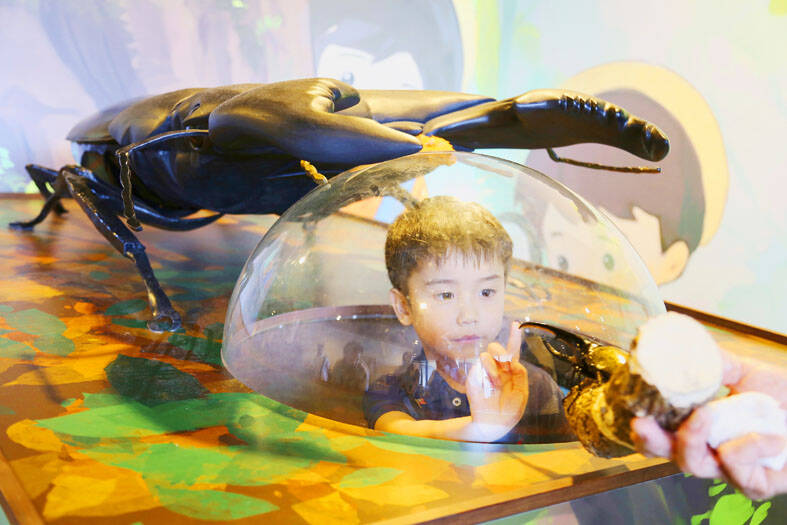
Photo: AP
In Japan, crawly and buzzing critters are not just relegated to the scientific realm of the entomologist working on a taxidermy of pinned butterflies. Celebrities boast about their fascination with bug-hunting as their hobbies just like a Western movie star might talk about their yacht or golf score.
The bug as companion is an essential part of what is observed, enjoyed and cared for in everyday life, reflecting a deeply rooted celebration of humankind’s oneness with nature.
“They are so tiny. If you catch and study them, you’re sure to discover something new,” said Munetoshi Maruyama, professor of bioenvironmental sciences at Kyushu University, whose fascination with bugs began as a child, like many Japanese. “They are so beautiful in shape and form.”
One thrill that comes from studying insects is discovering a new species, simply because there are more than 1.2 million known kinds of insects, far more than mammals, which translates to a lot of undiscovered ones, said Maruyama, who has discovered 250 new insect species himself and shrugs that off as a relatively small number.
Japan differs from much of the West in encouraging interaction with bugs from childhood, with lots of books written for children, as well as classes and tours.
“In Japan, kids love bugs. You can even buy a net at a convenience store,” he said. “It’s fantastic that bugs can serve as a doorway to science.”
That some insects go through metamorphoses, transforming from a larva to a butterfly adds to the excitement, allowing kids to observe the stages of a life span, he said.
Tracing the movement of bugs can be a way to study global warming, too, while “social insects,” such as bees and ants show intelligence in how they communicate, remember routes to find their way back to their nests or burrow elaborate underground paths as colonies.
The love affair with bugs was clear at an exhibit in Tokyo, aptly called “The Great Insect Exhibition,” running through the end of this month at the Sky Tree Tower, where crowds of children gathered around trees inside indoor cages so they could observe and touch the various beetles.
One kind of rhinoceros beetle known as Hercules, which originated in the Caribbean, but is now also found in Japan, is reputed to be the biggest beetle on record at 5cm to 8.5cm in length. Its back coat is a shiny khaki color, though such shades change depending on the season.
Four-year-old Asahi Yamauchi, who was at the exhibit with his grandmother and getting his photograph taken inside a special installation that made it look like he was inside a beetle, loves bugs as much as he loves dinosaurs and has what he called a cute beetle as a pet at home.
“My friend had one so I wanted one,” he said.


Through the noise of rushing papers and whirring belts at a print factory in Kyoto, two creators watch their photo essay come to life in broadsheet form — part of an effort to win new audiences in the age of artificial intelligence (AI). Despite the decline of the publishing industry, self-publication and handmade “zine” magazines are growing in popularity in Japan, reflecting the nation’s enduring love of paper in the digital era. While speaking to Agence France-Presse at the plant, his hands black with ink, one of the creators, Kazuma Obara, said: “I think [paper] is a medium that engages all five
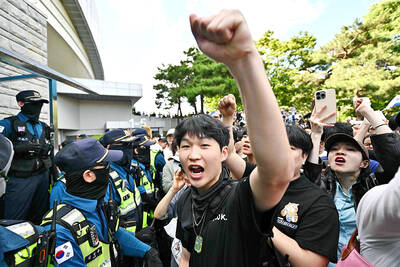
‘ABSURD MISTAKE’: The election commission said that there had been a failure to anticipate turnout after 14 polling stations ran short of ballot papers South Korean riot police yesterday cleared protesters from a Seoul polling station after a 35-hour blockade sparked by a shortage of ballot papers during local elections earlier this week. Wednesday’s election was the first nationwide vote since South Korean President Lee Jae-myung took office following the ouster of Yoon Suk-yeol over his short-lived martial law declaration. Lee’s ruling Democratic Party swept most races, but failed to flip the crucial Seoul mayoral seat. The South Korean National Election Commission apologized, blaming a failure to anticipate turnout after 14 polling stations in Seoul ran short of ballot papers. Some polling stations stayed open until 10pm to
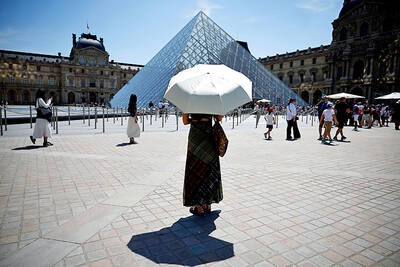
France experienced its hottest spring on record, the French weather service said on Tuesday, after an exceptional early heat wave that also broke highs for the season in England and Wales. Meteo-France said the average nationwide temperature over March to May was 13.8°C — about 1.7°C above the norm, and surpassing records set in 2011 and 2020. “The warmest spring since records began in 1900,” it said in a bulletin. All three months were warmer than average, but the onset of an “unprecedented heatwave” late last month pushed the mercury to highs typically seen at the height of the summer. “Our country had never

A Sherpa guide was found crawling to base camp on Mount Everest a week after he went missing and was reunited with his family, who had given up hope he would return. Dawa Sherpa was last seen on Friday last week descending the mountain, but he did not reach base camp even though his client did. The pair were among the last climbers on the mountain as the climbing season came to an end and the route was dismantled. Dawa was located by a cleaning crew on Thursday morning as he was crawling down the snowy slopes around the Khumbu Icefall, just above


 RSS
RSS