


Fired by France’s imminent recognition of Palestinian statehood, UN members meet next week to breathe life into the push for a two-state solution, as Israel, expected to be absent, presses its war in Gaza.
Days before the conference tomorrow until Wednesday on fostering Israeli and Palestinian states living peacefully side-by-side to be cochaired by Riyadh and Paris, French President Emmanuel Macron announced that France would formally recognize the State of Palestine in September.
His declaration “will breathe new life into a conference that seemed destined to irrelevance,” International Crisis Group analyst Richard Gowan said.
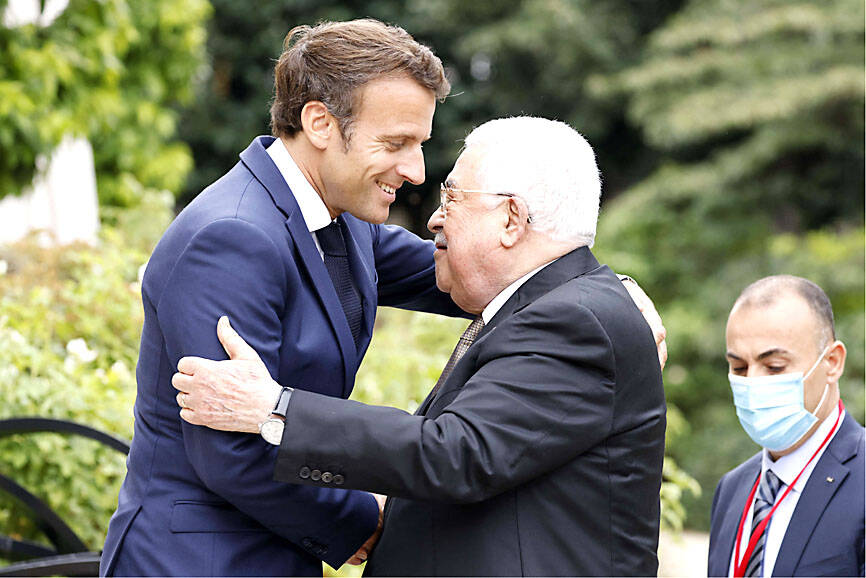
Photo: AFP
“Macron’s announcement changes the game. Other participants will be scrabbling to decide if they should also declare an intent to recognize Palestine,” he said.
According to an AFP database, at least 142 of the 193 UN member states — including France — now recognize the Palestinian state proclaimed by the Palestinian leadership in exile in 1988.
In 1947, a resolution of the UN General Assembly decided on the partition of Palestine, then under a British mandate, into two independent states — one Jewish and the other Arab. The following year, the State of Israel was proclaimed, and for several decades, the vast majority of UN member states have supported the idea of a two-state solution: Israeli and Palestinian, living side-by-side peacefully and securely.
However, after more than 21 months of war in Gaza, the ongoing expansion of Israeli settlements in the West Bank and senior Israeli officials declaring designs to annex occupied territory, it is feared a Palestinian state could be geographically impossible.
The war in Gaza started following a deadly attack by Hamas on Israel, which responded with a large-scale military response that has claimed tens of thousands of Palestinian lives.
The conference is a response to the crisis, with Palestinian Prime Minister Mohammad Mustafa and several dozen ministers from around the world expected to attend.
The meeting comes as a two-state solution is “more threatened than it has ever been [but] even more necessary than before, because we see very clearly that there is no alternative,” a French diplomatic source said.
Beyond facilitating conditions for recognition of a Palestinian state, the meeting would have three other focuses — reform of the Palestinian Authority, disarmament of Hamas and its exclusion from Palestinian public life, and normalization of relations with Israel by Arab states that have not yet done so.
The diplomatic source warned that no announcement of new normalization deals was expected next week.
Ahead of the conference, the UK said it would not recognize a Palestinian state unilaterally and would wait for “a wider plan” for peace in the region.
Macron has also not yet persuaded Germany to follow suit in recognizing a Palestinian state.
The conference “offers a unique opportunity to transform international law and the international consensus into an achievable plan, and to demonstrate resolve to end the occupation and conflict once and for all, for the benefit of all peoples,” Palestinian Ambassador to the UN Riyad Mansour said, calling for “courage” from participants.
Israel and the US would not take part in the meeting.
Embassy spokesman Jonathan Harounoff quoted Israeli Ambassador to the UN Danny Danon as saying that “Israel will not be taking part in this conference, which doesn’t first urgently address the issue of condemning Hamas and returning all of the remaining hostages.”
As international pressure continues to mount on Israel to end nearly two years of war in Gaza, the humanitarian catastrophe in the ravaged coastal territory is expected to dominate speeches by representatives of more than 100 countries as they take to the podium during the conference.
Gowan said he expected “very fierce criticism of Israel.”

SPEAKING OUT: After Siranudh Scott’s allegations surfaced, celebrities and public figures took to social media to share their own experiences of sexual misconduct and abuse A high-profile alleged sexual abuse case within a wealthy Thai beer brewing family has prompted a wave of painful accounts from survivors of unconnected abuse in the conservative nation. Siranudh Scott, a member of the billionaire Thai family that founded the ubiquitous Singha beer brand, posted an emotional video this month accusing his elder brother Sunit of repeatedly abusing him when he was a teenager. Sunit, who is in his 30s, later denied the allegations in a video posted online, but Singha parent Boonrawd dismissed him from his executive role with the company on Tuesday last week. “I felt I needed to speak

A Hong Kong astronaut is to join a Chinese space mission for the first time as part of a three-person crew launching today, as Beijing edges closer to its goal of landing people on the moon. The Tiangong space station — crewed by teams of three astronauts that are typically rotated every six months — is the crown jewel of China’s space program, boosted by billions in state investment in a bid to catch up with the US and Russia. The Shenzhou-23 mission is to blast off at 11:08pm from the Jiuquan Satellite Launch Center in northwestern China, carrying three astronauts to

UPGRADED ALERT: The risk inside DR Congo is now considered ‘very high,’ while neighboring countries face a ‘high’ threat as the outbreak continues, the WHO said Ebola is spreading faster than responders can track it in eastern Congo, where health workers managed to follow up with barely one in five identified contacts in a single day. Authorities in the Democratic Republic of the Congo (DR Congo) reported 83 confirmed infections, 746 suspected cases and 1,603 identified contacts as of Thursday, but health workers were able to follow up on only 342 contacts that day — about 21 percent of the total under monitoring — data released by the DR Congo Ministry of Public Health on Friday showed. The figures suggest the response is falling behind the outbreak itself,

SEEKING ORDER: Rodrigo Paz said that ‘anyone who wants to destroy the nation will have to deal with this president and the full force of the constitution’ Bolivian President Rodrigo Paz on Wednesday said that the nation was at a “breaking point” after nearly a month of protests that have caused shortages of food, fuel and medicine. Paz, who took office six months ago amid the worst economic crisis there in four decades, is battling a groundswell of fury over his policies. The political capital, La Paz, has been besieged by low-income workers and members of the indigenous majority calling for his resignation. “The country needs order and is reaching breaking point,” the 58-year-old said at a public event in La Paz, renewing his appeal for dialogue. On Tuesday, the Bolivian


 RSS
RSS