


Belarus freed top opposition figure Sergei Tikhanovsky and more than a dozen other political prisoners on Saturday following an appeal from the White House, Minsk said, a sign of warming ties between Washington and Belarus-ally Moscow.
The release came just hours after US Special Envoy for Ukraine Keith Kellogg met Belarusian President Alexander Lukashenko in Minsk, the highest-profile visit of a US official to the authoritarian state in years.
Tikhanovsky’s wife, Svetlana Tikhanovskaya — who took the mantle of the opposition movement after her husband’s jailing — thanked US President Donald Trump directly for brokering the deal.
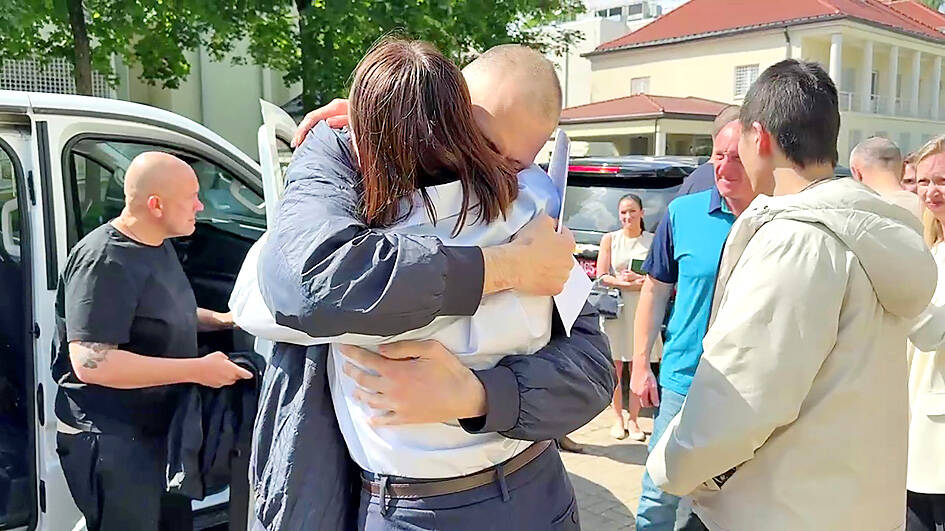
Photo: EPA-EFE
European politicians and members of Belarus’ exiled opposition also welcomed the news.
“This is fantastic news and a powerful symbol of hope for all the political prisoners suffering under the brutal Lukashenka regime,” European Commission President Ursula von der Leyen wrote on social media. “Europe continues to call for their immediate release.”
Polish Minister of Foreign Affairs Radoslaw Sikorski expressed his “sincerest joy,” while Latvian President Edgars Rinkevics called Tikhanovsky’s freedom a “much awaited and long overdue moment.”
German Minister of Foreign Affairs Johann Wadephul on social media wrote that Tikhanovsky’s release was “fantastically good news.”
“At the same time, we must not forget the many other prisoners in Belarus. Lukashenko must finally release them,” he added.
Pavel Latushko, a former culture minister in Belarus who supported the 2020 protests against Lukashenko, also hailed Tikhanovsky’s release as an “important moment.”
Tikhanovsky, 46, had been imprisoned for more than five years.
The popular Youtuber had planned to run against Lukashenko in the August 2020 presidential election, but was arrested and detained weeks before the vote.
He was sentenced in 2021 to 18 years in prison for “organizing riots” and “inciting hatred,” then to another 18 months for “insubordination.”
Svetlana — a political novice at the time of her husband’s arrest — ran against Lukashenko in his place, but lost after what the opposition described as widespread falsification. She later fled Belarus.
“It’s hard to describe the joy in my heart,” she wrote on social media following her husband’s release.
Among the 13 others freed were Radio Liberty journalist Igor Karnei, arrested in 2023 and jailed for participating in an “extremist” organization.
They have now been transferred from Belarus to Lithuania, where they were receiving “proper care,” Lithuanian Minister of Foreign Affairs Kestutis Budrys said.
Although none of the released prisoners needed emergency medical assistance, “one of them needed emergency medical attention,” as “they were imprisoned in difficult conditions,” Budrys told the LRT public broadcaster, without elaborating.
Swedish-Belarusian citizen Galina Krasnyanskaya, arrested in 2023 for allegedly supporting Ukraine, was also freed, Swedish Prime Minister Ulf Kristersson said.
Belarus, ruled by Lukashenko since 1994, has outlawed all genuine opposition parties. It is the only European country to retain the death penalty as a punishment.
The eastern European country still holds more than 1,000 political prisoners in its jails, according to Belarusian human rights group Viasna.
Lukashenko’s spokeswoman said the Belarusian leader had ordered the release of the prisoners on Trump’s “request,” Russian state media reported.
The US leader appeared to take credit, writing “Thank you President Trump!” on social media, alongside a link to a news story about the prisoner release.
Since taking office, Trump has engaged in direct talks with Russian President Vladimir Putin, ending his predecessor’s policy of isolation.
The two nuclear powers have since worked to normalize diplomatic ties, which have for years lingered at their lowest point since the Cold War.
Tikhanovsky was for years held incommunicado, and in 2023 his wife was told that he had “died.”
In a video published by Viasna on Saturday, he appeared almost unrecognizable, his head shaven and face emaciated.

SPEAKING OUT: After Siranudh Scott’s allegations surfaced, celebrities and public figures took to social media to share their own experiences of sexual misconduct and abuse A high-profile alleged sexual abuse case within a wealthy Thai beer brewing family has prompted a wave of painful accounts from survivors of unconnected abuse in the conservative nation. Siranudh Scott, a member of the billionaire Thai family that founded the ubiquitous Singha beer brand, posted an emotional video this month accusing his elder brother Sunit of repeatedly abusing him when he was a teenager. Sunit, who is in his 30s, later denied the allegations in a video posted online, but Singha parent Boonrawd dismissed him from his executive role with the company on Tuesday last week. “I felt I needed to speak

SEEKING ORDER: Rodrigo Paz said that ‘anyone who wants to destroy the nation will have to deal with this president and the full force of the constitution’ Bolivian President Rodrigo Paz on Wednesday said that the nation was at a “breaking point” after nearly a month of protests that have caused shortages of food, fuel and medicine. Paz, who took office six months ago amid the worst economic crisis there in four decades, is battling a groundswell of fury over his policies. The political capital, La Paz, has been besieged by low-income workers and members of the indigenous majority calling for his resignation. “The country needs order and is reaching breaking point,” the 58-year-old said at a public event in La Paz, renewing his appeal for dialogue. On Tuesday, the Bolivian

A Hong Kong astronaut is to join a Chinese space mission for the first time as part of a three-person crew launching today, as Beijing edges closer to its goal of landing people on the moon. The Tiangong space station — crewed by teams of three astronauts that are typically rotated every six months — is the crown jewel of China’s space program, boosted by billions in state investment in a bid to catch up with the US and Russia. The Shenzhou-23 mission is to blast off at 11:08pm from the Jiuquan Satellite Launch Center in northwestern China, carrying three astronauts to
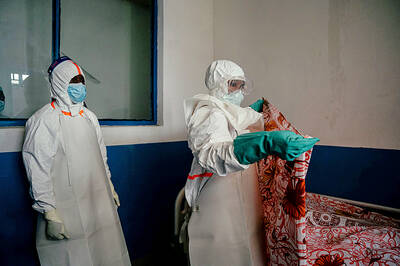
UPGRADED ALERT: The risk inside DR Congo is now considered ‘very high,’ while neighboring countries face a ‘high’ threat as the outbreak continues, the WHO said Ebola is spreading faster than responders can track it in eastern Congo, where health workers managed to follow up with barely one in five identified contacts in a single day. Authorities in the Democratic Republic of the Congo (DR Congo) reported 83 confirmed infections, 746 suspected cases and 1,603 identified contacts as of Thursday, but health workers were able to follow up on only 342 contacts that day — about 21 percent of the total under monitoring — data released by the DR Congo Ministry of Public Health on Friday showed. The figures suggest the response is falling behind the outbreak itself,


 RSS
RSS