

Teachers in Hong Kong have been warned to keep themselves and students away from any US Independence Day celebrations as they might breach national security laws, educators have said.
A text message purportedly sent by the principal of a Hong Kong school to staff said the education bureau’s regional education office had reminded them “to be careful about Independence Day activities organized by the US consulate in Hong Kong, and not to participate to avoid violating the national security law and Hong Kong laws.”
The text was published on Edu Lancet, a Facebook page run by a former manager at the Hong Kong Examinations and Assessment Authority, Hans Yeung. It urged staff to be diligent in “protecting” any students who were considering participating, and to discourage them.

Photo: AFP
Another e-mail shared on Edu Lancet told faculty staff that any teacher who received an invitation from an embassy or a foreign organization funded by an embassy must seek permission to attend from the principal for the purpose of “maintaining national security.”
The Hong Kong Education Bureau in a statement said it had enacted policies to help schools “effectively prevent and suppress acts and activities that endanger or are detrimental to national security.”
“Schools have the responsibility to play a good gatekeeper role and to enhance the sensitivity of teachers and students to national security,” it said.
The bureau had enacted “clear guidelines” for schools that required them to “establish school-based mechanisms and formulate appropriate measures, according to their own circumstances and needs, to implement various tasks related to safeguarding national security and national security education,” it added.
The bureau did not answer questions about what laws would be broken by attending any Fourth of July event, or whether such warnings only applied to the US holiday.
Edu Lancet and Yeung, who runs the page to voice concerns from those working with the education system and “expose the current problems,” have been criticized by the Hong Kong government for their posts.
Hong Kong Secretary for Security Chris Tang (鄧炳強) has said Yeung was “making incitements” from his current home in the UK.
The purported directives fit in with tightening restrictions on Hong Kong’s education system, and a push to have the curriculum focus more on national security.
In 2020, then-Hong Kong chief executive Carrie Lam (林鄭月娥) blamed the education system for fueling the pro-democracy protests that rocked the city in 2019, setting the tone for an overhaul that is ongoing.
The Hong Kong government has since altered the school curriculum to include teachings on national security in subjects such as English language, music, math and sports, and to focus more on patriotic education.
It has also banned texts it sees as endangering national security and prosecuted authors.
Teachers in Hong Kong have previously said they felt pressure to self-censor for fear of being reported for remarks seen as unpatriotic.
Since the start of the 2023 to 2024 school year, all new teachers in public sector schools, direct subsidy scheme schools and kindergartens are required to sit an exam on Hong Kong’s mini constitution, the Basic Law, and the national security law.
Hong Kong Secretary for Education Christine Choi Yuk-lin (蔡若蓮) has repeatedly warned of “soft resistance” in schools, and this month said educators had to be vigilant against the infiltration of “hostile forces” through events such as book fairs and extracurricular activities, which “could include undesirable reading materials.”
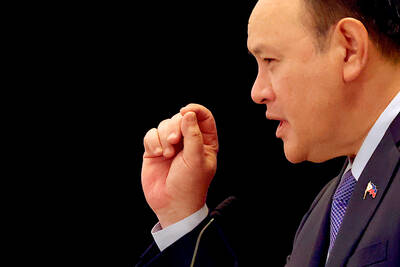
Philippine Secretary of National Defense Gilberto Teodoro Jr on Tuesday hit out at China at an international forum after a memo asserting Beijing’s position over their longstanding maritime dispute was delivered to him while he was speaking on stage. The unusual incident was captured on video at the Seoul Defense Dialogue as the secretary was responding to a question about “gray zone” coercion in the South China Sea. The video shows what appears to be a conference staffer placing it on the table next to him while speaking. “I have a note here, I think this is from China,” he said, describing

PAINSTAKING PROCESS: Ice makers freeze water for up to 72 hours, replace tainted water with a fresh batch once freezing begins, and are constantly stirring In the historic Japanese city of Kanazawa, craftsmen painstakingly shape and slice blocks of ice destined to chill negronis in some of the world’s trendiest bars. The men work for Kuramoto Ice, a century-old company in Ishikawa on the Sea of Japan coast and one of dozens of Japanese firms producing ultra-clear, premium ice. This luxury product, believed by those in the industry to melt more slowly than regular blocks, is a staple of Japan’s cocktail culture, but its popularity is also spilling over to bars abroad, from the US to Australia, who pay as much as ¥200 (US$1.28) per cube. Kuramoto Ice
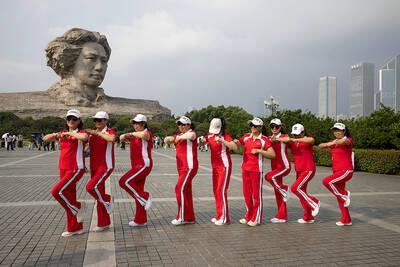
China yesterday marked half a century since the death of Mao Zedong (毛澤東), founder of the People’s Republic, who brought roughly one-quarter of the world’s population under communist rule and whose specter still haunts China’s future. Mao’s death on Sept. 9, 1976, at age 82, mourned by many and welcomed by some who suffered under his nearly three-decade rule, also hastened the end of the Cultural Revolution, a frenzied mass movement he launched in 1966. The party later condemned the Cultural Revolution as a grave error for which Mao bore primary responsibility, but still reveres him, saying his achievements outweigh his mistakes. Mao’s
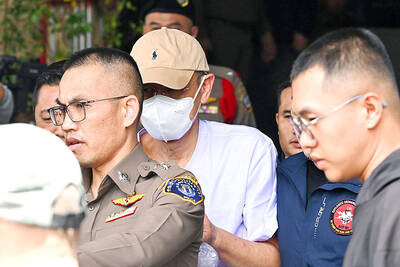
Thai police yesterday said that they arrested a senior Buddhist monk on suspicion of embezzling US$2.8 million intended for his monastery, alongside a suspected female accomplice he was having sex with. The case is the latest scandal to hit the clergy in Buddhist-majority Thailand after a sex and extortion case involving senior monks last year prompted public outrage and calls for greater scrutiny of temple finances. Phra Wachirayan Wi, the 66-year-old abbot of the 14th-century Wat Phutthaisawan in the ancient capital of Ayutthaya, was arrested on Thursday on charges including embezzlement and money laundering, lead police investigator Pattanasak Bupphasuwan said. A 47-year-old woman


 RSS
RSS