


A Beijing auction house on Tuesday sold a human-sized Labubu figure for 1.08 million yuan (US$150,260), setting a new record for the “blind box” toy as it moves from craze to collectible.
The event held by Yongle International Auction, which traditionally specializes in modern art as well as jewelry, marked the first-ever auction dedicated to Labubu, toothy monster figurines that are mainly sold by Chinese toy company Pop Mart and have been at the center of a global frenzy for the past year.
The auction offered 48 lots for sale and was attended in person by about 200 people, while more than 1,000 bidders put down offers via Yongle’s mobile app, the auction house said.
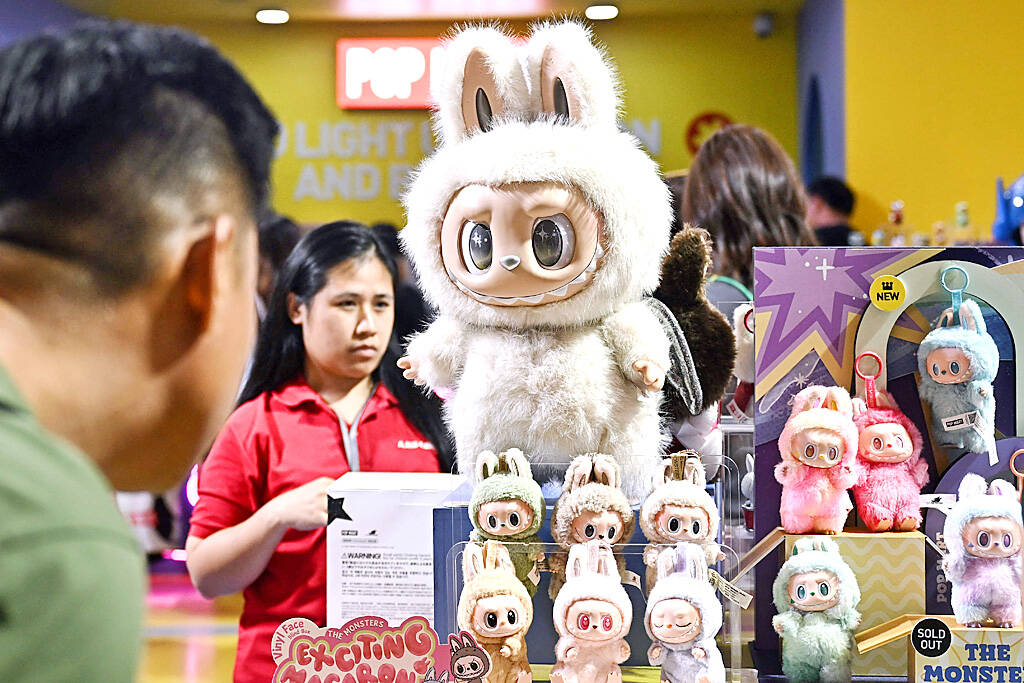
Photo: AFP
The starting price for all the items was zero, while the lots sold for a combined 3.73 million yuan.
The highest grossing item, a mint green, 1.31m-tall Labubu figure, received several bids to sell for 1.08 million yuan.
The auctioneer said it was the only one available in the world.
A set of three Labubu sculptures, about 40cm tall and made of PVC material, sold for 510,000 yuan.
The set, from a series called “Three Wise Labubu,” was limited to a run of 120 sets in 2017 and another one sold for HK$203,200 (US$25,888) at Sotheby’s most recent auction in Hong Kong.
Labubu was created a decade ago by Hong Kong artist and illustrator Kasing Lung (龍家昇). In 2019, Lung agreed to let them be sold by Pop Mart, which markets collectable figurines often sold in “blind boxes.”
A buyer of a blind box toy does not know exactly what design they will receive until they open it.
The starting price for Labubu blind box toys sold in Pop Mart’s stores is about 50 yuan.
The character’s popularity skyrocketed after Lisa of the South Korean pop music group Blackpink was spotted with a Labubu, and praised the doll in interviews and online posts.
Many celebrities followed. In May, British soccer star David Beckham shared a photograph on Instagram of his Labubu attached to a bag.

‘CROSSING THE LINE’: China’s embassy in Seoul criticized US Forces Korea Commander General Xavier Brunson, asking if his ‘hostile’ remarks were authorized by Washington South Korea and the US are in talks over recent public remarks by the commander of US Forces Korea, Seoul’s presidential office said yesterday, after the comments drew sharp criticism from China. In a recent podcast interview, US Forces Korea Commander General Xavier Brunson described South Korea as “the dagger in the heart of Asia” from China’s east coast, prompting the Chinese embassy in Seoul to say that he had “truly crossed the line.” The interview came amid growing speculation that Washington might seek to expand the role of US Forces Korea in countering the growing regional influence of China, a key

SEEKING ORDER: Rodrigo Paz said that ‘anyone who wants to destroy the nation will have to deal with this president and the full force of the constitution’ Bolivian President Rodrigo Paz on Wednesday said that the nation was at a “breaking point” after nearly a month of protests that have caused shortages of food, fuel and medicine. Paz, who took office six months ago amid the worst economic crisis there in four decades, is battling a groundswell of fury over his policies. The political capital, La Paz, has been besieged by low-income workers and members of the indigenous majority calling for his resignation. “The country needs order and is reaching breaking point,” the 58-year-old said at a public event in La Paz, renewing his appeal for dialogue. On Tuesday, the Bolivian

Australian researchers have trained lab-grown brain cells on a silicon computer chip to play the 1990s shooter game Doom and said they are just scratching the surface of what the neurons could be capable of doing. It is the science-fiction work of biotech boffins at Cortical Labs, who researched and developed the technology that harnesses the workings of the brain’s networking system. Each so-called “biological computer” contains about 200,000 living human brain cells, grown from stem cells that were harvested from blood donations. Having mastered the simple computer game Pong, where a paddle is moved up and down to send a ball

Through the noise of rushing papers and whirring belts at a print factory in Kyoto, two creators watch their photo essay come to life in broadsheet form — part of an effort to win new audiences in the age of artificial intelligence (AI). Despite the decline of the publishing industry, self-publication and handmade “zine” magazines are growing in popularity in Japan, reflecting the nation’s enduring love of paper in the digital era. While speaking to Agence France-Presse at the plant, his hands black with ink, one of the creators, Kazuma Obara, said: “I think [paper] is a medium that engages all five


 RSS
RSS