


Prominent Hong Kong democracy advocate Joshua Wong (黃之鋒) yesterday was charged with conspiracy to collude with foreign forces to endanger national security under a Beijing-imposed law that critics say has crushed Hong Kong’s once-thriving pro-democracy movement.
The prosecution was the second time Wong had been charged under the sweeping National Security Law. He was already convicted in a separate subversion case linked to an unofficial primary election and is serving a sentence of four years and eight months.
The prosecution accused Wong, 28, of conspiring with fellow activist Nathan Law (羅冠聰) and others to ask foreign countries, institutions, organizations and individuals outside of China to impose sanctions or blockades, or engage in other hostile actions, against Hong Kong and China.
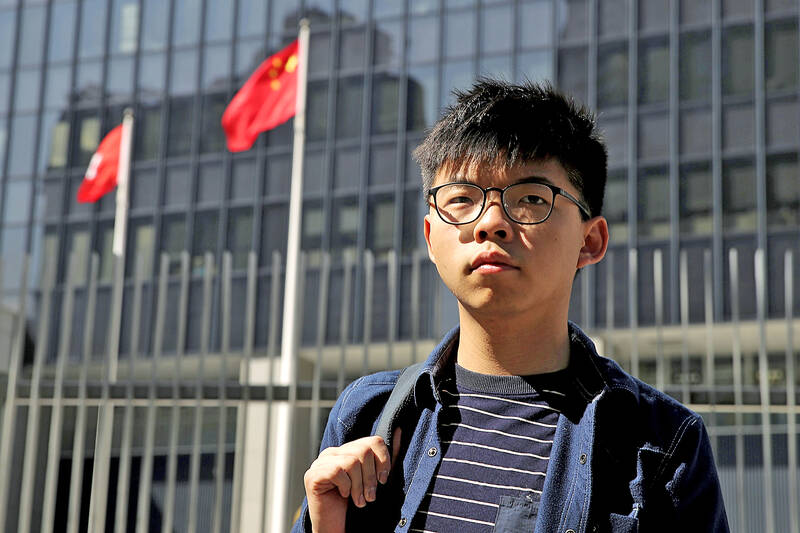
Photo: AP
They also said he disrupted the formulation and implementation of laws and policies by the Chinese and Hong Kong governments, and that the act was likely to have serious consequences. The alleged offense occurred between July 2020 and November 2020.
The prosecution did not elaborate on the accusations in court. The charge carries a maximum penalty of life imprisonment.
After hearing the charge in court, Wong, who wore a blue shirt and was visibly thinner, said he “understood” the charge.
The case was adjourned to August.
National security police arrested Wong in Stanley, an area in southern Hong Kong, over the national security charge and also on suspicion of “dealing with property known or believed to represent proceeds of indictable offense,” police said in a statement.
Wong rose to fame in Hong Kong in 2012 as a 14-year-old high-school student leading protests against the introduction of national education in the territory’s schools. Two years later, he became world-famous as a leader of the Occupy Movement.
In 2016, Wong cofounded a political party named “Demosisto” with fellow young activists Law and Agnes Chow (周庭). In the 2019 pro-democracy movement, Wong helped seek overseas support for the protests. His activism led Beijing to label him an advocate of Hong Kong’s independence who “begged for interference” by foreign forces.
Demosisto disbanded when Beijing imposed the security law in 2020. The Chinese and Hong Kong governments said the law brought back stability to the territory.

Through the noise of rushing papers and whirring belts at a print factory in Kyoto, two creators watch their photo essay come to life in broadsheet form — part of an effort to win new audiences in the age of artificial intelligence (AI). Despite the decline of the publishing industry, self-publication and handmade “zine” magazines are growing in popularity in Japan, reflecting the nation’s enduring love of paper in the digital era. While speaking to Agence France-Presse at the plant, his hands black with ink, one of the creators, Kazuma Obara, said: “I think [paper] is a medium that engages all five

‘CROSSING THE LINE’: China’s embassy in Seoul criticized US Forces Korea Commander General Xavier Brunson, asking if his ‘hostile’ remarks were authorized by Washington South Korea and the US are in talks over recent public remarks by the commander of US Forces Korea, Seoul’s presidential office said yesterday, after the comments drew sharp criticism from China. In a recent podcast interview, US Forces Korea Commander General Xavier Brunson described South Korea as “the dagger in the heart of Asia” from China’s east coast, prompting the Chinese embassy in Seoul to say that he had “truly crossed the line.” The interview came amid growing speculation that Washington might seek to expand the role of US Forces Korea in countering the growing regional influence of China, a key

Australian researchers have trained lab-grown brain cells on a silicon computer chip to play the 1990s shooter game Doom and said they are just scratching the surface of what the neurons could be capable of doing. It is the science-fiction work of biotech boffins at Cortical Labs, who researched and developed the technology that harnesses the workings of the brain’s networking system. Each so-called “biological computer” contains about 200,000 living human brain cells, grown from stem cells that were harvested from blood donations. Having mastered the simple computer game Pong, where a paddle is moved up and down to send a ball
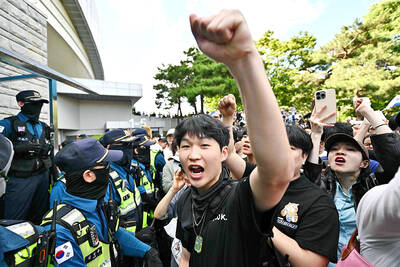
‘ABSURD MISTAKE’: The election commission said that there had been a failure to anticipate turnout after 14 polling stations ran short of ballot papers South Korean riot police yesterday cleared protesters from a Seoul polling station after a 35-hour blockade sparked by a shortage of ballot papers during local elections earlier this week. Wednesday’s election was the first nationwide vote since South Korean President Lee Jae-myung took office following the ouster of Yoon Suk-yeol over his short-lived martial law declaration. Lee’s ruling Democratic Party swept most races, but failed to flip the crucial Seoul mayoral seat. The South Korean National Election Commission apologized, blaming a failure to anticipate turnout after 14 polling stations in Seoul ran short of ballot papers. Some polling stations stayed open until 10pm to


 RSS
RSS