


Astronomers yesterday announced that they had detected the most promising “hints” of potential life on a planet beyond our solar system, although other scientists expressed skepticism.
There has been debate in scientific circles about whether the planet K2-18b, which is 124 light-years away in the Leo constellation, could be an ocean world capable of hosting microbial life.
Using the James Webb Space Telescope, a British-US team of researchers detected signs of two chemicals in the planet’s atmosphere long considered to be “biosignatures” indicating extraterrestrial life.
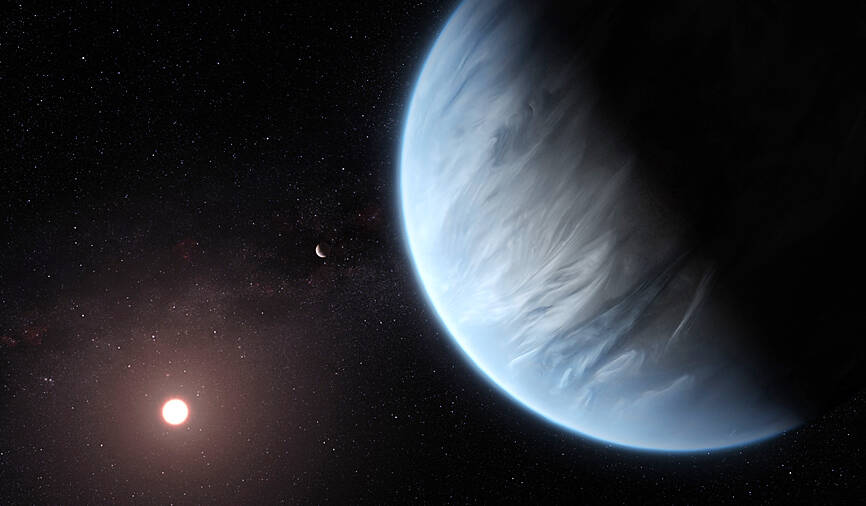
An artist’s impression released on Sept. 11, 2019, by the European Space Agency and Hubble depicts the K2-18b exoplanet, right, orbiting its sun.
On Earth, the chemicals dimethyl sulfide (DMS) and dimethyl disulfide are produced only by life, mostly microscopic marine algae called phytoplankton.
The researchers emphasized caution, saying that more observations were needed to confirm the findings and that they were not announcing a definitive discovery.
However, the implications could be huge, said Nikku Madhusudhan, a University of Cambridge astrophysicist and lead author of the study published in The Astrophysical Journal Letters.
“What we are finding at this point are hints of possible biological activity outside the solar system,” Madhusudhan told a news conference. “Frankly, I think this is the closest we have come to seeing a feature that we can attribute to life.”
However, outside experts pointed to disputes over previous discoveries about the exoplanet, adding that the chemicals could have been created by unknown means having nothing to do with life.
More than eight times the mass of Earth and 2.5 times as big, K2-18b is a rare exoplanet that orbits its star in a habitable or “goldilocks” zone.
This means it is neither too hot nor too cold to have liquid water, considered the most important ingredient for life.
Telescopes observe such far-off exoplanets when they cross in front of their star, allowing astronomers to analyze how molecules block the light streaming through their atmosphere.
In 2023, the Webb telescope detected methane and carbon dioxide in K2-18b’s atmosphere, the first time such carbon-based molecules were detected on an exoplanet in a habitable zone.
It also detected weak signals of DMS, leading astronomers to turn Webb toward the planet again a year ago, this time using its mid-infrared instrument to detect different wavelengths of light.
They found much stronger signs of the chemicals, although still well below the “five sigma” threshold of statistical significance scientists seek for such discoveries.
Even if the results are confirmed, it would not necessarily mean that the planet is home to life.
Last year, scientists found traces of DMS on a comet, which suggested it can be produced in non-organic ways.
However the concentration of the chemical observed on K2-18b appears to be thousands of times stronger than levels on Earth, strongly suggesting a biological origin, Madhusudhan said.
K2-18b has long been considered the premier candidate for a “hycean planet” — an ocean world bigger than Earth with a hydrogen-rich atmosphere.
These planets would not be expected to be home to intelligent alien life, but rather tiny microbes.

Four contenders are squaring up to succeed Antonio Guterres as secretary-general of the UN, which faces unprecedented global instability, wars and its own crushing budget crisis. Chile’s Michelle Bachelet, Argentina’s Rafael Grossi, Costa Rica’s Rebeca Grynspan and Senegal’s Macky Sall are each to face grillings by 193 member states and non-governmental organizations for three hours today and tomorrow. It is only the second time the UN has held a public question-and-answer, a format created in 2016 to boost transparency. Ultimately the five permanent members of the UN’s top body, the Security Council, hold the power, wielding vetoes over who leads the

A humanoid robot that won a half-marathon race for robots in Beijing on Sunday ran faster than the human world record in a show of China’s technological leaps. The winner from Honor, a Chinese smartphone maker, completed the 21km race in 50 minutes and 26 seconds, said a WeChat post by the Beijing Economic-Technological Development Area, also known as Beijing E-Town, where the race began. That was faster than the human world record holder, Ugandan Jacob Kiplimo, who finished the same distance in about 57 minutes in March at the Lisbon road race. The performance by the robot marked a significant step forward
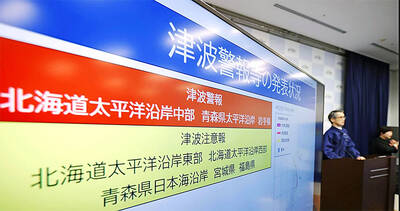
An earthquake registering a preliminary magnitude of 7.7 off northern Japan on Monday prompted a short-lived tsunami alert and the advisory of a higher risk of a possible mega-quake for coastal areas there. The Cabinet Office and the Japan Meteorological Agency said there was a 1% chance for a mega-quake, compared to a 0.1% chance during normal times, in the next week or so following the powerful quake near the Chishima and Japan trenches. Officials said the advisory was not a quake prediction but urged residents in 182 towns along the northeastern coasts to raise their preparedness while continuing their daily lives. Prime
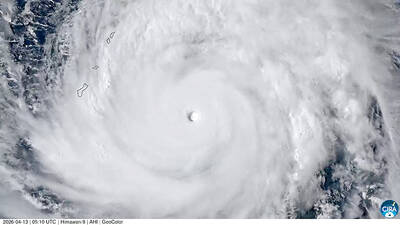
HAZARDOUS CONDITION: The typhoon’s sheer size, with winds extending 443km from its center, slowed down the ability of responders to help communities, an official said The US Coast Guard was searching for six people after losing contact with their disabled boat off the coast of Guam following Typhoon Sinlaku. The crew of the 44m dry cargo vessel, the US-registered Mariana, on Wednesday notified the coast guard that the boat had lost its starboard engine and needed assistance, Petty Officer 3rd Class Avery Tibbets said yesterday. The coast guard set up a one-hour communication schedule with the vessel, but lost contact on Thursday. A Coast Guard HC-130 Hercules aircraft was launched to search for the six people on board, but it had to return to Guam because of


 RSS
RSS