


Sweden is getting up a head of steam for what could be a record number of Eurovision wins this year with a humorous sauna act.
KAJ, a comedy group more accustomed to playing birthday parties than large arena shows, is already the bookies’ favorite to triumph at the extravaganza in Basel, Switzerland, on May 17.
With their song Bara Bada Bastu (Just Have a Sauna), the Finnish trio pay homage to sauna culture, clad in brown suits and accompanied by an accordion in a wink to Finland’s other big cultural phenomenon, the tango.

Photo: AFP
Dancers in lumberjack shirts grill sausages over a bonfire before appearing in a sauna with towels around their waists, slapping their backs with birch branches.
“We’re gonna have a sauna, sauna, steam up and let go of the stress of the day,” they sing repeatedly in Swedish, in a catchy chorus that sticks to the brain like chewing gum to the sole of a shoe.
“The melody works internationally. Even I am able to hum the chorus, and I absolutely do not speak the language,” said Fabien Randanne, a French Eurovision expert and journalist.
The Swedish public chose the song at its annual Melodifestivalen contest — a national institution broadcast five Saturday evenings in a row that attracts millions of viewers.
KAJ’s victory stunned the nation that brought us Abba and two-time winner Loreen, beating out 2015 Eurovision victor and pop heartthrob Mans Zelmerlow, who was broadly seen as the favorite.
“Sweden has usually competed with very slick numbers. Now I have the feeling that the public is a little more open to originality, to something unique,” Randanne said.
Melodifestivalen producer Karin Gunnarsson approached KAJ and asked them to send in a demo for the Swedish contest, said Swedish songwriter Anderz Wrethov, a Eurovision veteran who cowrote and coproduced KAJ’s song.
Founded in 2009, KAJ is made up of Kevin Holmstrom, Axel Ahman and Jakob Norrgard, its name formed by their first initials.
Until now they had a niche but steady following in Finland, primarily in the small Swedish-speaking community to which they belong.
Their song was one of 30 selected by Swedish broadcaster SVT — out of almost 2,800 entries — to compete in Melodifestivalen, ultimately winning the contest with 4.3 million votes.
“We’ve seen all these very polished artists, but underneath it all, the kind of music KAJ makes is very typical of Swedish schlager [popular hits],” said Andreas Onnerfors, professor of intellectual history at Linnaeus University in Sweden.
Randanne said that while it was hard to explain KAJ’s success, Swedes “voted with their hearts.”
“In the current context, we all need to destress ... but the vote also just shows what people find entertaining,” Onnerfors added.
He said it was also important to understand the song’s popularity in the broader context of Eurovision, a contest created to unite Europeans across borders.
“Eurovision is like a bonfire around which we gather... It doesn’t have to be very serious, it can also be eccentric,” he said.
Onnerfors said countries reveal their true selves through their cultural stereotypes — in the case of KAJ, poking fun at the way Swedes view Finns and their sauna culture.
Does KAJ have what it takes to claim Sweden’s eighth Eurovision victory in Basel? Onnerfors does not dare make any predictions.
Randanne said he expects them to place well thanks to the tune’s catchy melody.
“Eurovision is usually a little more open-minded than Sweden,” Wrethov said.

An American scientist convicted of lying to US authorities about payments from China while he was at Harvard University has rebuilt his research lab in Shenzhen, China, to pursue technology the Chinese government has identified as a national priority: embedding electronics into the human brain. Charles Lieber, 67, is among the world’s leading researchers in brain-computer interfaces. The technology has shown promise in treating conditions such as amyotrophic lateral sclerosis and restoring movement in paralyzed people. It also has potential military applications: Scientists at the Chinese People’s Liberation Army have investigated brain interfaces as a way to engineer super soldiers by boosting

Jailed media entrepreneur Jimmy Lai (黎智英) has been awarded Deutsche Welle’s (DW) freedom of speech award for his contribution to Hong Kong’s pro-democracy movement. The German public broadcaster on Thursday said Lai would be presented in absentia with the 12th iteration of the award on June 23 at the DW Global Media Forum in Bonn. Deutsche Welle director-general Barbara Massing praised the 78-year-old founder of the now-shuttered news outlet Apple Daily for standing “unwaveringly for press freedom in Hong Kong at great personal risk.” “With Apple Daily, he gave journalists a platform for free reporting and a voice to the democracy movement in
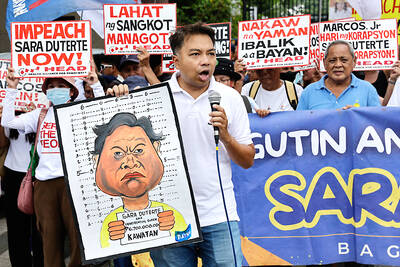
PHILIPPINE COMMITTEE: The head of the committee that made the decision said: ‘If there is nothing to hide, there is no reason to hide, there is no reason to obstruct’ A Philippine congressional committee on Wednesday ruled that there was “probable cause” to impeach Philippine Vice President Sara Duterte after hearing allegations of unexplained wealth, misuse of state funds and threats to have the president assassinated. The unanimous decision of the 53-member committee in the Philippine House of Representatives sends the two impeachment complaints to deliberations and voting by the entire lower chamber, which has more than 300 lawmakers. The complaints centered on Duterte’s alleged illegal use and mishandling of intelligence funds from the vice president’s office, and from her time as education secretary under Philippine President Ferdinand Marcos Jr. Duterte and the

Burmese President Min Aung Hlaing yesterday cut all prisoners’ sentences by one-sixth, a blanket measure that a source close to deposed leader Aung San Suu Kyi said would further shorten her detention. Aung San Suu Kyi has been sequestered since a 2021 military coup, but the senior member of her dissolved National League for Democracy (NLD) party said that while her term had been reduced, her remaining sentence is still unclear. “We also don’t know exactly how many years she has left,” the source told reporters, speaking on condition of anonymity for security reasons. The military toppled Aung San Suu Kyi’s elected government


 RSS
RSS