


At least 18 people have been killed in one of South Korea's worst wildfire outbreaks, with multiple raging blazes causing "unprecedented damage," the acting president said today.
More than a dozen fires broke out over the weekend, scorching wide swathes of the southeast and forcing about 27,000 people to evacuate, with the fire cutting off roads and downing communications lines as residents fled in panic.
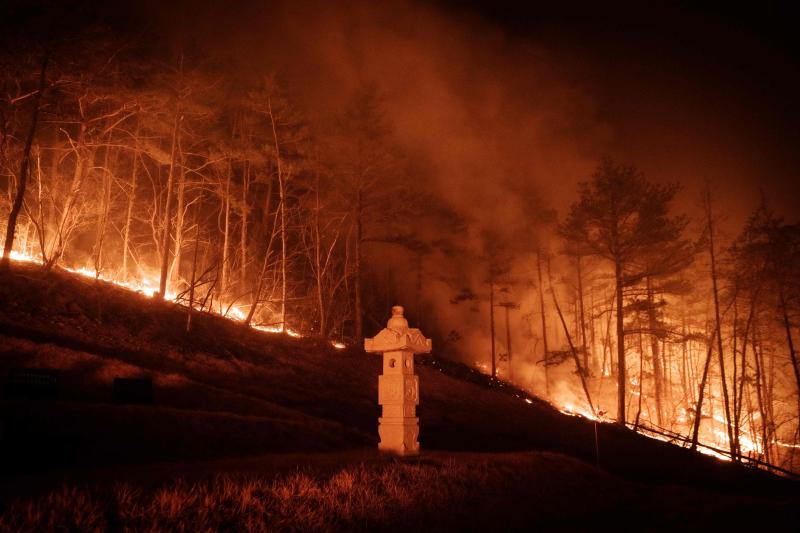
Photo: AFP
Overnight into today, the death toll jumped as wind-driven flames tore through neighborhoods and razed an ancient temple.
"Eighteen people died in the wildfires," a South Korean Ministry of the Interior and Safety official said.
According to the ministry, the wildfires have charred 17,398 hectares, with the blaze in Uiseong County alone accounting for 87 percent of the total.
The government has raised the crisis alert to its highest level and taken the rare step of transferring thousands of prisoners.
"Wildfires burning for a fifth consecutive day ... are causing unprecedented damage," South Korean Acting President Han Duck-soo said.
He told an emergency safety and disaster meeting that the blazes were "developing in a way that is exceeding both existing prediction models and earlier expectations."
"Throughout the night, chaos continued as power and communication lines were cut in several areas and roads were blocked," he added.
In the city of Andong, some evacuees sheltering in an elementary school gym said they had to flee so quickly they could bring nothing with them.
"The wind was so strong," said Kwon So-han, a 79-year-old resident in Andong, adding that as soon as he got the evacuation order he fled.
"The fire came from the mountain and fell on my house," he said. "Those who haven't experienced it won't know. I could only bring my body."
By today, one of the fires was threatening historic Hahoe Folk Village — a UNESCO-listed world heritage site popular with tourists, but now under an emergency alert.
Thousands of firefighters have been deployed, but "strong winds reaching speeds of 25mps persisted from yesterday afternoon through the night, forcing the suspension of helicopter and drone operations," Han said.
The changing wind patterns and dry weather have "revealed the limitations of conventional firefighting methods," he added.
Hundreds of soldiers have joined the effort, with helicopter support also provided by US forces stationed in the South.
The fires are "the most devastating" yet in South Korea, Han said.
Last year was South Korea's hottest year on record, with the Korea Meteorological Administration saying that the average annual temperature was 14.5°C — two degrees higher than the preceding 30-year average of 12.5C°.
Some types of extreme weather have a well-established link with climate change, such as heatwaves or heavy rainfall.
Other phenomena, such as forest fires, droughts, snowstorms and tropical storms, can result from a combination of complex factors.
"The region had been experiencing unusually dry weather with below-average precipitation," Han said, adding that the South had been hit by more than double the number of fires this year than last.
The major fire in Uiseong was reportedly caused by a person tending to a family grave who accidentally ignited the blaze.
The government has said more than 27,000 people have been relocated to temporary shelters, and it is promising to provide emergency relief and financial support to those displaced.

SPEAKING OUT: After Siranudh Scott’s allegations surfaced, celebrities and public figures took to social media to share their own experiences of sexual misconduct and abuse A high-profile alleged sexual abuse case within a wealthy Thai beer brewing family has prompted a wave of painful accounts from survivors of unconnected abuse in the conservative nation. Siranudh Scott, a member of the billionaire Thai family that founded the ubiquitous Singha beer brand, posted an emotional video this month accusing his elder brother Sunit of repeatedly abusing him when he was a teenager. Sunit, who is in his 30s, later denied the allegations in a video posted online, but Singha parent Boonrawd dismissed him from his executive role with the company on Tuesday last week. “I felt I needed to speak

SEEKING ORDER: Rodrigo Paz said that ‘anyone who wants to destroy the nation will have to deal with this president and the full force of the constitution’ Bolivian President Rodrigo Paz on Wednesday said that the nation was at a “breaking point” after nearly a month of protests that have caused shortages of food, fuel and medicine. Paz, who took office six months ago amid the worst economic crisis there in four decades, is battling a groundswell of fury over his policies. The political capital, La Paz, has been besieged by low-income workers and members of the indigenous majority calling for his resignation. “The country needs order and is reaching breaking point,” the 58-year-old said at a public event in La Paz, renewing his appeal for dialogue. On Tuesday, the Bolivian

‘CROSSING THE LINE’: China’s embassy in Seoul criticized US Forces Korea Commander General Xavier Brunson, asking if his ‘hostile’ remarks were authorized by Washington South Korea and the US are in talks over recent public remarks by the commander of US Forces Korea, Seoul’s presidential office said yesterday, after the comments drew sharp criticism from China. In a recent podcast interview, US Forces Korea Commander General Xavier Brunson described South Korea as “the dagger in the heart of Asia” from China’s east coast, prompting the Chinese embassy in Seoul to say that he had “truly crossed the line.” The interview came amid growing speculation that Washington might seek to expand the role of US Forces Korea in countering the growing regional influence of China, a key

Forecasters in Europe yesterday warned of exceptional heat as record temperatures driven by a “heat dome” push temperatures well above seasonal norms across the continent. The surge follows a record-breaking Monday, with France logging its hottest day in the month of May on record, its weather agency said, and the UK also posting unprecedented highs. A so-called “heat dome” of warm air from northern Africa trapped under a high-pressure system over western Europe is behind the high temperatures not usually seen until high summer. Restrictions on outdoor work were imposed in parts of Italy, beaches in southwest France filled earlier than usual and


 RSS
RSS