


At first glance, the office desk could belong to any Chinese executive — an ashtray, mini-flags, a golden sculpture inscribed with the character for “integrity” and a picture of a local celebrity.
Instead, it is part of a defiant art show challenging Hong Kong’s stuffy power structures, held in an office tower at the heart of a finance district famous for its long hours and cut-throat competition.
The group exhibition — named “RE:Urgent” in mockery of corporate-speak — is meant to “subvert the office space that we are working in every day,” said curator Renee Lui, managing director of Young Soy Gallery.
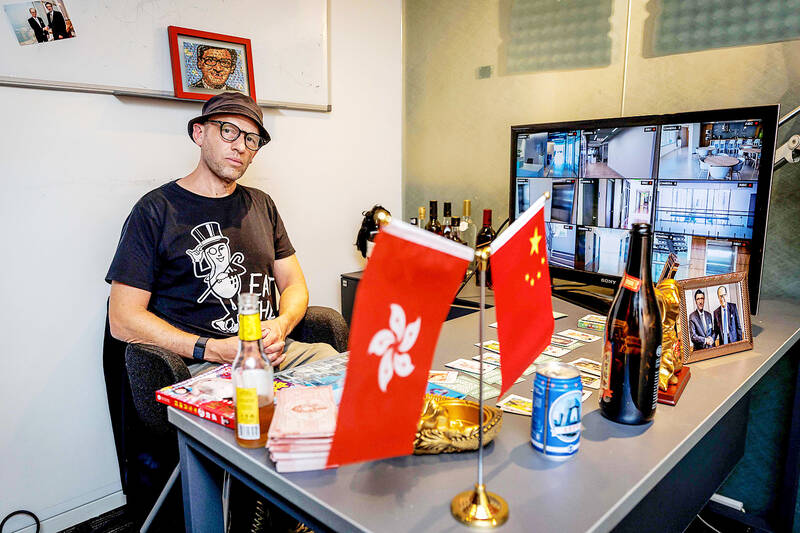
Photo: AFP
The exhibition mirrors a workspace, with four artists given a standard office cubicle to present their work in, and one displaying in the boss’ office. “This is sort of a really rigid space that people (wouldn’t normally) see as being able to contain creative ideas,” Lui said.
The main office is occupied by artist Dominic Johnson-Hill, whose idiosyncratic desktop was inspired by his 28 years doing business in Beijing.
“I went to a lot of bosses’ offices,” he said. “I really wanted to sort of copy a lot of that paraphernalia.”
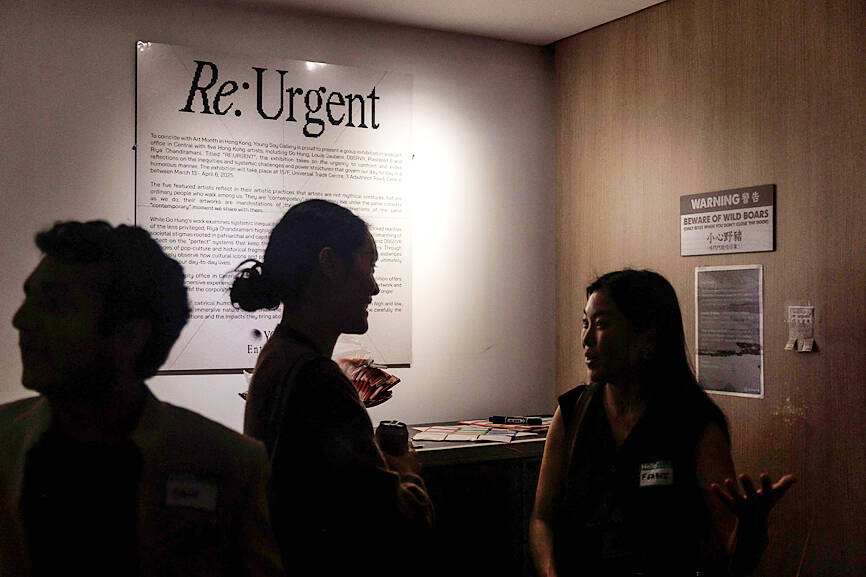
Photo: AFP
His displayed pieces include a surreal digital wall clock, which tells time in an eerie, robotic voice. Next to its numbers is a picture of people looking down at their phones whilst queuing to enter a coffin store.
Johnson-Hill came across such traditional shops in a Hong Kong neighborhood and was inspired to create the piece, which he said poked fun at aimless work culture.
“I thought how wonderful it would be to see people dressed in office attire queuing... [it is] a ridiculous idea that was quite playful,” he said.
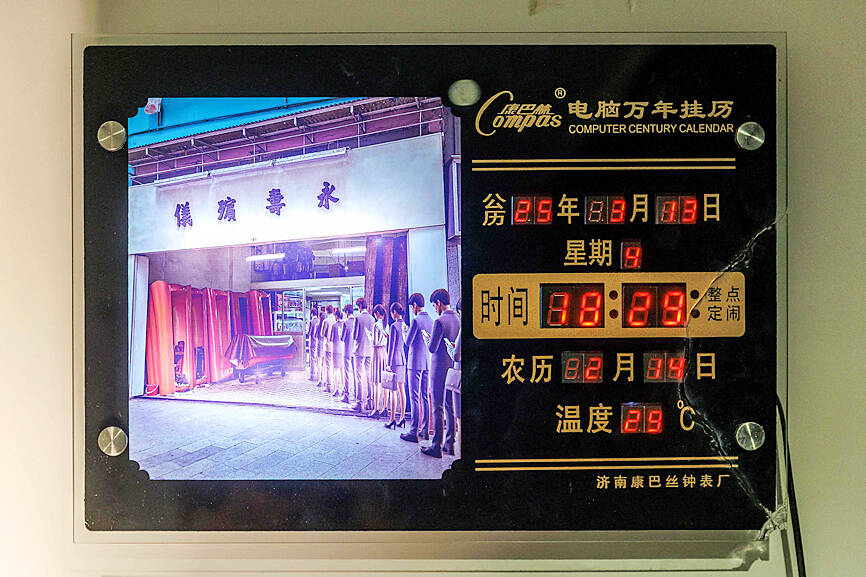
Photo: AFP
In another cubicle, artist Riya Chandiramani sits role-playing as an “unpaid intern” who dreams of starting a feminist revolution. In a painting, she imagines herself as the Hindu goddess, Kali, forced into a treacherous game of snakes and ladders set in the workplace.
“The numbers also represent ages, and so there is also that aspect of women not being allowed to age,” Chandiramani said.
The show is taking place during Hong Kong’s “Art Month,” headlined by art fairs that draw wealthy buyers from around the world.
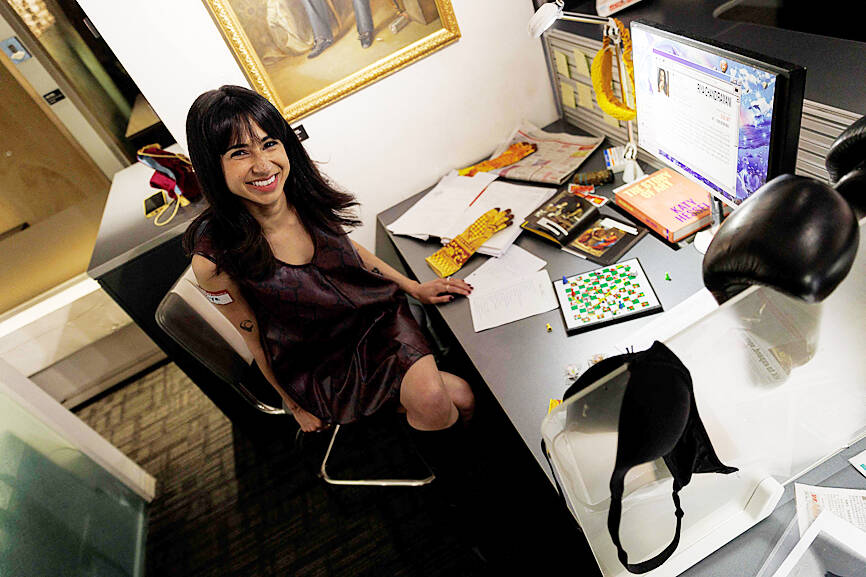
Photo: AFP
However, gallery co-founder Shivang Jhunjhnuwala said he decided to ditch the fairs after two years because of high exhibition costs and “a lack of confidence in the art market.”
The show is pushing against the mainstream in its thematic matter too. In one corner, almost unnoticed, is a palm-sized paper cutout of Chinese President Xi Jinping (習近平), trapped within multiple frames, by pseudonymous artist Louie Jaubere. “The people are not in control of what the state dictates,” the artist said, “but it is not targeted at China; it generally represents government or state control.”
Hong Kong’s freedom of expression and political rights have been whittled away since Beijing imposed a sweeping national security law in 2020 after large and sometimes violent protests the year before. At the show’s opening, retired architect Serena Chan said she appreciated the show’s sense of humor.
“The other rebels are all gone,” she said. “Rebels in art are probably still allowed, so let’s have more of that.”
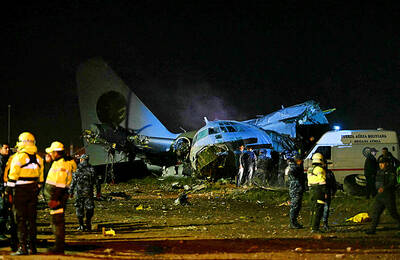
MONEY GRAB: People were rushing to collect bills scattered on the ground after the plane transporting money crashed, which an official said hindered rescue efforts A cargo plane carrying money on Friday crashed near Bolivia’s capital, damaging about a dozen vehicles on highway, scattering bills on the ground and leaving at least 15 people dead and others injured, an official said. Bolivian Minister of Defense Marcelo Salinas said the Hercules C-130 plane was transporting newly printed Bolivian currency when it “landed and veered off the runway” at an airport in El Alto, a city adjacent to La Paz, before ending up in a nearby field. Firefighters managed to put out the flames that engulfed the aircraft. Fire chief Pavel Tovar said at least 15 people died, but
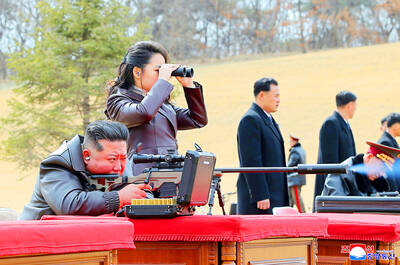
LIKE FATHER, LIKE DAUGHTER: By showing Ju-ae’s ability to handle a weapon, the photos ‘suggest she is indeed receiving training as a successor,’ an academic said North Korea on Saturday released a rare image of leader Kim Jong-un’s teenage daughter firing a rifle at a shooting range, adding to speculation that she is being groomed as his successor. Kim’s daughter, Ju-ae, has long been seen as the next in line to rule the secretive, nuclear-armed state, and took part in a string of recent high-profile outings, including last week’s military parade marking the closing stages of North Korea’s key party congress. Pyongyang’s official Korean Central News Agency (KCNA) released a photo of Ju-ae shooting a rifle at an outdoor shooting range, peering through a rifle scope
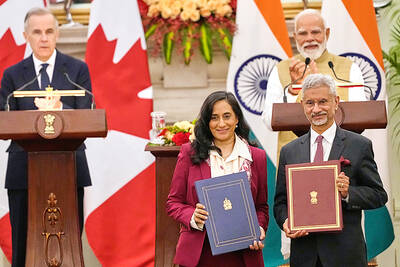
India and Canada yesterday reached a string of agreements, including on critical mineral cooperation and a “landmark” uranium supply deal for nuclear power, the countries’ leaders said in New Delhi. The pacts, which also covered technology and promoting the use of renewable energy, were announced after Indian Prime Minister Narendra Modi and Canadian Prime Minister Mark Carney hailed a fresh start in the relationship between their nations. “Our ties have seen a new energy, mutual trust and positivity,” Modi said. Carney’s visit is a key step forward in ties that effectively collapsed in 2023 after Ottawa accused New Delhi
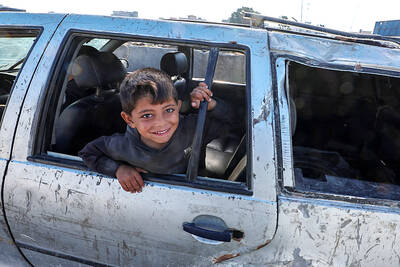
Gaza is rapidly running out of its limited fuel supply and stocks of food staples might become tight, officials said, after Israel blocked the entry of fuel and goods into the war-shattered territory, citing fighting with Iran. The Israeli military closed all Gaza border crossings on Saturday after announcing airstrikes on Iran carried out jointly with the US. Israeli authorities late on Monday night said that they would reopen the Kerem Shalom crossing from Israel to Gaza yesterday, for “gradual entry of humanitarian aid” into the strip, without saying how much. Israeli authorities previously said the crossings could not be operated safely during


 RSS
RSS