


Israel on Sunday ordered an immediate halt to Gaza’s electricity supply in an effort to pressure Hamas into releasing hostages, even as it prepared for fresh talks on the future of its truce with the Palestinian militants.
Israel’s decision came a week after it blocked all aid supplies to the war-battered territory, a move reminiscent of the initial days of the war when Israel announced a “siege” of Gaza.
Hamas described the electricity cut as “blackmail,” a term it had also used after Israel blocked the aid.
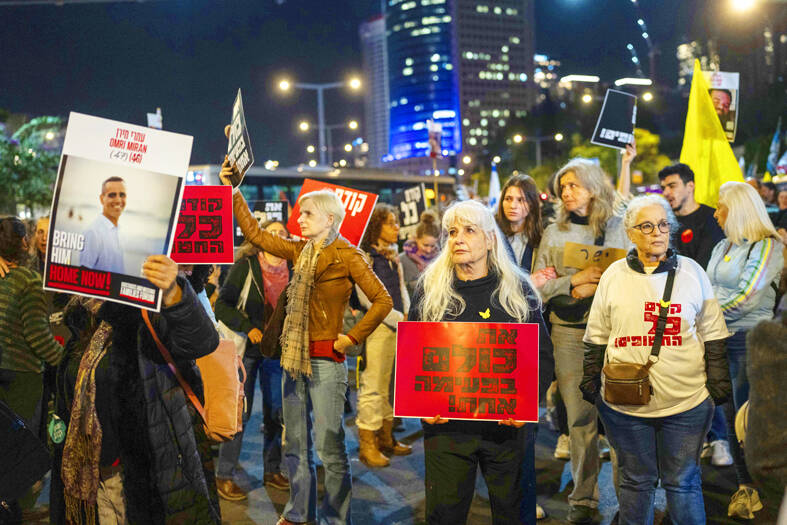
Photo: AP
The truce’s initial phase ended on March 1 and both sides have refrained from returning to all-out war, despite sporadic violence including an airstrike on Sunday that Israel said targeted militants.
Hamas has repeatedly called for an immediate start to negotiations on the ceasefire’s second phase, aiming to end the war permanently.
Israel says it prefers extending phase one until the middle of next month and halted aid to Gaza over the impasse.
“I have just signed the order to stop supplying electricity immediately to the Gaza Strip,” Israeli Minister of Energy and Infrastructure Eli Cohen said in a video statement.
“We will use all the tools at our disposal to bring back the hostages and ensure that Hamas is no longer in Gaza the day after” the war, he said.
Izzat al-Rishq, a member of the Hamas political bureau, described Israel’s move as “a desperate attempt to pressure our people and their resistance through cheap and unacceptable blackmail tactics.”
Just days after the war erupted on Oct. 7, 2023, after Hamas’ attack, Israel cut electricity to Gaza, only restoring it in the middle of last year.
The sole power line between Israel and Gaza supplies the main desalination plant, and Gazans mainly rely now on solar panels and fuel-powered generators to produce electricity.
Hundreds of thousands of Palestinians in Gaza live in tents, with nighttime temperatures now forecast at about 12°C.
Hamas representatives met Egyptian mediators over the weekend, emphasizing the urgent need to resume aid deliveries “without restrictions or conditions,” a Hamas statement said.
“We call on mediators in Egypt and Qatar, as well as the guarantors in the US administration, to ensure that the [Israeli] occupation complies with the agreement ... and proceeds with the second phase according to the agreed-upon terms,” Hamas spokesman Hazem Qassem said.
Hamas’ key demands for the second phase include a hostage-prisoner exchange, Israel’s complete withdrawal from Gaza, a permanent ceasefire, reopening border crossings and lifting the blockade, he said.
Former US president Joe Biden had also outlined a second phase involving the release of remaining living hostages, the withdrawal of all Israeli forces left in Gaza and establishment of a permanent ceasefire.
After meeting mediators, another Hamas spokesman, Abdel Latif al-Qanoua, said indicators were so far “positive.”
Israeli Prime Minister Benjamin Netanyahu’s office said it would send delegates to Doha yesterday.
The truce largely halted more than 15 months of fighting in Gaza, where virtually the entire population was displaced.

ECONOMIC WORRIES: The ruling PAP faces voters amid concerns that the city-state faces the possibility of a recession and job losses amid Washington’s tariffs Singapore yesterday finalized contestants for its general election on Saturday next week, with the ruling People’s Action Party (PAP) fielding 32 new candidates in the biggest refresh of the party that has ruled the city-state since independence in 1965. The move follows a pledge by Singaporean Prime Minister Lawrence Wong (黃循財), who took office last year and assumed the PAP leadership, to “bring in new blood, new ideas and new energy” to steer the country of 6 million people. His latest shake-up beats that of predecessors Lee Hsien Loong (李顯龍) and Goh Chok Tong (吳作棟), who replaced 24 and 11 politicians respectively

Archeologists in Peru on Thursday said they found the 5,000-year-old remains of a noblewoman at the sacred city of Caral, revealing the important role played by women in the oldest center of civilization in the Americas. “What has been discovered corresponds to a woman who apparently had elevated status, an elite woman,” archeologist David Palomino said. The mummy was found in Aspero, a sacred site within the city of Caral that was a garbage dump for more than 30 years until becoming an archeological site in the 1990s. Palomino said the carefully preserved remains, dating to 3,000BC, contained skin, part of the

Russian hackers last year targeted a Dutch public facility in the first such an attack on the lowlands country’s infrastructure, its military intelligence services said on Monday. The Netherlands remained an “interesting target country” for Moscow due to its ongoing support for Ukraine, its Hague-based international organizations, high-tech industries and harbors such as Rotterdam, the Dutch Military Intelligence and Security Service (MIVD) said in its yearly report. Last year, the MIVD “saw a Russian hacker group carry out a cyberattack against the digital control system of a public facility in the Netherlands,” MIVD Director Vice Admiral Peter Reesink said in the 52-page

‘WATER WARFARE’: A Pakistani official called India’s suspension of a 65-year-old treaty on the sharing of waters from the Indus River ‘a cowardly, illegal move’ Pakistan yesterday canceled visas for Indian nationals, closed its airspace for all Indian-owned or operated airlines, and suspended all trade with India, including to and from any third country. The retaliatory measures follow India’s decision to suspend visas for Pakistani nationals in the aftermath of a deadly attack by shooters in Kashmir that killed 26 people, mostly tourists. The rare attack on civilians shocked and outraged India and prompted calls for action against their country’s archenemy, Pakistan. New Delhi did not publicly produce evidence connecting the attack to its neighbor, but said it had “cross-border” links to Pakistan. Pakistan denied any connection to


 RSS
RSS