


The Moutier-Grandval Bible, an illustrated ninth-century masterpiece considered one of the finest manuscripts in the world, is back in Switzerland, where it miraculously survived the ages in impeccable condition.
The priceless Bible was produced in Tours in France in about 830 to 840, before making its way to Moutier-Grandval Abbey, in the mountainous Jura region in northwestern Switzerland.
Now in the care of the British Library, the 22kg manuscript is being loaned for three months to the Jura Museum of Art and History in the region’s tiny capital, Delemont.
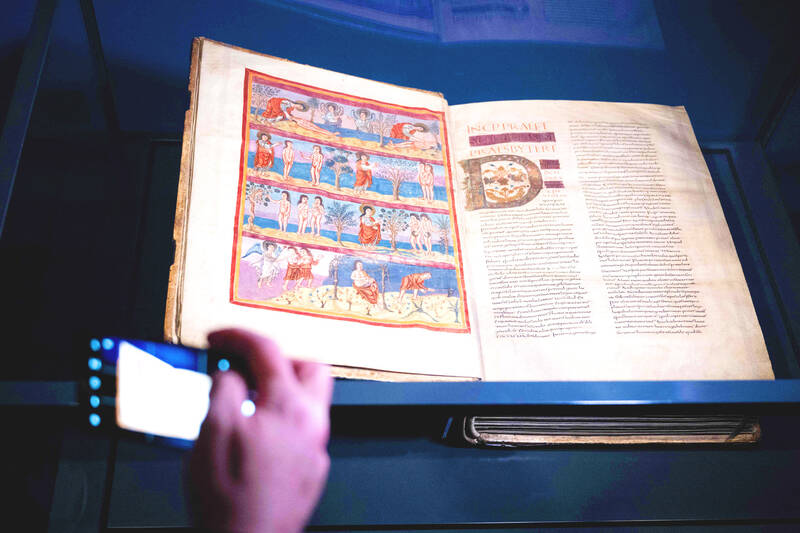
Photo: AFP
It is only the second time it has been loaned from London, after being shown at the Jura Museum in 1981, when 32,000 people flocked to see it.
“We could even call it a miracle: this mediaeval masterpiece has survived the ages, the circumstances of history; it has escaped ransacking, wars, fires, revolutions and has reached us in remarkable condition,” Jura Museum of Art and History director Nathalie Fleury said.
When it returned on Tuesday, “the emotion was palpable: more than 1,200 years of history were in our hands,” she said.
About 100 Bibles were produced during the same period in Tours, of which 18 have survived intact, including only three that are illustrated. The Moutier-Grandval Bible is the best-known.
The Bible is going on show in the museum’s basement, behind a thick steel door. Sealed inside a glass cabinet, it is the only object in the bare, darkened room.
It is open on the first page, showing a vivid illustration of the story of Adam and Eve — its colours still remarkably bright — from the Book of Genesis.
For optimum conservation conditions, only five people at a time are allowed in the room, for five minutes only.
“The Moutier-Grandval Bible really is a masterpiece of scribal and artistic endeavor,” said Claire Breay, head of ancient, medieval and early modern manuscripts at the British Library.
“It is one of the greatest treasures of the British Library,” where it is periodically displayed on rotation.
The 450 leaves, or 900 pages, measure 50cm by 37.5cm, with text written in two columns of 50 to 52 lines each. The skins of 210 to 225 sheep were required to produce the parchment.
It contains four full-page illustrations and about 20 copyist monks worked on the text, written in Latin in highly legible Carolingian minuscule script.
“It’s very emotional to see it in real life: It’s completely different from seeing a reproduction of it in a book or online,” book historian and co-curator Angeline Rais said.
“There’s a lot of mystery around the Bible,” she said..
How it came to Moutier-Grandval remains uncertain.
The Bible was left behind by canons and forgotten about until it was found, according to legend, in a Delemont attic in the late 1810s or early 1820s. It was sold to an antiques dealer in 1822.
It was eventually sold to the British Museum in 1836 for 750 pounds, or US$93,600 in today’s money.
With much of its back story so little known, the Bible even today remains shrouded in a degree of mystery: how it was transported from London to Delemont, and all matters of security, remain a guarded secret.
The exhibition opens to the public from today until June 8.
Research continues on the Bible, notably on the parchment and the pigments used in the illustrations.
The museum’s experts hope that the Bible will be displayed in the Jura again, and when it does, studies will finally unravel the mysteries of its long journey.
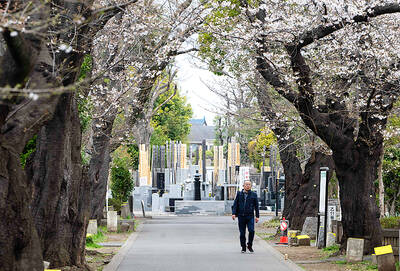
ROCKY RELATIONS: The figures on residents come as Chinese tourist numbers drop following Beijing’s warnings to avoid traveling to Japan The number of Chinese residents in Japan has continued to rise, even as ties between the two countries have become increasingly fractious, data released on Friday showed. As of the end of December last year, the number of Chinese residents had increased by 6.5 percent from the previous year to 930,428. Chinese people accounted for 22.6 percent of all foreign residents in Japan, making them by far the largest group, Japanese Ministry of Justice data showed. Beijing has criticized Tokyo in increasingly strident terms since Japanese Prime Minister Sanae Takaichi last year suggested that a military conflict around Taiwan could

Germany is considering Australia’s Ghost Bat robot fighter as it looks to select a combat drone to modernize its air force, German Minister of Defense Boris Pistorius said yesterday. Germany has said it wants to field hundreds of uncrewed fighter jets by 2029, and would make a decision soon as it considers a range of German, European and US projects developing so-called “collaborative combat aircraft.” Australia has said it will integrate the Ghost Bat, jointly developed by Boeing Australia and the Royal Australian Air Force, into its military after a successful weapons test last year. After inspecting the Ghost Bat in Queensland yesterday,

A pro-Iran hacking group claimed to breach FBI Director Kash Patel’s personal e-mail inbox and posted some of the contents online. The e-mails provided by the hacking group include travel details, correspondence with leasing agents in Washington and global entry, and loyalty account numbers. The e-mail address the hackers claim to have compromised has been previously tied to Patel’s personal details, and the leaked e-mails contain photos of Patel and others, in addition to correspondence with family members and colleagues. “The FBI is aware of malicious actors targeting Director Patel’s personal email information,” the agency said in a statement on
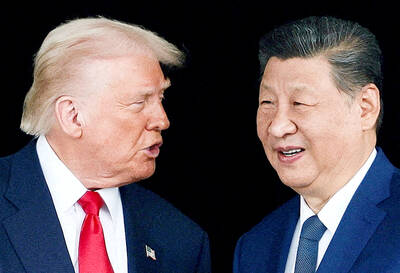
RIVALRY: ‘We know that these are merely symbolic investigations initiated by China, which is in fact the world’s most profligate disrupter of supply chains,’ a US official said China has started a pair of investigations into US trade practices, retaliating against similar probes by US President Donald Trump’s administration as the superpowers stake out positions before an expected presidential summit in May. The move, announced by the Chinese Ministry of Commerce on Friday, is a direct mirror of steps Trump took to revive his tariff agenda after the US Supreme Court last month struck down some of his duties. “China expresses its strong dissatisfaction and firm opposition to these actions,” a ministry spokesperson said in a statement, referring to the so-called Section 301 investigations initiated on March 11.


 RSS
RSS