


The crack of a gunshot and the blonde man flinches behind the lectern, clutching his ear, but instead of horrified gasps, the crowd erupts in laughter and applause.
“It’s a bullet! It wants to put me in the grave,” Hong Kong actor Loong Koon-tin sings, in the high-pitched falsetto that is the hallmark of traditional Cantonese opera.
The attempted assassination of US President Donald Trump when campaigning to be president last year recreated as part of an absurdist play in Hong Kong, has given fresh inspiration to a centuries-old art form, drawing hundreds to witness the spectacle at a beloved theater on the verge of shutdown.
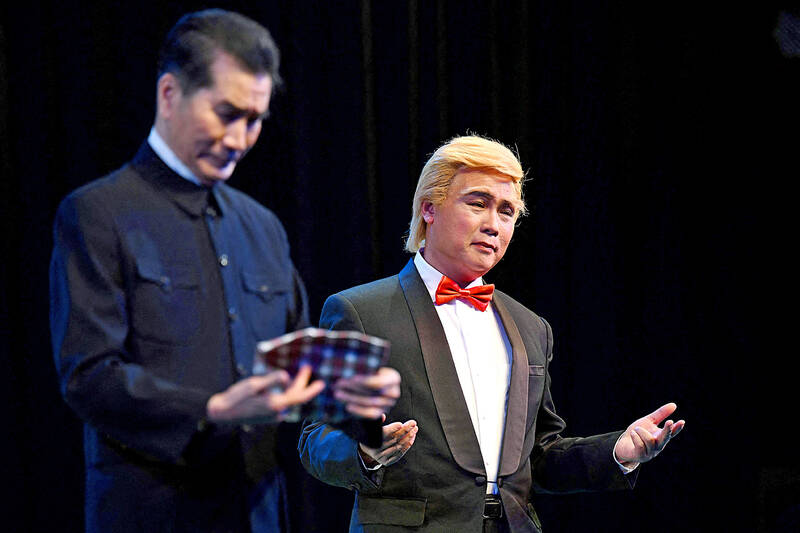
Photo: AP
Older theater-goers recall a time when operas were mostly about Chinese stories and legends.
The Trump show — which debuted in 2019 and has been updated twice — is part of an effort to modernize the genre and connect with younger audiences, for years an uphill battle for the industry.
“Audiences want to see how the assassination scene can be done using Cantonese opera,” said playwright and feng shui master Edward Li (李居明), citing four techniques — singing, acting, recitation and acrobatics.
The sold-out show, which runs for nearly four hours, begins with former US president Richard Nixon meeting Mao Zedong (毛澤東) in 1972 then spirals into a tale about Trump searching for his lost Chinese twin.
North Korean leader Kim Jong-un also makes an appearance.
“It’s Cantonese opera with black humor,” Li said. “We are not making fun of the situation, but the audience finds it funny.”
The novelty factor is key to the appeal of Trump, the Twins President and there are plans to take it on tour, he said. “Trump is someone the whole world wants to know.”
Crowds last week flocked to the 52-year-old Sunbeam Theatre, an ornate venue with a huge neon sign and posters overlooking a busy intersection in Hong Kong’s North Point neighborhood.
Its lobby is adorned with calligraphy, a gong and drum for good luck, and 108 signature round lamps suspended from the ceiling. Cantonese opera originated in southern China and became a staple of Hong Kong’s post-World War II cultural life, with its popularity peaking in the 1960s.
However, with changing tastes, Sunbeam ran into financial trouble and nearly closed in 2012 before Li, the playwright, took it over.
“We live in an era when Cantonese opera is at its lowest and closest to death. We need to give it an adrenaline shot to revive it,” he said.
However, the revival could not last. Following a sale, the theater is to close its doors for good on March 3 and its new owners plan to convert it into an evangelical church.
Hong Kong officials said they have spent HK$200 million (US$26 million) in the span of two decades to promote Cantonese opera. A purpose-built theater was opened in 2019.
However, Dennis Cheng, a supporting actor, said he was “not positive” about the future of the art, citing the lack of venues and dwindling audience.
It would be hard to match how Sunbeam — with its history and communal spaces — felt like home to performers, he added.
“[Sunbeam] carries the energy of veteran actors, as well as the emotions and dreams of many people,” said Man Chan, who plays Ivanka Trump.
Since its 2019 premiere, the Trump show has sparked both acclaim and ridicule, becoming the subject of memes.
As it wrapped up a three-day run, questions remain as to whether newcomers who bought tickets out of curiosity can be persuaded to stay for more conventional fare.
High-school student Matthew Tsui said that he was introduced to Cantonese opera by his grandmother and fell in love with the elaborate costumes.
However, he said it was “tough to sit in a theater for hours to watch patiently” and that his classmates preferred K-pop.
Fanny Cheng, 60, a self-described Cantonese opera superfan, said she enjoyed both traditional and modern takes and hoped that Sunbeam Theatre would be preserved.
“It’ll be a pity to lose Sunbeam,” she said. “But if the landlord wants to sell the property, there’s nothing we can do.”

POLITICAL PRISONERS VS DEPORTEES: Venezuela’s prosecutor’s office slammed the call by El Salvador’s leader, accusing him of crimes against humanity Salvadoran President Nayib Bukele on Sunday proposed carrying out a prisoner swap with Venezuela, suggesting he would exchange Venezuelan deportees from the US his government has kept imprisoned for what he called “political prisoners” in Venezuela. In a post on X, directed at Venezuelan President Nicolas Maduro, Bukele listed off a number of family members of high-level opposition figures in Venezuela, journalists and activists detained during the South American government’s electoral crackdown last year. “The only reason they are imprisoned is for having opposed you and your electoral fraud,” he wrote to Maduro. “However, I want to propose a humanitarian agreement that

ECONOMIC WORRIES: The ruling PAP faces voters amid concerns that the city-state faces the possibility of a recession and job losses amid Washington’s tariffs Singapore yesterday finalized contestants for its general election on Saturday next week, with the ruling People’s Action Party (PAP) fielding 32 new candidates in the biggest refresh of the party that has ruled the city-state since independence in 1965. The move follows a pledge by Singaporean Prime Minister Lawrence Wong (黃循財), who took office last year and assumed the PAP leadership, to “bring in new blood, new ideas and new energy” to steer the country of 6 million people. His latest shake-up beats that of predecessors Lee Hsien Loong (李顯龍) and Goh Chok Tong (吳作棟), who replaced 24 and 11 politicians respectively

Young women standing idly around a park in Tokyo’s west suggest that a giant statue of Godzilla is not the only attraction for a record number of foreign tourists. Their faces lit by the cold glow of their phones, the women lining Okubo Park are evidence that sex tourism has developed as a dark flipside to the bustling Kabukicho nightlife district. Increasing numbers of foreign men are flocking to the area after seeing videos on social media. One of the women said that the area near Kabukicho, where Godzilla rumbles and belches smoke atop a cinema, has become a “real

‘WATER WARFARE’: A Pakistani official called India’s suspension of a 65-year-old treaty on the sharing of waters from the Indus River ‘a cowardly, illegal move’ Pakistan yesterday canceled visas for Indian nationals, closed its airspace for all Indian-owned or operated airlines, and suspended all trade with India, including to and from any third country. The retaliatory measures follow India’s decision to suspend visas for Pakistani nationals in the aftermath of a deadly attack by shooters in Kashmir that killed 26 people, mostly tourists. The rare attack on civilians shocked and outraged India and prompted calls for action against their country’s archenemy, Pakistan. New Delhi did not publicly produce evidence connecting the attack to its neighbor, but said it had “cross-border” links to Pakistan. Pakistan denied any connection to


 RSS
RSS