


South Koreans are repurposing flower wreaths and K-pop light sticks as political protest tools amid the nation’s deepest political crisis in decades, sparked by South Korean President Yoon Suk-yeol’s short-lived martial law declaration last month.
Hundreds of wreaths, predominantly directed at Yoon himself, have been sent to his residence and government buildings connected to the impeachment proceedings, with some targeting other officials involved in the martial law controversy. Local media estimate the number of wreaths delivered to government offices as several thousand.
While many wreaths carry moderate messages supporting Yoon or opposing impeachment, several contain extreme rhetoric directed at recipients. The black-ribboned funeral wreaths with white chrysanthemums and celebratory wreaths with vibrant roses and orchids, costing as much as US$75, carry messages reflecting South Korea’s deepening political divide.
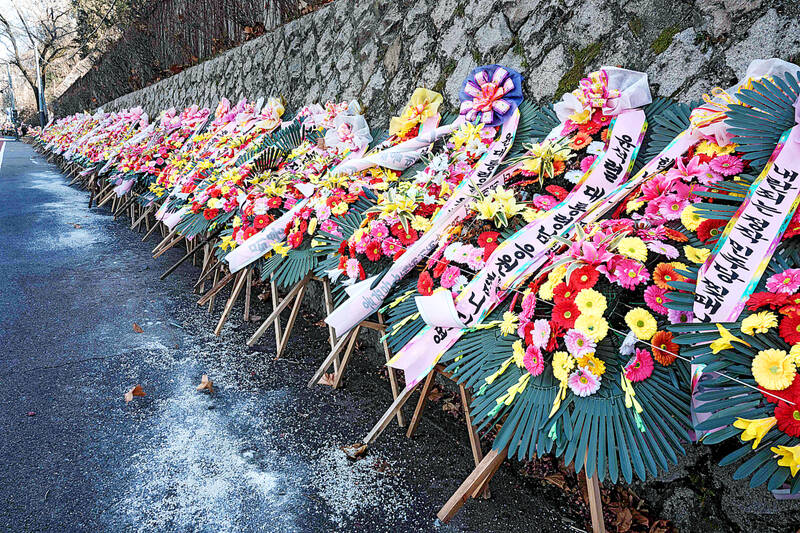
Photo: AFP
The protest method has gained traction, with media coverage increasing in tandem over the last few years. A search on Big Kinds, which collects and analyzes articles from more than 100 local news outlets, shows wreath protests received four times more media coverage last year compared with 2023, reflecting the method’s growing popularity.
News articles about these protests started to appear in the early 2010s, though experts cannot specify their exact origin.
While dozens of flower shops say they have not received protest wreath orders, and a handful of online blogs promote wreath sales emphasizing political neutrality, certain shops have become focal points for the movement.
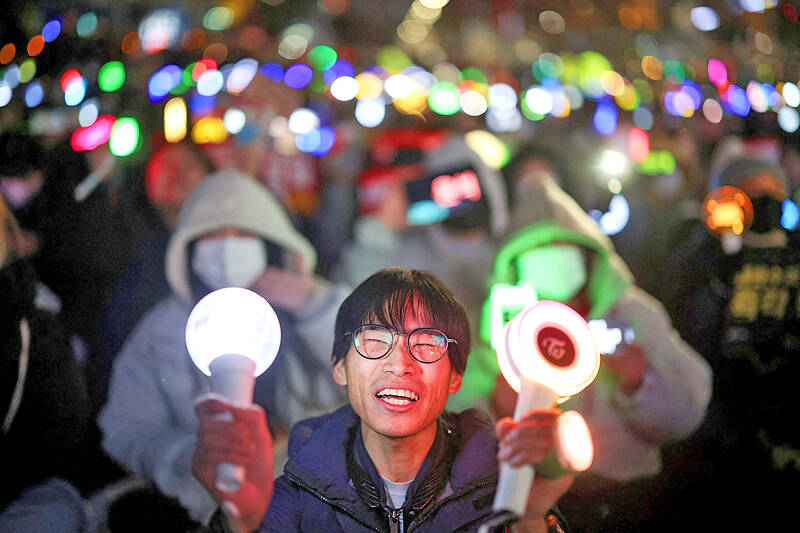
Photo: Reuters
Yoon Miyoung, of Seoul-based Dongsung Flower, said she has delivered more than 1,000 wreaths since last month, exclusively for pro-Yoon supporters.
“We’ve sent out so many wreaths that Seoul is running out of flowers,” she said, adding that more than one-third of her customers are in their 20s and 30s, with orders coming from outside South Korea including Japan, US and the Netherlands.
“Even though the form remains the same, the types of flowers or the messages differ,” Kookmin University sociology professor Choi Hang-sub said. “While wreaths avoid physical violence, the messages on funeral wreaths have evolved into a form of offline hate speech, similar to malicious online comments, but now decorated with flowers.”
Wreath protests remain “an isolated form of demonstration limited to certain political groups,” making it difficult to gain broader public support, Jungwon University professor Kim Hern-sik said.
Experts also raise concerns about wreath protests’ environmental impact.
“Most wreaths use cheap, non-environmentally friendly materials that neither help flower farmers nor the environment,” Kim said.
However, Kim sees promise in younger generations’ protest methods.
“K-pop fandom culture, especially centered around young women in their teens and 20s, is now being applied to political rallies,” he said.
Last month, outside the South Korean National Assembly where lawmakers voted to impeach Yoon, thousands of people wielded K-pop light sticks costing about US$50 from popular bands like BIGBANG, NCT and Epik High during pro-impeachment rallies.
“Even though these idol light sticks are expensive ... people are bringing their most precious possessions to express their opinions,” said Hong Gayeong, a 29-year-old protester at a Dec. 13 protest calling for Yoon’s impeachment.
The phenomenon has sparked a protest coalition, with some offering free shipping and light-stick rentals through popular resale apps.
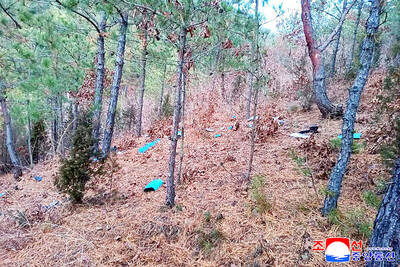
DENIAL: Pyongyang said a South Korean drone filmed unspecified areas in a North Korean border town, but Seoul said it did not operate drones on the dates it cited North Korea’s military accused South Korea of flying drones across the border between the nations this week, yesterday warning that the South would face consequences for its “unpardonable hysteria.” Seoul quickly denied the accusation, but the development is likely to further dim prospects for its efforts to restore ties with Pyongyang. North Korean forces used special electronic warfare assets on Sunday to bring down a South Korean drone flying over North Korea’s border town. The drone was equipped with two cameras that filmed unspecified areas, the General Staff of the North Korean People’s Army said in a statement. South Korea infiltrated another drone
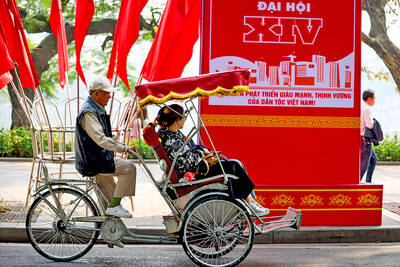
COMMUNIST ALIGNMENT: To Lam wants to combine party chief and state presidency roles, with the decision resting on the election of 200 new party delegates next week Communist Party of Vietnam General Secretary To Lam is seeking to combine his party role with the state presidency, officials said, in a move that would align Vietnam’s political structure more closely to China’s, where President Xi Jinping (習近平) heads the party and state. Next week about 1,600 delegates are to gather in Hanoi to commence a week-long communist party congress, held every five years to select new leaders and set policy goals for the single-party state. Lam, 68, bade for both top positions at a party meeting last month, seeking initial party approval ahead of the congress, three people briefed by

Indonesia and Malaysia have become the first countries to block Grok, the artificial intelligence (AI) chatbot developed by Elon Musk’s xAI, after authorities said it was being misused to generate sexually explicit and nonconsensual images. The moves reflect growing global concern over generative AI tools that can produce realistic images, sound and text, while existing safeguards fail to prevent their abuse. The Grok chatbot, which is accessed through Musk’s social media platform X, has been criticized for generating manipulated images, including depictions of women in bikinis or sexually explicit poses, as well as images involving children. Regulators in the two Southeast Asian
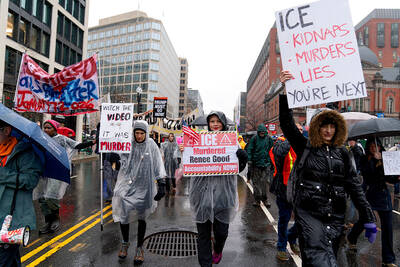
ICE DISPUTE: The Trump administration has sought to paint Good as a ‘domestic terrorist,’ insisting that the agent who fatally shot her was acting in self-defense Thousands of demonstrators chanting the name of the woman killed by a US federal agent in Minneapolis, Minnesota, took to the city’s streets on Saturday, amid widespread anger at use of force in the immigration crackdown of US President Donald Trump. Organizers said more than 1,000 events were planned across the US under the slogan “ICE, Out for Good” — referring to the US Immigration and Customs Enforcement, which is drawing growing opposition over its execution of Trump’s effort at mass deportations. The slogan is also a reference to Renee Good, the 37-year-old mother shot dead on Wednesday in her


 RSS
RSS