


A community in southern Madagascar has pulled together to save thousands of critically endangered tortoises swept away from their sanctuary and left swimming for their lives in floods this month caused by a tropical cyclone.
The 12,000 radiated and spider tortoises that were housed at the Lavavolo Tortoise Center had been confiscated from illegal wildlife traffickers, but faced a new and unexpected ordeal when Cyclone Dikeledi hit the southern part of the Indian Ocean island this month.
A meter-high flood waters engulfed the sanctuary, and the tortoises — many of them mere whippersnappers in the tortoise world at about 25 to 50 years old — were carried away.
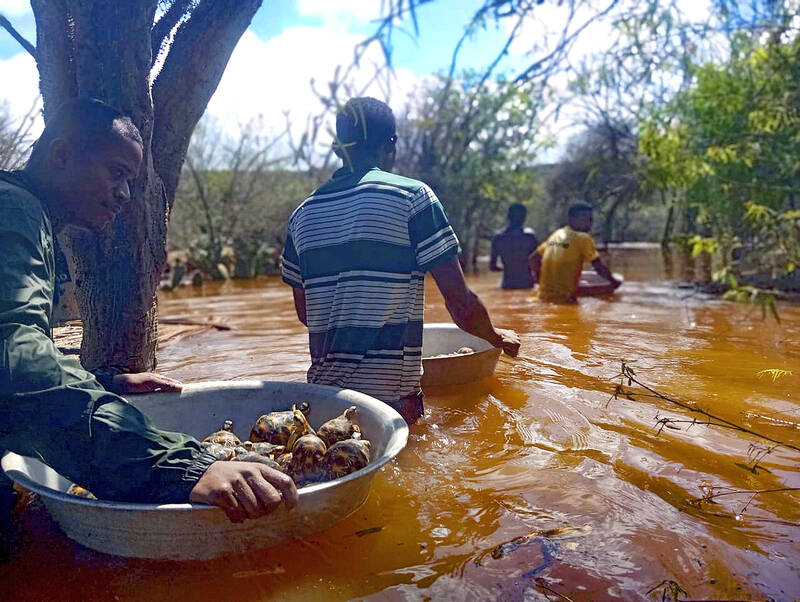
Photo: Lavavolo Tortoise Center via AP
Sanctuary staff, members of the community and even police officers joined together in a rescue operation, wading through the water with large containers to collect the bewildered tortoises. Some rescuers converted damaged building structures into makeshift rafts for the tortoises to ride on as they moved around to find others.
Hery Razafimamonjiraibe, the Madagascar director for the Turtle Survival Alliance, which runs the sanctuary, said they were optimistic that they had saved more than 10,000 tortoises, although they still had to do an official count.
That is not easy, he said, as tortoises can move faster than you think when they want to and rarely cooperate.
The rescuers had recovered about 700 dead tortoises so far, which Razafimamonjiraibe said were trapped by rocks and debris in the floods.
“Fortunately, most of the tortoises were able to float,” Razafimamonjiraibe said.
“Tortoises are actually very good swimmers,” he added. “You should see them.”
While most of the tortoises have been returned to the sanctuary, the floods were a blow to the center, which has lost much of its infrastructure, the Turtle Survival Alliance said.
Lavavolo Tortoise Center underwent a major renovation in 2018 when authorities seized a group of 10,000 radiated tortoises from wildlife traffickers and needed somewhere to keep them. More confiscated tortoises arrived later.
Most of the tortoises at Lavavolo are radiated tortoises, which are native to Madagascar. They generally grow to about 30cm in length, but are long-lived and can reach 100 years or more.
British explorer Captain James Cook is believed to have given a radiated tortoise to the Tongan royal family as a gift in 1777. The tortoise reportedly died in 1966 at the age of 188.
Radiated and spider tortoises are critically endangered in Madagascar because of habitat destruction and poaching. They are eaten, but also illegally trafficked to be sold as pets because of the striking yellow and black markings on their shells, Razafimamonjiraibe said.
There were once tens of millions of radiated tortoises in Madagascar, the Turtle Alliance said, but their numbers have been drastically reduced, and they have disappeared from 65 percent of their natural habitat.

School bullies in Singapore are to face caning under new guidelines, but the education minister on Tuesday said it would be meted out only as a last resort with strict safeguards. Human rights groups regularly criticize Singapore for the use of corporal punishment, which remains part of the school and criminal justice systems, but authorities have defended it as a deterrent to crime and serious misconduct. Caning was discussed in the parliament after legislators asked how it would be used in relation to bullying in schools. The debate followed stricter guidelines on serious student misconduct, including bullying, unveiled by the Singaporean Ministry of

As evening falls in Fiji’s capital, a steady stream of people approaches a makeshift clinic that is a first line of defense against one of the world’s fastest-growing HIV epidemics. In the South Pacific nation — a popular tourist destination of just under a million people — more than 2,000 new HIV cases were recorded last year, a 26 percent increase from 2024. The government has declared an HIV outbreak and described it as a national crisis. “It’s spreading like wildfire,” said Siteri Dinawai, 46, who came to be tested. The Moonlight Clinic, a converted minibus parked in a suburban cul-de-sac in Suva, is

A MESSAGE: Japan’s participation in the Balikatan drills is a clear deterrence signal to China not to attack Taiwan while the US is busy in the Middle East, an analyst said The Japan Self-Defense Forces yesterday fired a Type 88 anti-ship missile during a joint maritime exercise with US, Australian and Philippine forces, hitting a decommissioned Philippine Navy ship in waters facing the disputed South China Sea, in drills that underscore Tokyo’s rising willingness to project military power on China’s doorstep. The drill took place as Manila and Tokyo began talks on a potential defense equipment transfer, made possible by Japan’s decision to scrap restrictions on military exports. The discussions include the possible early transfer of Abukuma-class destroyers and TC-90 aircraft to the Philippines, Japanese Minister of Defense Shinjiro Koizumi said. Philippine Secretary of
Separatists in Alberta are preparing to submit a petition tomorrow that they said has enough signatures to force a referendum on independence for the oil-rich Canadian province. Polls indicate the pro-independence camp remains a minority among Alberta’s 5 million people, but has hit a historic high of roughly 30 percent. Alberta separatists are also closer than ever to forcing a referendum, riding momentum fueled by intensifying grievances over Ottawa’s control of the provincial oil industry. They have also undeniably gotten a boost from the return to power of US President Donald Trump. After launching a petition in January, Stay Free Alberta, the group


 RSS
RSS