


One day before a key meeting of China’s anti-graft watchdog, the state broadcaster aired a program on how grassroots corruption is being crushed, dispelling any notion that China is losing its grip on graft.
The first of four episodes of Fighting Corruption for the People aired on Sunday night, focusing on petty corruption cases including a northeastern primary school director profiting from kickbacks from on-campus meals and an official in rural Sichuan Province taking bribes from farm project contractors.
Last year, China was rocked by a surge of corruption probes ensnaring individuals from a vice central bank governor to a former chairman of its biggest oil and gas company, adding to unease in an economy struggling to secure a firm footing and a society grappling with a fading sense of wealth.

Photo: Reuters
The list of individuals also included a top military official, Miao Hua (苗華), an admiral, whose fall from grace comes at a time when China is trying to modernize its armed forces and boost its battle readiness.
To quash any thought the ruling Chinese Communist Party helmed by Chinese President Xi Jinping (習近平) is behind the curve, the Central Commission for Discipline Inspection declared in the past few days that a record 58 “tigers,” or senior officials, were probed last year.
The anti-graft watchdog was to gather from yesterday through tomorrow to firm up its tasks for the year, state media said.
Last year, 47 of the officials probed were at the vice-ministerial level or above, including former Chinese minister of agriculture and rural affairs Tang Renjian (唐仁健) and former Chinese General Administration of Sport director Gou Zhongwen (苟仲文).
Even retired high-ranking officials were not spared, such as Wang Yilin (王宜林), former chairman and party secretary of state-owned China National Petroleum Corp.
The corruption crackdown would continue, Georgia State University professor Andrew Wedeman said.
“I don’t see how Xi could afford to back off at this point,” Wedeman said. “A dozen years after he set out to cleanse the senior ranks, Xi is still finding widespread corruption at the top of the party-state and the PLA” (the Chinese People’s Liberation Army).
The PLA has been swept by a wave of purges since 2023. Li Shangfu (李尚福) was removed as minister of national defense after seven months. His predecessor Wei Fenghe (魏鳳和) was expelled from the party for “serious violations of discipline,” a euphemism for corruption.
“It would thus seem that the ‘pool’ Xi is drawing on to replace corrupt officials is also full of corrupt officials,” Wedeman said. “If Xi is promoting corrupt officials, this suggests the party’s internal vetting apparatus is not functioning effectively or, more seriously, is itself corrupted.”
China admits its anti-corruption efforts face new challenges, with traditional forms of corruption such as accepting cash becoming more insidious.
“A businessman might offer me money directly, and I’d refuse,” said Fan Yifei (范一飛), a former vice governor of the People’s Bank of China who was sentenced to death with a two-year reprieve.
“But if he gives it in the form of stocks or other assets, not directly to me, but to my family, that’s a whole different matter,” state media quoted Fan as saying.
Even the lowly “flies” and “ants” in China’s vast bureaucracy would not be spared in the corruption fight, as Sunday’s television program showed.
“Compared to the ‘tigers’ far away, the public feels more strongly about the corruption around them,” Sun Laibin (孫來賓), a professor at Peking University’s School of Marxism, said on the program.
The anti-corruption fight must reach the “hearts” of the masses, so that they can “deeply feel” the care of the party, he said.
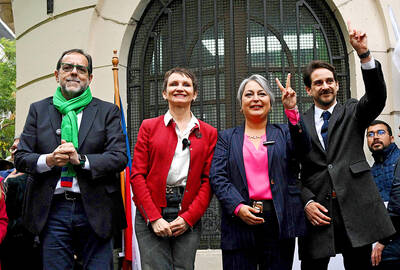
Two former Chilean ministers are among four candidates competing this weekend for the presidential nomination of the left ahead of November elections dominated by rising levels of violent crime. More than 15 million voters are eligible to choose today between former minister of labor Jeannette Jara, former minister of the interior Carolina Toha and two members of parliament, Gonzalo Winter and Jaime Mulet, to represent the left against a resurgent right. The primary is open to members of the parties within Chilean President Gabriel Boric’s ruling left-wing coalition and other voters who are not affiliated with specific parties. A recent poll by the

TENSIONS HIGH: For more than half a year, students have organized protests around the country, while the Serbian presaident said they are part of a foreign plot About 140,000 protesters rallied in Belgrade, the largest turnout over the past few months, as student-led demonstrations mount pressure on the populist government to call early elections. The rally was one of the largest in more than half a year student-led actions, which began in November last year after the roof of a train station collapsed in the northern city of Novi Sad, killing 16 people — a tragedy widely blamed on entrenched corruption. On Saturday, a sea of protesters filled Belgrade’s largest square and poured into several surrounding streets. The independent protest monitor Archive of Public Gatherings estimated the

Irish-language rap group Kneecap on Saturday gave an impassioned performance for tens of thousands of fans at the Glastonbury Festival despite criticism by British politicians and a terror charge for one of the trio. Liam Og O hAnnaidh, who performs under the stage name Mo Chara, has been charged under the UK’s Terrorism Act with supporting a proscribed organization for allegedly waving a Hezbollah flag at a concert in London in November last year. The rapper, who was charged under the anglicized version of his name, Liam O’Hanna, is on unconditional bail before a further court hearing in August. “Glastonbury,
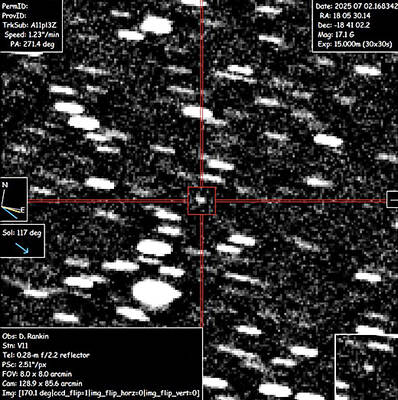
FLYBY: The object, appears to be traveling more than 60 kilometers per second, meaning it is not bound by the sun’s orbit, astronomers studying 3I/Atlas said Astronomers on Wednesday confirmed the discovery of an interstellar object racing through the solar system — only the third-ever spotted, although scientists suspect many more might slip past unnoticed. The visitor from the stars, designated 3I/Atlas, is likely the largest yet detected, and has been classified as a comet, or cosmic snowball. “It looks kind of fuzzy,” said Peter Veres, an astronomer with the International Astronomical Union’s Minor Planet Center, which was responsible for the official confirmation. “It seems that there is some gas around it, and I think one or two telescopes reported a very short tail.” Originally known as A11pl3Z before


 RSS
RSS