


The Philippine Senate today ratified a reciprocal access agreement (RAA) with Japan that would allow their militaries to deploy on each other's soil as both countries worry about China's increasingly assertive stance in the region.
The RAA, the first of its kind that Japan has signed in Asia, is to ease the entry of equipment and troops for combat training and disaster response, smoothing military cooperation between Manila and Tokyo.
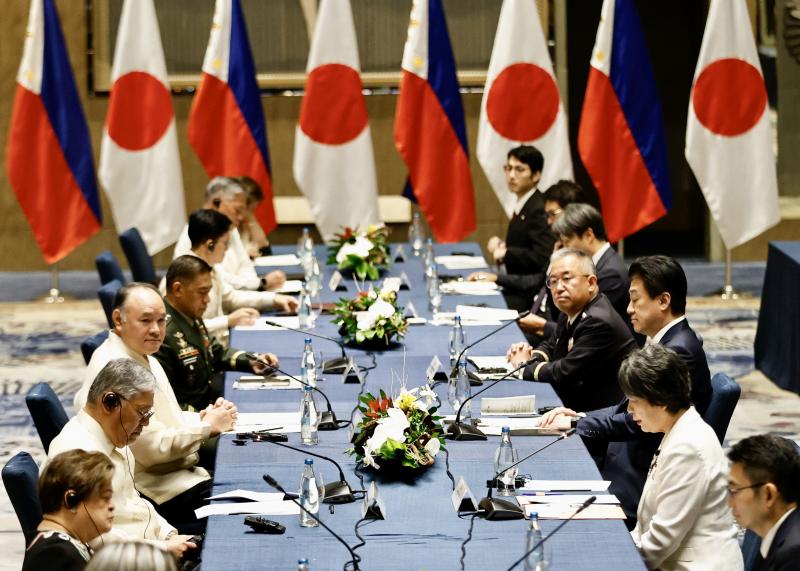
Photo: EPA-EFE
All 19 senators present at today's session voted to ratify the deal, with Japanese Ambassador Kazuya Endo in attendance at the legislative hall in Manila.
"The ... treaty is deemed ratified," Senate President Francis Escudero said.
The agreement was signed by the defense and foreign ministers of both nations in July, but the deal needed parliament's approval to enter into force.
The Chinese embassy in Manila did not immediately reply to a request for comment.
The Philippines and Japan, two of the US' closest Asian allies, have taken a strong line against what they see as an increasingly assertive China in the East and South China Seas, and voicing concern over tension across the Taiwan Strait.
China claims much of the South China Sea, a conduit for the bulk of northeast Asia's trade with the rest of the world in which Taiwan, Brunei, Malaysia, the Philippines and Vietnam also have claims.
Japan has a separate maritime dispute with China in the East China Sea, where the neighbors have repeatedly faced off.
The Philippines has a Visiting Forces Agreement with the US and Australia.
Tokyo, which hosts the biggest concentration of US forces abroad, has similar RAA deals with Australia and Britain, and is negotiating another with France.

An American scientist convicted of lying to US authorities about payments from China while he was at Harvard University has rebuilt his research lab in Shenzhen, China, to pursue technology the Chinese government has identified as a national priority: embedding electronics into the human brain. Charles Lieber, 67, is among the world’s leading researchers in brain-computer interfaces. The technology has shown promise in treating conditions such as amyotrophic lateral sclerosis and restoring movement in paralyzed people. It also has potential military applications: Scientists at the Chinese People’s Liberation Army have investigated brain interfaces as a way to engineer super soldiers by boosting
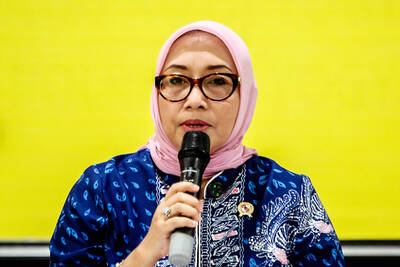
Indonesian police have arrested 13 people after shocking images of alleged abuse against small children at a daycare center went viral, sparking outrage across the nation, officials said on Monday. Police on Friday last week raided Little Aresha, a daycare center in Yogyakarta on Java island, following a report from a former employee. CCTV footage circulating on social media showed children, most younger than two, lying on the floor wearing only diapers, their hands and feet bound with rags. The police have confirmed that the footage is authentic. Police said they also found 20 children crammed into a room just 3m by 3m. “So
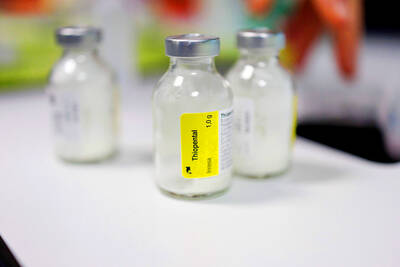
A grieving mother has ended her life at a clinic in Switzerland four years after the death of her only child. Wendy Duffy, 56, a physically healthy woman, died at the Pegasos clinic in Basel after struggling to cope with the death of her 23-year-old son, Marcus. The former care worker, from the West Midlands, England, had previously attempted to take her own life. The case comes as assisted dying would not become law in England and Wales after proposed legislation, branded “hopelessly flawed” by opponents, ran out of time. Ruedi Habegger, the founder of Pegasos, described Duffy’s death as
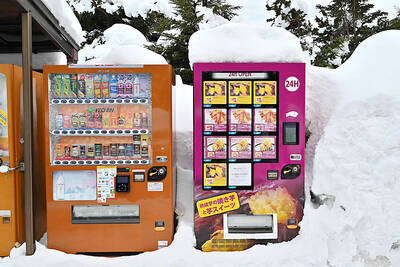
From post offices and parks to stations and even the summit of Mount Fuji, Japan’s vending machines are ubiquitous, but with the rapid pace of inflation cooling demand for their drinks, operators are being forced to rethink the business. Last month beverage giant DyDo Group Holdings announced it would remove about 20,000 vending machines — about 7 percent of their stock nationwide — by January next year, to “reconstruct a profitable network.” Pokka Sapporo Food & Beverage, based in Nagoya, also said last month it would sell its 40,000-machine operation to Osaka-based Lifedrink Co. “The strength of the vending machine


 RSS
RSS