


Senegal on Sunday commemorated the 80th anniversary of a massacre of African soldiers who fought for France during World War II, and were gunned down by French troops in 1944 for demanding fair treatment and payment on their return.
The West African nation has long demanded its former colonizer take responsibility, officially apologize and properly investigate the massacre that took place in Thiaroye, a fishing village on the outskirts of Senegal’s capital, Dakar.
The event, which renewed those demands, came as France is losing influence over its former African colonies, many of which have turned to Russia for security instead.
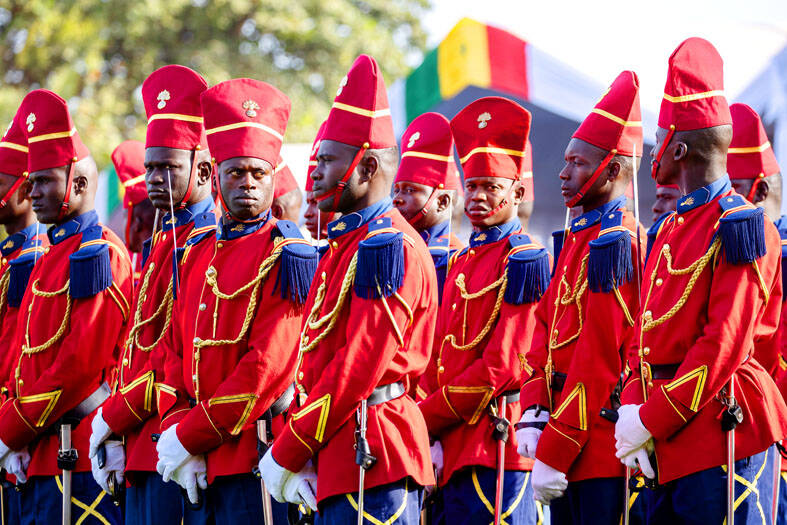
Photo: EPA-EFE
“The riflemen sacrificed everything. They gave of their youth, they gave of their blood, they gave of their flesh for freedom and world peace,” Senegalese President Bassirou Diomaye Faye told guests and reporters.
Accounts of the massacre vary, as does the death toll, which former French president Francois Hollande raised to at least 70 from 35 during a visit to Thiaroye in 2014. Historians say hundreds might have died in the confrontation with colonial authorities.
The ceremony, which French Minister of Europe and Foreign Affairs Jean-Noel Barrot attended alongside other African heads of state, started with a visit to the Thiaroye military cemetery to lay flowers.
A printed guide to the ceremony described the “horrific repression” of members of the Senegalese infantry unit, who were surrounded and gunned down for requesting due compensation.
A few days before the commemoration, French President Emmanuel Macron wrote a public letter to his Senegalese counterpart in which he referred to the killings as a “massacre.”
Faye said Macron’s acknowledgement was a significant step in the process of rehabilitating the honor and dignity of the victims.
Barrot said in a speech that his nation had recognized that on that day, “a chain of events was set in motion that led to a massacre.”
Gaspard Mbaye, head of an association dedicated to the soldiers’ memory, said that he was disappointed because he expected more from the French government.
“They continue to conceal the truth and try to divert attention,” Mbaye said.

‘CROSSING THE LINE’: China’s embassy in Seoul criticized US Forces Korea Commander General Xavier Brunson, asking if his ‘hostile’ remarks were authorized by Washington South Korea and the US are in talks over recent public remarks by the commander of US Forces Korea, Seoul’s presidential office said yesterday, after the comments drew sharp criticism from China. In a recent podcast interview, US Forces Korea Commander General Xavier Brunson described South Korea as “the dagger in the heart of Asia” from China’s east coast, prompting the Chinese embassy in Seoul to say that he had “truly crossed the line.” The interview came amid growing speculation that Washington might seek to expand the role of US Forces Korea in countering the growing regional influence of China, a key

SEEKING ORDER: Rodrigo Paz said that ‘anyone who wants to destroy the nation will have to deal with this president and the full force of the constitution’ Bolivian President Rodrigo Paz on Wednesday said that the nation was at a “breaking point” after nearly a month of protests that have caused shortages of food, fuel and medicine. Paz, who took office six months ago amid the worst economic crisis there in four decades, is battling a groundswell of fury over his policies. The political capital, La Paz, has been besieged by low-income workers and members of the indigenous majority calling for his resignation. “The country needs order and is reaching breaking point,” the 58-year-old said at a public event in La Paz, renewing his appeal for dialogue. On Tuesday, the Bolivian

Through the noise of rushing papers and whirring belts at a print factory in Kyoto, two creators watch their photo essay come to life in broadsheet form — part of an effort to win new audiences in the age of artificial intelligence (AI). Despite the decline of the publishing industry, self-publication and handmade “zine” magazines are growing in popularity in Japan, reflecting the nation’s enduring love of paper in the digital era. While speaking to Agence France-Presse at the plant, his hands black with ink, one of the creators, Kazuma Obara, said: “I think [paper] is a medium that engages all five

Australian researchers have trained lab-grown brain cells on a silicon computer chip to play the 1990s shooter game Doom and said they are just scratching the surface of what the neurons could be capable of doing. It is the science-fiction work of biotech boffins at Cortical Labs, who researched and developed the technology that harnesses the workings of the brain’s networking system. Each so-called “biological computer” contains about 200,000 living human brain cells, grown from stem cells that were harvested from blood donations. Having mastered the simple computer game Pong, where a paddle is moved up and down to send a ball


 RSS
RSS