


British Prime Minister Keir Starmer would become the first UK prime minister in six years to meet Chinese President Xi Jinping (習近平), promising to turn the page on UK-China relations by building “a pragmatic and serious relationship.”
Starmer and British Chancellor of the Exchequer Rachel Reeves have been pursuing a thawing of relations with the world’s second-largest economy on pragmatic grounds, suggesting that the UK cannot achieve its growth ambitions without better terms with China.
However, the move to deepen ties is likely to be controversial among human rights groups and backbenchers, and with several high-profile Conservative MPs who have had sanctions imposed on them by China.

Photo: Reuters
British lawmakers Tom Tugendhat and Alicia Kearns, both prominent Conservative critics of China, called on Starmer to use the meeting to raise with Xi the plight of UK nationals including Jimmy Lai (黎智英), the pro-democracy media owner detained and tried in Hong Kong.
Starmer was to meet Xi yesterday after press time in Rio de Janeiro at the G20 summit, a meeting of world leaders that is likely to be marked by divisions over the climate crisis and Ukraine.
No British prime minister has met Xi since then-British prime minister Theresa May visited Beijing in 2018 in the midst of a trade push during Brexit negotiations, although her successor, former British prime minister Boris Johnson, spoke to the Chinese president during the pandemic.
Since then, relations have significantly cooled because of cyber threats, a human rights crackdown in Hong Kong and the sanctions against British MPs.
Then-British prime minister Rishi Sunak attempted to renew relations at the G20 summit in 2022 where a bilateral was planned, but cancelled due to Ukraine developments. However, Conservative leaders have toyed with designating China a threat to British security — stronger language than the US had used.
Tugendhat said: “Jimmy Lai [黎智英] — a British citizen — is being put on a show trial in Hong Kong. Others are being threatened here in the UK.”
“It is essential that Starmer raises Mr Lai’s case and the threats we are witnessing against other British nationals who have spoken out who are now here in the UK. Starmer must clearly defend Britain against Beijing’s authoritarian regime,” he added.
British Secretary of State for Foreign, Commonwealth and Development Affairs visited China last month in the first signal that the new Labour government saw a renewal of better ties as a priority.
Reeves, who is understood to be taking a leading role in pursuing new economic opportunities with China, is to head to Beijing in January.
In remarks before his meeting with Xi, Starmer sought to head off gloomy predictions for the summit, at which there would be a number of world leaders who are facing election defeat.
“It is in the UK’s best interests to engage on the global stage — whether that’s building strong and fruitful partnerships with our closest allies or being frank with those whose values differ from our own,” Starmer said.
Starmer expects to meet at least eight world leaders in one-to-one discussions in Rio.
Speaking to reporters en route to the summit, Starmer underlined the need for a realistic approach, saying it was important that he met Xi and stressing the potential economic benefits — without mentioning the potential security risks to better relations.
“We are both global players, global powers, both permanent members of the [UN] security council and of the G20. China’s economy is obviously the second biggest in the world,” he said.
“It’s one of our biggest trading partners and therefore I will be having serious, pragmatic discussions with the president when I meet him,” he added.
No. 10 said that any change in relations would be “rooted at all times in the UK’s national interests,” adding that there are “clear areas of mutual cooperation — including on international stability, climate and growth.”
Starmer would be “firm on the need to have honest conversations on areas of disagreement, while competing and challenging where we have to,” it added.

ROCKY RELATIONS: The figures on residents come as Chinese tourist numbers drop following Beijing’s warnings to avoid traveling to Japan The number of Chinese residents in Japan has continued to rise, even as ties between the two countries have become increasingly fractious, data released on Friday showed. As of the end of December last year, the number of Chinese residents had increased by 6.5 percent from the previous year to 930,428. Chinese people accounted for 22.6 percent of all foreign residents in Japan, making them by far the largest group, Japanese Ministry of Justice data showed. Beijing has criticized Tokyo in increasingly strident terms since Japanese Prime Minister Sanae Takaichi last year suggested that a military conflict around Taiwan could
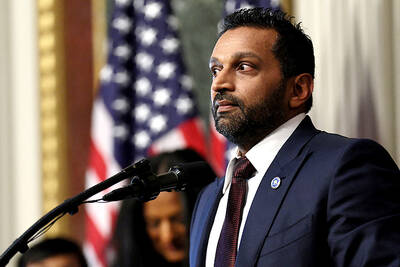
A pro-Iran hacking group claimed to breach FBI Director Kash Patel’s personal e-mail inbox and posted some of the contents online. The e-mails provided by the hacking group include travel details, correspondence with leasing agents in Washington and global entry, and loyalty account numbers. The e-mail address the hackers claim to have compromised has been previously tied to Patel’s personal details, and the leaked e-mails contain photos of Patel and others, in addition to correspondence with family members and colleagues. “The FBI is aware of malicious actors targeting Director Patel’s personal email information,” the agency said in a statement on
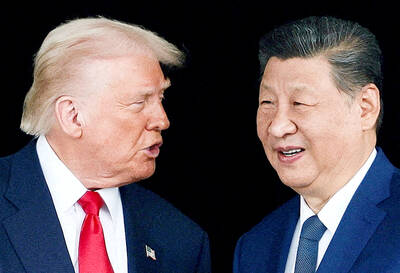
RIVALRY: ‘We know that these are merely symbolic investigations initiated by China, which is in fact the world’s most profligate disrupter of supply chains,’ a US official said China has started a pair of investigations into US trade practices, retaliating against similar probes by US President Donald Trump’s administration as the superpowers stake out positions before an expected presidential summit in May. The move, announced by the Chinese Ministry of Commerce on Friday, is a direct mirror of steps Trump took to revive his tariff agenda after the US Supreme Court last month struck down some of his duties. “China expresses its strong dissatisfaction and firm opposition to these actions,” a ministry spokesperson said in a statement, referring to the so-called Section 301 investigations initiated on March 11.

When a hiker fell from a 55m waterfall in wild New Zealand bush, rescuers were forced to evacuate the badly hurt woman without her dog, which could not be found. After strangers raised thousands of dollars for a search, border collie Molly was flown to safety by a helicopter pilot who was determined to reunite the pet and the owner. A week earlier, an emergency rescue helicopter found the woman with bruises and lacerations after a fall at a rocky spot at the waterfall on the South Island’s West Coast. She was airlifted on March 24, but they were forced to


 RSS
RSS