


Five years of investigation and expert reports have failed to identify the precise cause of the 2019 fire that ravaged Paris’ landmark Notre Dame Cathedral, even as the probe draws to a close just as the cathedral prepares to reopen early next month.
Notre Dame’s bells rang out Friday for the first time since the fire, ahead of a reopening ceremony on Dec. 7.
However, investigators have yet to establish who, if anyone, is responsible for the fire whose images went around the world.
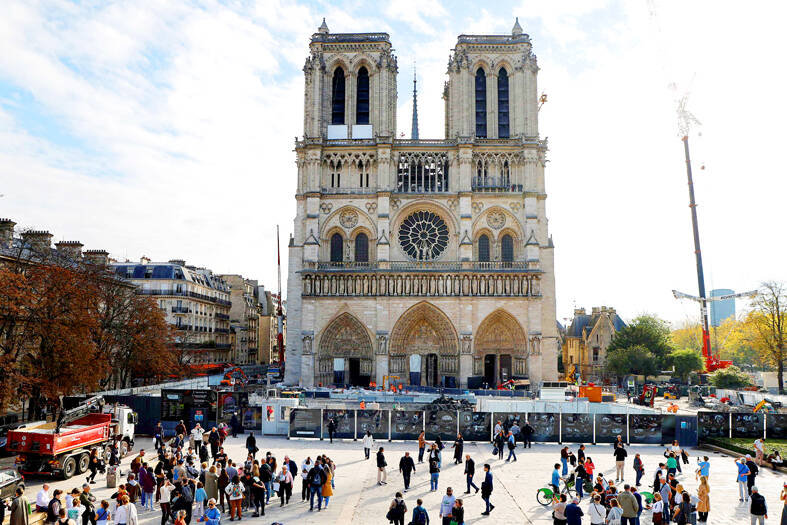
Photo: AFP
“Every avenue, including the hypothesis of a human role in the origin of this fire [has been] explored since the beginning of the investigation,” Paris’ chief prosecutor Laure Beccuau said in April.
“But the truth is that the closer we have got to the spot the fire started, and the more results of analyses come back, the more weight is lent to the theory of an accident,” she added.
Beccuau at the time said that investigating magistrates had last year called for new expert reports on the cathedral debris, the place where the fire started and the church’s “technical infrastructure.”
Although all had been carried out by April, the experts have been asked to summarize and cross-reference their “extremely technical” findings “to see if it is possible to determine a potential cause for the fire,” she added.
Prosecutors this week said that investigating magistrates have now ordered “a 3D simulation be created of the start of the fire using the images taken at the time. This simulation will allow us to compare different theories” about the blaze.
So far “no charges have been filed” against anyone, the prosecutors confirmed.
A source familiar with the case said the investigation was drawing to a close.
Remy Heitz, chief Paris prosecutor of the initial investigation, said at the time he believed an accidental cause such as an electrical fault or smoldering cigarette butt was most likely.
Since then, no new information has surfaced to suggest deliberate arson.
“Over the past year, every zone has been cleared of debris” — without revealing any new relevant evidence, a source in the judiciary said last year.
The more than 850-year-old cathedral of Notre Dame, whose silhouette is known worldwide, was undergoing restoration work when fire broke out on April 15, 2019.
In a spectacularly destructive blaze relayed around the world in images and live broadcasts, the church lost its spire, roof, clock and part of its stone vault.
Several safety failings were later singled out, including the cathedral’s alarm system which contributed to slowing firefighters’ response, as well the electrical system in one of its elevators.
Neither is believed to have initially set off the fire, but they enabled the flames to spread through the monument.
Investigators have a separate case open into the potentially harmful health effects of the Notre Dame fire, which has also filed no charges so far, prosecutors said.
A health association joined forces with a union and two parents of local schoolchildren for a 2022 criminal complaint that accused authorities of failing to take every precaution to prevent lead pollution.
Supported by its “forest” of wooden beams, Notre Dame’s roof and spire were covered by about 400 tonnes of lead, a toxic heavy metal that went up in smoke with the fire — some of which likely came back down to earth in the neighbourhood.
The weight is “four times the total annual lead emissions into the atmosphere for all of France,” the plaintiffs pointed out.
Possible charges for the lead’s impact on the health of both local residents and workers sent in to decontaminate the Notre Dame site are being investigated by the same judge, a judicial source said.
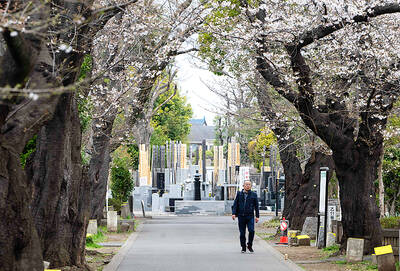
ROCKY RELATIONS: The figures on residents come as Chinese tourist numbers drop following Beijing’s warnings to avoid traveling to Japan The number of Chinese residents in Japan has continued to rise, even as ties between the two countries have become increasingly fractious, data released on Friday showed. As of the end of December last year, the number of Chinese residents had increased by 6.5 percent from the previous year to 930,428. Chinese people accounted for 22.6 percent of all foreign residents in Japan, making them by far the largest group, Japanese Ministry of Justice data showed. Beijing has criticized Tokyo in increasingly strident terms since Japanese Prime Minister Sanae Takaichi last year suggested that a military conflict around Taiwan could

Germany is considering Australia’s Ghost Bat robot fighter as it looks to select a combat drone to modernize its air force, German Minister of Defense Boris Pistorius said yesterday. Germany has said it wants to field hundreds of uncrewed fighter jets by 2029, and would make a decision soon as it considers a range of German, European and US projects developing so-called “collaborative combat aircraft.” Australia has said it will integrate the Ghost Bat, jointly developed by Boeing Australia and the Royal Australian Air Force, into its military after a successful weapons test last year. After inspecting the Ghost Bat in Queensland yesterday,
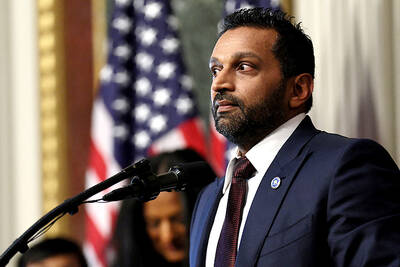
A pro-Iran hacking group claimed to breach FBI Director Kash Patel’s personal e-mail inbox and posted some of the contents online. The e-mails provided by the hacking group include travel details, correspondence with leasing agents in Washington and global entry, and loyalty account numbers. The e-mail address the hackers claim to have compromised has been previously tied to Patel’s personal details, and the leaked e-mails contain photos of Patel and others, in addition to correspondence with family members and colleagues. “The FBI is aware of malicious actors targeting Director Patel’s personal email information,” the agency said in a statement on
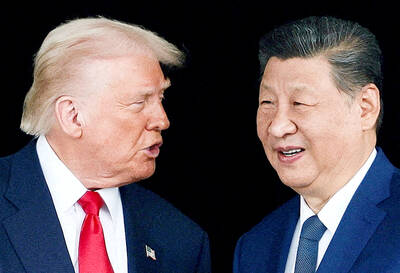
RIVALRY: ‘We know that these are merely symbolic investigations initiated by China, which is in fact the world’s most profligate disrupter of supply chains,’ a US official said China has started a pair of investigations into US trade practices, retaliating against similar probes by US President Donald Trump’s administration as the superpowers stake out positions before an expected presidential summit in May. The move, announced by the Chinese Ministry of Commerce on Friday, is a direct mirror of steps Trump took to revive his tariff agenda after the US Supreme Court last month struck down some of his duties. “China expresses its strong dissatisfaction and firm opposition to these actions,” a ministry spokesperson said in a statement, referring to the so-called Section 301 investigations initiated on March 11.


 RSS
RSS