


Western security officials suspect Russian intelligence was behind a plot to put incendiary devices in packages on cargo planes headed to North America, including one that caught fire at a courier hub in Germany and another that ignited in a warehouse in England.
Poland last month said that it had arrested four people suspected to be linked to a foreign intelligence operation that carried out sabotage and was searching for two others. Lithuania’s prosecutor general Nida Grunskiene on Tuesday said that there were an unspecified number of people detained in several countries, offering no elaboration.
The events come as Western officials say they are seeing an intensification of a hybrid war of sabotage by Russia targeting Ukraine’s allies, including election disinformation and arson attacks in Europe this year.

Photo: AP
Several officials said they believe the attacks were the work of Russian military intelligence, the GRU, although Moscow denied involvement.
Poland’s Internal Security Agency, or ABW, said that incidents in Poland, as well as other EU and NATO members, had intensified this year.
The ABW believes the incidents are initiated and coordinated by the Russian special services.
So far, 20 people have been charged in investigations led by the prosecutors’ office, the ABW and police.
Polish Prosecutor Katarzyna Calow-Jaszewska said the investigation focuses on foreign agents conducting acts of sabotage, including damaging industrial facilities or critical infrastructure such as airports, airplanes and other vehicles, and as well as arson using self-combustible parcels sent to EU countries and the UK that would ignite during road or air transport.
The group tested a channel for sending such parcels to the US and Canada, Calow-Jaszewska said.
The Wall Street Journal first reported the details of the cargo plane incidents.
The US Transportation Security Administration (TSA) said it has put extra security measures in place in the past few months for some cargo shipments heading to the US.
“We continually adjust our security posture as appropriate and promptly share any and all relevant information with our industry partners, to include requirements and recommendations that help them reduce risk,” the TSA said.
Dirk Heinrichs, a spokesman for DHL in Germany, said in an e-mailed statement that the company could not provide details about the matter, but was “fully cooperating with the relevant authorities to protect our people, our network and our customers’ shipments.”
The head of Britain’s domestic intelligence agency, MI5, last month said that the UK is facing a “staggering rise” in attempts at assassination, sabotage and other crimes on its soil by Russia as well as Iran.
Calow-Jaszewska on Oct. 25 said that parcels with camouflaged explosives were sent via cargo companies to EU countries and Britain to “test the transfer channel for such parcels” that were ultimately destined for the US and Canada.
The incendiary devices in Germany and the UK both ignited in July.
One was at a stopover at a DHL logistics center at an airport in the city of Leipzig, according to Thomas Haldenwang, head of the Germany’s domestic intelligence agency.
German news agency dpa reported that the connecting flight containing the package, which came from one of the Baltic nations, was delayed in Leipzig and was on the ground when it ignited and set fire to a freight container.
British counterterrorism police are investigating whether Russian agents were behind an incendiary device in a parcel that caught fire in a DHL warehouse in Minworth, near Birmingham, England, on July 22.
The incident, first reported by the Guardian and German broadcasters, was similar to the one in Germany.
Polish newspaper Gazeta Wyborcza also reported that a fire was reported in a courier truck near Warsaw.
“We are observing aggressive action by the Russian intelligence services. In particular Russian espionage and sabotage in Germany are on the rise, both quantitatively and qualitatively,” Haldenwang told the German Budestag last month while discussing the Leipzig incident. “The activities of Russian intelligence services in the real world as well as in cyberspace show that Germany is the focus of this Russia’s hybrid war against Western democracies.”

ROCKY RELATIONS: The figures on residents come as Chinese tourist numbers drop following Beijing’s warnings to avoid traveling to Japan The number of Chinese residents in Japan has continued to rise, even as ties between the two countries have become increasingly fractious, data released on Friday showed. As of the end of December last year, the number of Chinese residents had increased by 6.5 percent from the previous year to 930,428. Chinese people accounted for 22.6 percent of all foreign residents in Japan, making them by far the largest group, Japanese Ministry of Justice data showed. Beijing has criticized Tokyo in increasingly strident terms since Japanese Prime Minister Sanae Takaichi last year suggested that a military conflict around Taiwan could
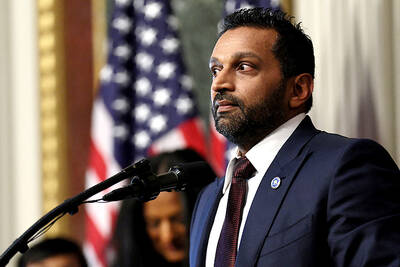
A pro-Iran hacking group claimed to breach FBI Director Kash Patel’s personal e-mail inbox and posted some of the contents online. The e-mails provided by the hacking group include travel details, correspondence with leasing agents in Washington and global entry, and loyalty account numbers. The e-mail address the hackers claim to have compromised has been previously tied to Patel’s personal details, and the leaked e-mails contain photos of Patel and others, in addition to correspondence with family members and colleagues. “The FBI is aware of malicious actors targeting Director Patel’s personal email information,” the agency said in a statement on
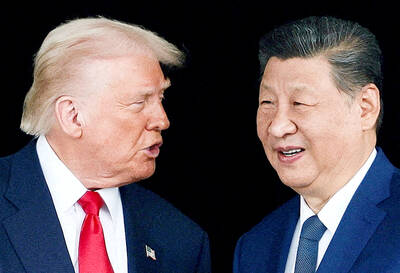
RIVALRY: ‘We know that these are merely symbolic investigations initiated by China, which is in fact the world’s most profligate disrupter of supply chains,’ a US official said China has started a pair of investigations into US trade practices, retaliating against similar probes by US President Donald Trump’s administration as the superpowers stake out positions before an expected presidential summit in May. The move, announced by the Chinese Ministry of Commerce on Friday, is a direct mirror of steps Trump took to revive his tariff agenda after the US Supreme Court last month struck down some of his duties. “China expresses its strong dissatisfaction and firm opposition to these actions,” a ministry spokesperson said in a statement, referring to the so-called Section 301 investigations initiated on March 11.

When a hiker fell from a 55m waterfall in wild New Zealand bush, rescuers were forced to evacuate the badly hurt woman without her dog, which could not be found. After strangers raised thousands of dollars for a search, border collie Molly was flown to safety by a helicopter pilot who was determined to reunite the pet and the owner. A week earlier, an emergency rescue helicopter found the woman with bruises and lacerations after a fall at a rocky spot at the waterfall on the South Island’s West Coast. She was airlifted on March 24, but they were forced to


 RSS
RSS