


Deforestation continued last year at a rate far beyond pledges to end the practice by 2030, according to a major study published yesterday.
Forests nearly the size of Ireland were lost last year, according to two dozen research organizations, non-governmental organizations and advocacy groups, with 6.37 million hectares of trees felled and burned. This “significantly exceeded” levels that would have kept the world on track to eliminate deforestation by the end of the decade, a commitment made in 2021 by more than 140 leaders.
Forests are home to 80 percent of the world’s terrestrial plant and animal species, and crucial for regulating water cycles and sequestering carbon dioxide, the main greenhouse gas responsible for global warming.
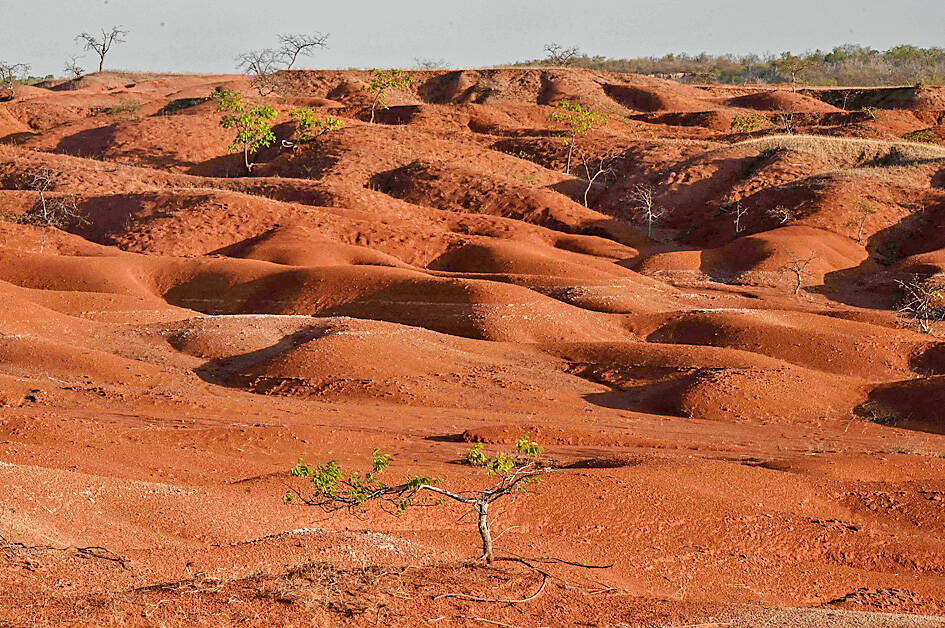
Photo: AFP
“Globally, deforestation has gotten worse, not better, since the beginning of the decade,” said Ivan Palmegiani, a biodiversity and land use consultant at Climate Focus and lead author of the “Forest Declaration Assessment” report.
“We’re only six years away from a critical global deadline to end deforestation, and forests continue to be chopped down, degraded, and set ablaze at alarming rates,” he said.
Last year, 3.7 million hectares of tropical primary forest — particularly carbon rich and ecologically biodiverse environments — disappeared, a figure that should have fallen significantly to meet the 2030 objective.
In high-risk regions, researchers pointed to backsliding in Bolivia and Indonesia. The report said there was an “alarming rise” in deforestation in Bolivia, which jumped 351 percent between 2015 and last year.
The “trend shows no sign of abating,” it added, with forests largely cleared for agriculture, notably for soya, but also beef and sugar.
In Indonesia, deforestation slumped between 2020 and 2022, but started rising sharply last year.
Ironically, that is partly down to demand for materials often seen as eco-friendly, such as viscose for clothing, and a surge in nickel mining for electric vehicle batteries and renewable energy technologies.
There was better news from Brazil.
While it remains the nation with the highest deforestation rates in the world, it has made key progress. The situation has significantly improved in the Amazon, which has benefited from protective measures put in place by Brazilian President Luiz Inacio Lula da Silva.
However, in the Cerrado, a key tropical savannah below the Amazon, deforestation has increased.
Erin Matson, senior consultant at Climate Focus and coauthor of the report, said “strong policies and strong enforcement” are needed.
“To meet global forest protection targets, we must make forest protection immune to political and economic whims,” she said.
The report comes in the wake of the European Commission’s proposal last week to postpone by a year (to the end of next year) its anti-deforestation law, despite protests from non-governmental organizations.
“We have to fundamentally rethink our relationship with consumption and our models of production to shift away from a reliance on overexploiting natural resources,” Matson said.

Four contenders are squaring up to succeed Antonio Guterres as secretary-general of the UN, which faces unprecedented global instability, wars and its own crushing budget crisis. Chile’s Michelle Bachelet, Argentina’s Rafael Grossi, Costa Rica’s Rebeca Grynspan and Senegal’s Macky Sall are each to face grillings by 193 member states and non-governmental organizations for three hours today and tomorrow. It is only the second time the UN has held a public question-and-answer, a format created in 2016 to boost transparency. Ultimately the five permanent members of the UN’s top body, the Security Council, hold the power, wielding vetoes over who leads the

A humanoid robot that won a half-marathon race for robots in Beijing on Sunday ran faster than the human world record in a show of China’s technological leaps. The winner from Honor, a Chinese smartphone maker, completed the 21km race in 50 minutes and 26 seconds, said a WeChat post by the Beijing Economic-Technological Development Area, also known as Beijing E-Town, where the race began. That was faster than the human world record holder, Ugandan Jacob Kiplimo, who finished the same distance in about 57 minutes in March at the Lisbon road race. The performance by the robot marked a significant step forward

An earthquake registering a preliminary magnitude of 7.7 off northern Japan on Monday prompted a short-lived tsunami alert and the advisory of a higher risk of a possible mega-quake for coastal areas there. The Cabinet Office and the Japan Meteorological Agency said there was a 1% chance for a mega-quake, compared to a 0.1% chance during normal times, in the next week or so following the powerful quake near the Chishima and Japan trenches. Officials said the advisory was not a quake prediction but urged residents in 182 towns along the northeastern coasts to raise their preparedness while continuing their daily lives. Prime
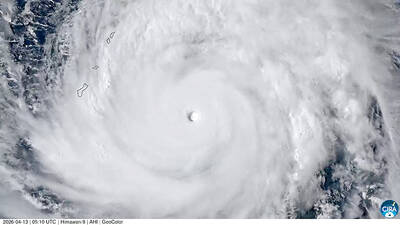
HAZARDOUS CONDITION: The typhoon’s sheer size, with winds extending 443km from its center, slowed down the ability of responders to help communities, an official said The US Coast Guard was searching for six people after losing contact with their disabled boat off the coast of Guam following Typhoon Sinlaku. The crew of the 44m dry cargo vessel, the US-registered Mariana, on Wednesday notified the coast guard that the boat had lost its starboard engine and needed assistance, Petty Officer 3rd Class Avery Tibbets said yesterday. The coast guard set up a one-hour communication schedule with the vessel, but lost contact on Thursday. A Coast Guard HC-130 Hercules aircraft was launched to search for the six people on board, but it had to return to Guam because of


 RSS
RSS