


A pair of rare Amur tiger cubs are making their public debut at Minnesota Zoo, raising hopes for preserving an endangered species that is native to far eastern Russia and northern China.
Andrei and Amaliya got to venture outside and feel the grass of their new home under their paws on Wednesday for the first time since their 12-year-old mother, Dari, gave birth on May 23.
“They’ve done quite well since then,” zoologist Trista Fischer said.
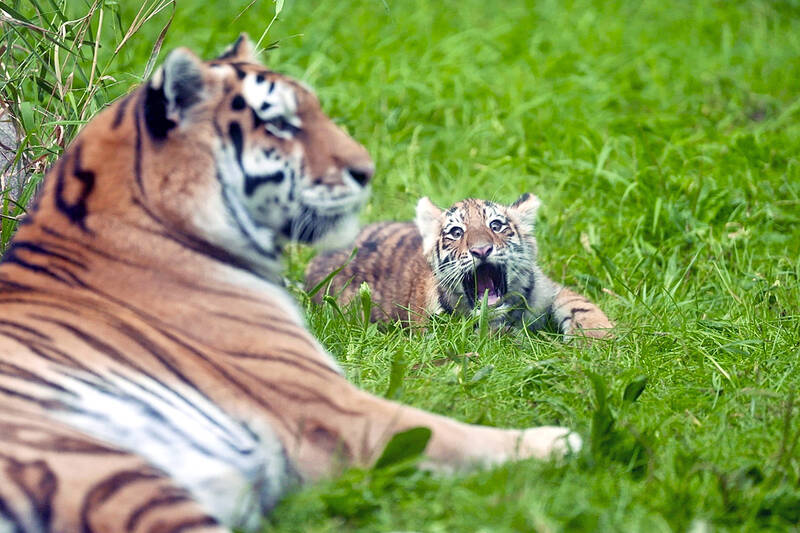
Photo: AP
“We’ve monitored them very closely. Dari’s been fantastic. She’s provided outstanding maternal care, and so today we’ve reached the point where they’re fully vaccinated and they’re now about 40 to 45 pounds [18 to 20kg],” she added.
Scientists estimate the Amur tiger population is just about 400 to 500 in the wild.
They were near the brink of extinction in the 1930s and 1940s, but have recovered somewhat since then.
It is tricky to breed them, and about one in four Amur cubs do not make it to adulthood, whether it is in the wild or in captivity, she said. Poachers are another major threat.
However, Minnesota Zoo, in the Minneapolis suburb of Apple Valley, has a long history of conserving tigers. Its Amur tigers have produced 57 cubs, 46 of which survived for at least 30 days.
Of those 46, 21 have gone on to produce litters of their own, amounting to another 86 cubs.
The births of Andrei and Amaliya raised the zoo’s population to seven Amur tigers, including their sire, Luka.
Fischer is the leading coordinator for the Tiger Species Survival Plan, a breeding program in the US with facilities in other countries that works on a global level to preserve the big cats.
The plan manages three groups of tigers: Sumatran, Malayan and Amur.
“This litter is so valuable to the population right now,” she said, adding that the genetic diversity of healthy tigers in human care could someday be used to help support populations in the wild.
Zoo spokesperson Zach Nugent said the cubs would remain housed together with their mom for about 18 months, before Andrei, the male, is moved to separate housing, about the same time a male cub in the wild would start venturing out on his own.
Amaliya, the female, might spend a little more time with Dari, up to 24 months.
Then Fischer would determine whether either cub should be bred, and potentially moved for that to another accredited zoo, which typically happens after the cubs are two years old.
“Aww, I love when they get their little Yoda ears,” Fischer said referring to the pointy ears of the Star Wars character as she watched Amaliya and Andrei explore the new terrain of their enclosure.
She said it was an emotional, exciting and proud moment for her and her team.
“Our work’s not over, but all that work so far is really paying off in how well these cubs are acclimating to a new surrounding, pretty much immediately,” she said as the little tigers roamed outside with their mother.
“They’re showing a lot of resiliency, which is something that we work hard for in human care. We want these animals to have a lot of confidence and be able to adapt to new environments just as they’re doing today,” she said.


PHISHING: The con might appear convincing, as the scam e-mails can coincide with genuine messages from Apple saying you have run out of storage For a while you have been getting messages from Apple saying “your iCloud storage is full.” They say you have exceeded your storage plan, so documents are no longer being backed up, and photos you take are not being uploaded. You have been resisting Apple’s efforts to get you to pay a minimum of £0.99 (US$1.33) a month for more storage, but it seems that you cannot keep putting off the inevitable: You have received an e-mail which says your iCloud account has been blocked, and your photos and videos would be deleted very soon. To keep them you need

For two decades, researchers observed members of the Ngogo chimpanzee group of Kibale National Park in Uganda spend their days eating fruits and leaves, resting, traveling and grooming in their tropical rainforest abode, but this stable community then fractured and descended into years of deadly violence. The researchers are now describing the first clearly documented example of a group of wild chimpanzees splitting into two separate factions, with one launching a series of coordinated attacks against the other. Adult males and infants were targeted, with 28 deaths. “Biting, pounding the victim with their hands, dragging them, kicking them — mostly adult males,

The Israeli military has demolished entire villages as part of its invasion of south Lebanon, rigging homes with explosives and razing them to the ground in massive remote detonations. The Guardian reviewed three videos posted by the Israeli military and on social media, which showed Israel carrying out mass detonations in the villages of Taybeh, Naqoura and Deir Seryan along the Israel-Lebanon border. Lebanese media has reported more mass detonations in other border villages, but satellite imagery was not readily available to verify these claims. The demolitions came after Israeli Minister of Defense Israel Katz called for the destruction of

SUPERFAN: The Japanese PM played keyboard in a Deep Purple tribute band in middle school and then switched to drums at university, she told the British rock band Legendary British rock band Deep Purple yesterday made Japanese Prime Minister Sanae Takaichi’s day with a brief visit to their high-profile superfan as they returned to the nation they first toured more than half a century ago. Takaichi’s reputation as an amateur drummer, and a fan of hard rock and heavy metal has been well documented, and she has referred to Deep Purple as one of her favorite bands along with the likes of Black Sabbath and Iron Maiden. “You are my god,” a giddy Takaichi said in English to Deep Purple drummer Ian Paice, presenting him with a set of made-in-Japan


 RSS
RSS