


Thailand has netted more than 1.3 million kilograms of highly destructive blackchin tilapia fish, the government said yesterday, as it battles to stamp out the invasive species.
Shoals of blackchin tilapia, which can produce up to 500 young at a time, have been found in 19 provinces, damaging ecosystems in rivers, swamps and canals by preying on small fish, shrimp and snail larvae.
As well as the ecological impact, the government is worried about the effect on the kingdom’s crucial fish-farming industry.
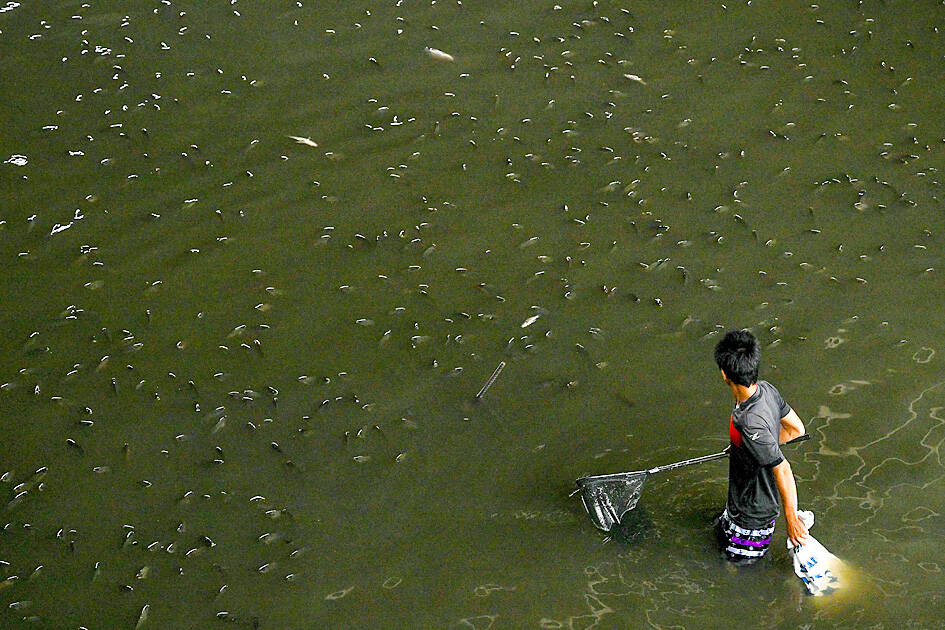
Photo: AFP
Fishing authorities caught 1,332,000kg of blackchin tilapia from February to Wednesday last week, said Nattacha Boonchaiinsawat, vice president of a parliamentary committee set up to tackle the spread of the fish.
“We talked to local residents and found out that the spread of tilapia has got worse — they found them in small canals, which was not the case before,” Nattacha said.
The outbreak of tilapia would cost the Thai economy at least 10 billion baht (US$292 million), he said.
The fish, native to West Africa, were first discovered in Thailand’s rivers in 2010 before spreading rapidly in 2018, and are now also found in the US state of Florida and in the Philippines.
In July, the Thai government declared the eradication of the species a national priority and began encouraging people to consume the fish.
Promotional activities in Phetchaburi Province advertised tilapia-based fish sauces and sausages.
Restaurants have also increasingly used the fish in cuisine, fried with garlic or sun-dried.
It remains unclear how the fish arrived in Thailand, but local media reports have said they could have been imported by a company from Ghana in 2010.
A parliamentary investigation is under way to determine the cause of the infestation, Nattacha said.
The Thai government has encouraged locals to catch the fish, offering to pay people 15 baht per kilogram.
It has also designated 75 vending areas around the country where the fish can be sold.
Authorities have released predator species to hunt down the tilapia and are also developing genetically modified blackchin tilapia to produce sterile offspring.
A UN science panel last year warned that the tilapia are spreading faster than ever, wrecking crops, distributing disease and upending ecosystems.
More than 37,000 alien species have taken hold far from their places of origin, costing upwards of US$400 billion a year in damages and lost income, the panel said.

‘GROSS NEGLIGENCE?’ Despite a spleen typically being significantly smaller than a liver, the surgeon said he believed Bryan’s spleen was ‘double the size of what is normal’ A Florida surgeon who is facing criminal charges after allegedly removing a patient’s liver instead of his spleen has said he is “forever traumatized” by that person’s death. In a deposition from November last year that was recently obtained by NBC, 44-year-old Thomas Shaknovsky described the death of 70-year-old William Bryan as an “incredibly unfortunate event that I regret deeply.” Bryan died after the botched surgery; and last month, a grand jury in Tallahassee indicted Shaknovsky on a charge of manslaughter. “I’m forever traumatized by it and hurt by it,” Shaknovsky added, also saying that wrong-site surgeries can happen “during

Former Chinese ministers of national defense Wei Fenghe(魏鳳和) and Li Shangfu (李尚福) were both sentenced to death with a two-year reprieve over graft charges, state news agency Xinhua reported on Thursday, underscoring the severity of the purge in the military. The armed forces have been one of the main targets of a broad corruption crackdown ordered by Chinese President Xi Jinping (習近平) after coming to power in 2012. The purges reached the elite Rocket Force, which oversees nuclear weapons as well as conventional missiles, in 2023. Earlier this year they escalated further, resulting in the removal of the top general in

‘PERSONAL MISTAKES’: Eileen Wang has agreed to plead guilty to the felony, which comes with a maximum sentence of 10 years in federal prison A southern California mayor has agreed to plead guilty to acting as an illegal agent for the Chinese government and has resigned from her city position, officials said on Monday. Eileen Wang (王愛琳), mayor of Arcadia, was charged last month with one count of acting in the US as an illegal agent of a foreign government. She was accused of doing the bidding of Chinese officials, such as sharing articles favorable to Beijing, without prior notification to the US government as required by law. The 58-year-old was elected in November 2022 to a five-person city council, from which the mayor is selected

The Philippine Coast Guard yesterday said it deployed aircraft to issue radio warnings to a Chinese research ship in a disputed area of the South China Sea “swarming” with vessels from Beijing’s so-called maritime militia. The research vessel Xiang Yang Hong 33 (向陽紅33), which is capable of supporting submersible craft, was operating near a reef in the contested Spratly Islands (Nansha Islands, 南沙群島), which Taiwan also claims, the Philippine Coast Guard said. The Chinese ship was deploying a service boat toward the Spratly’s Iroquois Reef on Wednesday when it was spotted by a coast guard plane, “confirming ongoing unauthorized [marine scientific research]


 RSS
RSS