

Hundreds of police officers backed by riot squads yesterday raided a vast religious compound in a southern Philippine city in search of a local preacher accused of sexual abuse and human trafficking, police officials said.
A supporter of the group, called Kingdom of Jesus Christ, reportedly died due to a heart attack during the massive police raid that started at dawn in the group’s compound in Davao City, livestreamed online by a local TV network owned by the group, police said, adding that the death was not related to the police operations.
Officers brought equipment that could detect people behind cement walls, but by midafternoon, they found no sign of Apollo Quiboloy in the compound — about 30 hectares that includes a cathedral, a school, a living area, a hangar and a taxiway leading to Davao International Airport.

Photo: AP
Quiboloy and his lawyer have denied the criminal allegations against him and his religious group, saying these were fabricated by critics and former members, who were removed from the religious group after committing irregularities.
Quiboloy’s followers, many filming the police raid with their cellphones, yelled at the police, questioning the legality of the raid and pronouncing the innocence of Quiboloy, who was a close supporter and spiritual adviser of former Philippine president Rodrigo Duterte.
Duterte had criticized previous attempts by large numbers of police to arrest Quiboloy as overkill.
Quiboloy claims to be the appointed son of God. In 2019, he claimed he stopped a major earthquake from hitting the southern Philippines.
Philippine Police Brigadier General Nicolas Torre III, who led the raid, said that officers wanted to serve warrants for the arrest of Quiboloy for various criminal cases, including child abuse and human trafficking.
He said the large deployment was needed as the compound had more than 40 buildings and structures to be searched, where large numbers of Quiboloy’s followers heckled and opposed the raid noisily.
“We won’t leave here until we get him,” Torre told reporters as sirens blared in the background. “We have no-bail warrants for Quiboloy and four others for very grave crimes, including human trafficking, child abuse and other cases.”
In 2021, US federal prosecutors announced the indictment of Quiboloy for allegedly having sex with women and underage girls who faced threats of abuse and “eternal damnation” unless they catered to the self-proclaimed “son of God.”
Quiboloy and two of his top administrators were among nine people named in a superseding indictment returned by a federal grand jury and unsealed in November 2021.
The superseding indictment contained a raft of charges, including conspiracy, sex trafficking of children, sex trafficking by force, fraud and coercion, marriage fraud, money laundering, cash smuggling and visa fraud.
Quiboloy’s group said then that he was ready to face the charges in court, but he went into hiding after a Philippine court ordered his arrest and several others for child and sexual abuse.
The Philippine Senate has separately ordered Quiboloy’s arrest for refusing to appear in committee hearings that was looking into criminal allegations against him.
Philippine President Ferdinand Marcos Jr has urged Quiboloy to surrender and assured him of fair treatment by authorities.
When he was mayor of Davao and later as president, Duterte appeared in Quiboloy’s news program to promote his police-enforced drug crackdowns, which left thousands of mostly poor suspects dead.
Duterte and his police officials have denied authorizing extrajudicial killings of drug suspects, but he openly threatened drug dealers with death when he was in office.
The International Criminal Court has been investigating the widespread killings under Duterte’s campaign against illegal drugs as a possible crime against humanity.
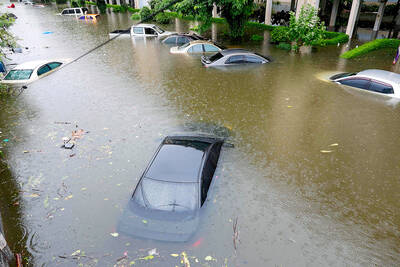
Several areas of Thailand’s capital city Bangkok were inundated by continuous rain from Thursday afternoon to yesterday morning that has disrupted traffic and forced some residents to evacuate. Major canals in Bangkok filled with accumulated rainfall exceeding 20cm, officials said yesterday. Floodwaters spread across the city, particularly in the central and eastern parts, blocking roads and stopping traffic. The Thai Meteorological Department warned that the heavy rain would continue in most parts of the country through today, citing a strong low-pressure system over the central region and strengthening southwest monsoon conditions. More than 84,000 people in 21 provinces nationwide were
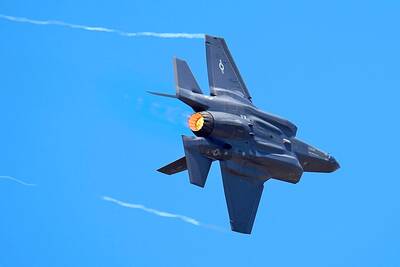
BAD TIMING: The disclosure of the incident, which is under investigation by at least two congressional committees, comes as Xi was to meet with Trump The Pentagon is investigating how parts of the US’ most advanced fighter jet ended up in Hong Kong, with a news outlet on Wednesday reporting that China has obtained the F-35 equipment. The F-35 Joint Program Office said in a statement that it and the US Department of Defense are aware of “a shipment issue” with F-35 components. “We are actively working with US authorities and industry partners to retrieve these components, investigate the incident and place safeguards to avoid a future occurrence,” the office said. UPS was shipping a cockpit canopy and weapons-bay door from an Australian military F-35 that was being

Yemen’s Saudi-led coalition early yesterday said it had intercepted two ballistic missiles and two drones launched by the Iran-backed Houthis toward the kingdom. The coalition said in posts on social media that the missiles were headed towards Khamis Mushait and the drones toward the capital, Riyadh, adding that it was monitoring the missile threat and drones launched at the kingdom, without providing further details. The Saudi Civil Defense had sent alerts overnight for Khamis Mushait and Abha, but not for Riyadh. The Houthis, who control the most populous parts of Yemen and much of the north, have been launching attacks
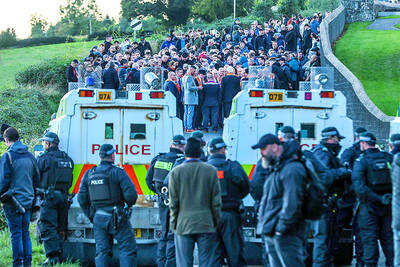
OLD WOUNDS: Protestant marchers seized on an overturned injunction to stage a march, which drew thousands of counterprotesters to block the road in Portadown UK leaders called for calm as a tense standoff with residents seeking to halt a pro-British Protestant march through a primarily Catholic area stretched into the night on Sunday, in one of the worst crises for Northern Ireland in the past few years. The tensions were triggered after a Belfast appeal court overturned a High Court injunction in the early hours of Sunday to clear the march by the Orange Order to go ahead for the first time since 1997. The Parades Commission, Northern Ireland’s independent body regulating contentious processions, had authorized 35 Orangemen to march silently along Garvaghy Road in Portadown,


 RSS
RSS