


Russia began evacuating thousands more people from its border regions yesterday after Ukraine said it was advancing deeper into the country in a lightning incursion aimed at forcing Moscow to slow its advance along the rest of the front.
The biggest foreign attack on sovereign Russian territory since World War II unfurled on Tuesday last week when thousands of Ukrainian troops smashed through Russia’s western border in an embarrassment for the Russian top military brass.
Supported by swarms of drones, heavy artillery and tanks, Ukrainian units have since carved out a sliver of the world’s biggest nuclear power and battles were ongoing along a front about 18km inside Russian territory yesterday.
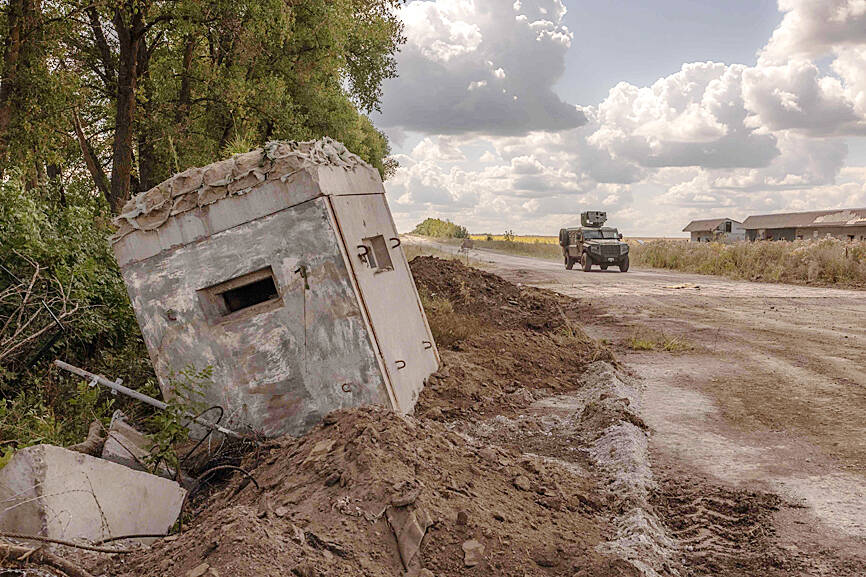
Photo: AFP
Acting Kursk Governor Alexei Smirnov said that Glushkov District, which has a population of 20,000, was being evacuated.
At least 200,000 people have so far been evacuated from the border regions, according to Russian data.
Ukrainian President Volodymyr Zelenskiy on Wednesday said that his forces had advanced a few kilometers and that the goal of replenishing an “exchange fund” of prisoners of war was being achieved.
One Ukrainian official said Kyiv was carving out a buffer zone to protect its population against attack.
The Russian Ministry of Defense yesterday said that its forces had shot down Ukrainian drones over the neighboring Belgorod region of Russia and that Sukhoi-34 bombers had pummeled Ukrainian positions in Kursk.
The Russian ministry also reported intense battles along the Ukraine front, and said that its troops had taken better positions at several points.
While the Ukrainian attack has embarrassed Moscow, revealed the weakness of its border defenses and changed the public narrative of the war, Russian officials said what they cast as a Ukrainian “invasion” would not change the course of the war.
Russia, which invaded Ukraine in 2022, has been advancing for most of the year along the 1,000km front in Ukraine and has a vast numerical superiority. It controls 18 percent of Ukraine.
The Ukrainian incursion into Russia has yielded its biggest battlefield gains since 2022.
The West, which backs Ukraine and has said it would not allow Russian President Vladimir Putin to win the war, has repeatedly said it knew nothing of the Ukrainian plans to attack Russia.
Russian officials say they do not believe such statements.
“Of course they are involved,” Russian lawmaker Maria Butina told Reuters. “When I studied in the United States the main rule was: ‘Don’t poke the bear.’ What the West is doing today? They are poking the bear.”
Putin on Monday said that Ukraine “with the help of its Western masters” was aiming to improve Kyiv’s negotiating position ahead of possible peace talks.
Russian officials have said that if Western weapons were used on Russian territory, then Moscow would consider that a grave escalation.
Major General Apti Alaudinov, who commands Chechnya’s Akhmat special forces, said that 12,000 Ukrainian troops had crossed into Russia.
The Ukrainian forces would be ejected, Alaudinov said.
By bringing the war to Russia, Zelenskiy faces the risk of weakening Kyiv’s defenses along the front in Ukraine while Russia has already sent in thousands of reserves in a bid to expel the Ukrainian soldiers.
If Ukraine wants to hold the Russian territory it has taken, it would need to build a sophisticated logistics operation to support its forces, military analysts said.

POLITICAL PRISONERS VS DEPORTEES: Venezuela’s prosecutor’s office slammed the call by El Salvador’s leader, accusing him of crimes against humanity Salvadoran President Nayib Bukele on Sunday proposed carrying out a prisoner swap with Venezuela, suggesting he would exchange Venezuelan deportees from the US his government has kept imprisoned for what he called “political prisoners” in Venezuela. In a post on X, directed at Venezuelan President Nicolas Maduro, Bukele listed off a number of family members of high-level opposition figures in Venezuela, journalists and activists detained during the South American government’s electoral crackdown last year. “The only reason they are imprisoned is for having opposed you and your electoral fraud,” he wrote to Maduro. “However, I want to propose a humanitarian agreement that
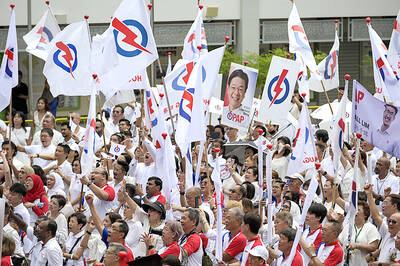
ECONOMIC WORRIES: The ruling PAP faces voters amid concerns that the city-state faces the possibility of a recession and job losses amid Washington’s tariffs Singapore yesterday finalized contestants for its general election on Saturday next week, with the ruling People’s Action Party (PAP) fielding 32 new candidates in the biggest refresh of the party that has ruled the city-state since independence in 1965. The move follows a pledge by Singaporean Prime Minister Lawrence Wong (黃循財), who took office last year and assumed the PAP leadership, to “bring in new blood, new ideas and new energy” to steer the country of 6 million people. His latest shake-up beats that of predecessors Lee Hsien Loong (李顯龍) and Goh Chok Tong (吳作棟), who replaced 24 and 11 politicians respectively

Young women standing idly around a park in Tokyo’s west suggest that a giant statue of Godzilla is not the only attraction for a record number of foreign tourists. Their faces lit by the cold glow of their phones, the women lining Okubo Park are evidence that sex tourism has developed as a dark flipside to the bustling Kabukicho nightlife district. Increasing numbers of foreign men are flocking to the area after seeing videos on social media. One of the women said that the area near Kabukicho, where Godzilla rumbles and belches smoke atop a cinema, has become a “real
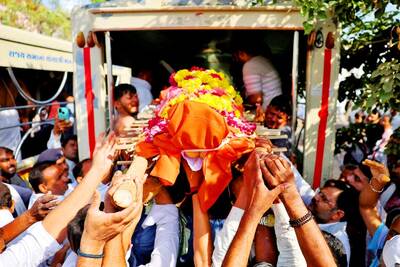
‘WATER WARFARE’: A Pakistani official called India’s suspension of a 65-year-old treaty on the sharing of waters from the Indus River ‘a cowardly, illegal move’ Pakistan yesterday canceled visas for Indian nationals, closed its airspace for all Indian-owned or operated airlines, and suspended all trade with India, including to and from any third country. The retaliatory measures follow India’s decision to suspend visas for Pakistani nationals in the aftermath of a deadly attack by shooters in Kashmir that killed 26 people, mostly tourists. The rare attack on civilians shocked and outraged India and prompted calls for action against their country’s archenemy, Pakistan. New Delhi did not publicly produce evidence connecting the attack to its neighbor, but said it had “cross-border” links to Pakistan. Pakistan denied any connection to


 RSS
RSS