


Russia yesterday ordered more evacuations in a region bordering Ukraine as it battled to contain an unprecedented push onto its territory by Kyiv’s forces.
Ukraine last week sent troops into Russia’s border region of Kursk, in the largest cross-border operation by Kyiv since Moscow launched its offensive more than two years ago.
The assault, which has sent tens of thousands of people fleeing, marked the most significant attack by a foreign army on Russian territory since World War II.
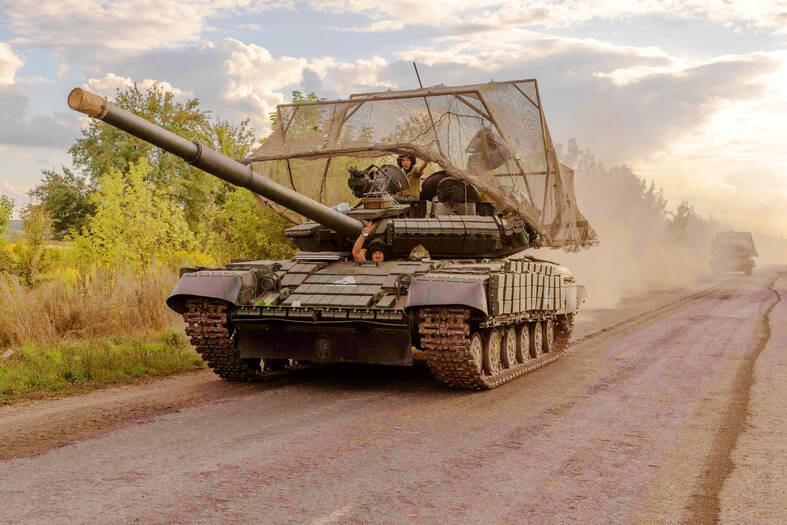
Photo: AFP
A top Ukrainian official said that the operation was aimed at stretching Moscow troops and destabilizing the nation after months of slow Russian advances across the front line.
The assault appeared to catch the Kremlin off guard, with Moscow’s army rushing in reserve troops, tanks, aviation, artillery and drones in a bid to quash it.
Despite the efforts, the army on Sunday conceded that Ukraine had been able to penetrate its territory by up to 30km in places.
In a daily briefing on the situation in the western Kursk region, the Russian Ministry of Defense said that it had “foiled attempts” by Ukraine’s forces to “break through deep into Russian territory” using armored vehicles, but it said that some of those forces were near the villages of Tolpino and Obshchy Kolodez, about 25km and 30km from the Russia-Ukraine border.
A Ukrainian security official said on condition of anonymity that “the aim is to stretch the positions of the enemy, to inflict maximum losses and to destabilize the situation in Russia as they are unable to protect their own border.”
The Ukrainian official also said Russian claims that Kyiv had deployed 1,000 troops were a serious underestimate.
“It is a lot more,” he said. “Thousands.”
Russia yesterday ordered fresh evacuations in the region, moving people from the neighboring region of Belgorod.
“The enemy is active on the border of the Krasnoyaruzhsky District,” Vyacheslav Gladkov said on Telegram. “For the health and security of our population, we’re beginning to move people who live in Krasnoyaruzhsky to safer places.”
On Sunday, each nation blamed the other for a fire at the Zaporizhzhia nuclear power plant in southern Ukraine occupied by Russian forces, though both sides — and the UN’s nuclear watchdog — said there was no sign of a nuclear leak.
“No impact has been reported for nuclear safety,” said a statement from the International Atomic Energy Agency (IAEA), which has experts at the site.
Both Kyiv and Moscow said there had been no rise in radiation levels.
In a later statement, the IAEA said it had requested that its team get “immediate access to the cooling tower to assess the damage.”
A Moscow-installed official, Vladimir Rogov, said that the blaze had been “completely extinguished” in a Telegram post yesterday.

PHISHING: The con might appear convincing, as the scam e-mails can coincide with genuine messages from Apple saying you have run out of storage For a while you have been getting messages from Apple saying “your iCloud storage is full.” They say you have exceeded your storage plan, so documents are no longer being backed up, and photos you take are not being uploaded. You have been resisting Apple’s efforts to get you to pay a minimum of £0.99 (US$1.33) a month for more storage, but it seems that you cannot keep putting off the inevitable: You have received an e-mail which says your iCloud account has been blocked, and your photos and videos would be deleted very soon. To keep them you need
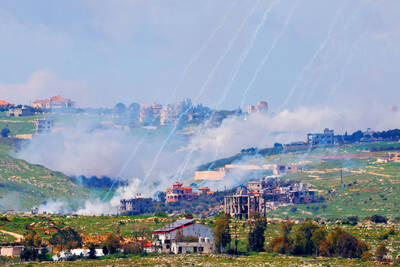
The Israeli military has demolished entire villages as part of its invasion of south Lebanon, rigging homes with explosives and razing them to the ground in massive remote detonations. The Guardian reviewed three videos posted by the Israeli military and on social media, which showed Israel carrying out mass detonations in the villages of Taybeh, Naqoura and Deir Seryan along the Israel-Lebanon border. Lebanese media has reported more mass detonations in other border villages, but satellite imagery was not readily available to verify these claims. The demolitions came after Israeli Minister of Defense Israel Katz called for the destruction of

A US YouTuber who caused outrage for filming himself kissing a statue commemorating Korean wartime sex slaves has been sentenced to six months in prison, a court in Seoul said yesterday. Johnny Somali, 25, gained notoriety several years ago for recording himself doing a series of provocative stunts in South Korea and Japan, and streaming them on platforms such as YouTube and Twitch. South Korean authorities indicted Somali — whose real name is Ramsey Khalid Ismael — in 2024 on public order violations and obstruction of business, and banned him from leaving the country. “The court has sentenced him to six months in

The death toll from a shooting in western Afghanistan rose to 11 on Saturday, after gunmen targeted civilians at a picnic spot in Herat, the provincial authority said. Bullet marks were visible on a wall of the Sayed Mohammad Agha Shia shrine, while bloodstains marked a blanket abandoned at the scene. “Eleven people have been recorded dead and eight others wounded from Friday’s incident, with the condition of two of the wounded reported as critical,” Herat’s information office said in a statement. The update raises a toll of seven killed provided on Friday by the Afghan Ministry of Interior Affairs


 RSS
RSS