


Countries in central Africa are racing to contain a multinational outbreak of a mutated mpox strain that has killed almost 500 people in the Democratic Republic of the Congo (DRC) alone since January.
The fast-spreading virus is suspected to have infected more than 12,300 people this year in the DRC, where it was first reported less than a year ago.
Recent cases in Ivory Coast, Kenya and at least three other African countries have raised concern of an explosive contagion carried along newly built roads and highways connecting remote mining sites to cities and camps housing hundreds of thousands of conflict-displaced Congolese.

Photo: Reuters
Mpox is caused by the monkeypox virus, the most life-threatening form of poxvirus to arise since the eradication of smallpox in the 1970s. Although it has been spilling over from rodents and infecting humans with increasing frequency for decades, the current outbreak is unprecedented, driven by a variant that has undergone genetic changes that scientists worry might have made it more dangerous.
“The uninterrupted human-to-human transmission for at least the last eight months, possibly more, has never been seen in mpox spread in the region before,” said Sylvie Jonckheere, an adviser on emerging infectious diseases at the medical aid group MSF, or Doctors Without Borders.
Africa is the only continent where mpox is endemic, yet has struggled to get vaccines made by Bavarian Nordic A/S and KM Biologics Co.
The DRC is working to get supplies of shots, an e-mailed statement from MSF said.
Bavarian Nordic, maker of Jynneos vaccine, said it has pledged to donate doses for African countries.
KM Biologics did not respond to a request for comment.
“We can only plead, like so many others, for the vaccines to arrive in the country as quickly as possible and in large quantities so we can protect people in the areas most affected,” Louis Albert Massing, MSF’s medical coordinator in the DRC, said in the statement.
Children and adolescents have been most affected in the outbreak, with more than 60 percent of known fatal cases under the age of 5.
The variant is reported to be spreading faster through sexual contact, like the milder strain known as clade IIb that erupted globally in 2022.
A report in June found 29 percent of confirmed cases of the new strain were among sex workers.
However, the current virus is more closely related to the dangerous clade I strain; the rate of deaths among reported cases in the DRC is almost 5 percent.
Stemming the spread is also proving difficult in the country, roughly the size of western Europe and wracked by decades-long conflict and poverty.
About three-fourths of its 100 million people lived on less than US$2.15 a day last year, according to the World Bank.
The nation’s cobalt resources — the world’s largest — have lured billions of dollars of infrastructure investments from Chinese state-owned companies. Newly paved roads improve access to foods and healthcare, yet help spread infectious threats. Viruses like Ebola that were once contained largely in remote communities are now transported to densely populated African cities and the rest of the world.
“Diseases follow people and people are traveling faster and further than they did in the past,” said Jonckheere, who has long worked in the DRC. “In the 1980s you were not seeing motorbikes, or very few, in deeper Congo. Now people mostly travel on them.”
Health authorities recently reported mpox at a border crossing in southern Kenya in a person traveling from Uganda to Rwanda. Central African Republic also reported an outbreak, including cases in its densely populated capital, Bangui. Uganda’s Ministry of Health last week reported two new cases that it said were imported from the DRC. Rwanda, Burundi and Ivory Coast have also recorded cases.
The large volume of people moving between Kenya and other East African countries “is a significant risk for regional transmission” of mpox, Kenya’s public health department said Wednesday in a statement.
Another concern is the possibility that some mpox patients are also infected with HIV, which cuts the body’s ability to fight disease. Africa has the world’s biggest number of HIV infections.
“It’s clear there’s a big problem,” with fighting mpox, said Marion Koopmans, who heads the department of viroscience at Erasmus University Medical Center in the Netherlands. “We’re now trying to get a sense of how it’s spreading. It’s a difficult area in which to work.”
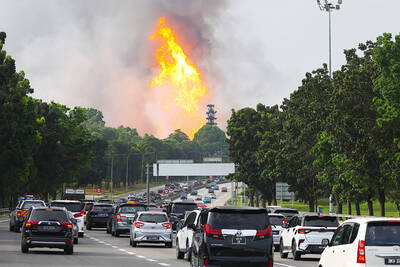
A fire caused by a burst gas pipe yesterday spread to several homes and sent a fireball soaring into the sky outside Malaysia’s largest city, injuring more than 100 people. The towering inferno near a gas station in Putra Heights outside Kuala Lumpur was visible for kilometers and lasted for several hours. It happened during a public holiday as Muslims, who are the majority in Malaysia, celebrate the second day of Eid al-Fitr. National oil company Petronas said the fire started at one of its gas pipelines at 8:10am and the affected pipeline was later isolated. Disaster management officials said shutting the
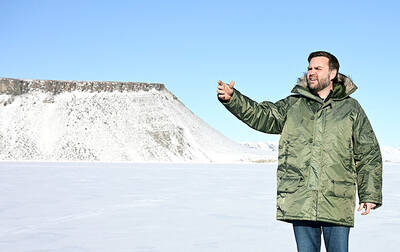
US Vice President J.D. Vance on Friday accused Denmark of not having done enough to protect Greenland, when he visited the strategically placed and resource-rich Danish territory coveted by US President Donald Trump. Vance made his comment during a trip to the Pituffik Space Base in northwestern Greenland, a visit viewed by Copenhagen and Nuuk as a provocation. “Our message to Denmark is very simple: You have not done a good job by the people of Greenland,” Vance told a news conference. “You have under-invested in the people of Greenland, and you have under-invested in the security architecture of this

Japan unveiled a plan on Thursday to evacuate around 120,000 residents and tourists from its southern islets near Taiwan within six days in the event of an “emergency”. The plan was put together as “the security situation surrounding our nation grows severe” and with an “emergency” in mind, the government’s crisis management office said. Exactly what that emergency might be was left unspecified in the plan but it envisages the evacuation of around 120,000 people in five Japanese islets close to Taiwan. China claims Taiwan as part of its territory and has stepped up military pressure in recent years, including

UNREST: The authorities in Turkey arrested 13 Turkish journalists in five days, deported a BBC correspondent and on Thursday arrested a reporter from Sweden Waving flags and chanting slogans, many hundreds of thousands of anti-government demonstrators on Saturday rallied in Istanbul, Turkey, in defence of democracy after the arrest of Istanbul Mayor Ekrem Imamoglu which sparked Turkey’s worst street unrest in more than a decade. Under a cloudless blue sky, vast crowds gathered in Maltepe on the Asian side of Turkey’s biggest city on the eve of the Eid al-Fitr celebration which started yesterday, marking the end of Ramadan. Ozgur Ozel, chairman of the main opposition Republican People’s Party (CHP), which organized the rally, said there were 2.2 million people in the crowd, but


 RSS
RSS