


The Philippines has turned down offers from the US to assist operations in the South China Sea, after a flare-up with China over missions to resupply Filipino troops on a contested shoal, its military chief said.
Tensions in the disputed waterway have boiled over into violence in the past year, with a Filipino sailor losing a finger in the latest June 17 clash that Manila described as “intentional high-speed ramming” by the Chinese coast guard.
The US, a treaty ally, has offered support, but Manila prefers to handle operations on its own, Armed Forces of the Philippines Chief General Romeo Brawner told Reuters late on Thursday.
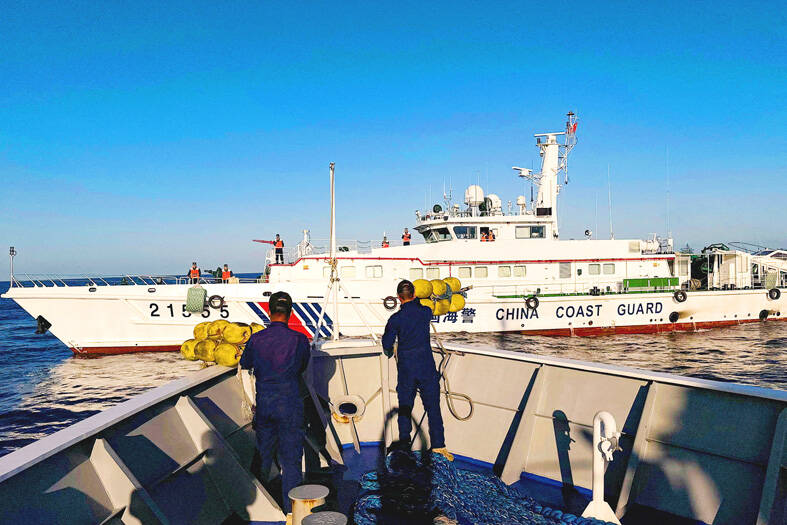
Photo: Reuters
“Yes, of course, they have been offering help and they asked us how they could help us in any way,” he said.
“We try to exhaust all possible options that we have before we ask for help,” he said.
Manila and Washington are bound by the 1951 Mutual Defense Treaty, a military pact that can be invoked in the case of armed attacks on Philippine forces, public vessels or aircraft in the South China Sea.
Confrontations between the Philippines and China in Asia’s most contested waters have increased in frequency over the past year, as Beijing has pressed its claim to the waterway and Manila continued missions to bring supplies to soldiers living aboard a rusty, aging warship that it grounded on a contested shoal.
Some observers, including former deputy US national security adviser Matt Pottinger, have called for direct US naval support for the resupply missions.
However, Philippine National Security Adviser Eduardo Ano said the Philippines wanted them to be a “pure Philippine operation.”
“This is our legitimate national interest, so we don’t see any reason for them [the US] to come in,” Ano told Reuters.
Ano, who spoke to his US counterpart, Jake Sullivan, last month to discuss shared concerns over China’s “dangerous and escalatory actions,” said the Mutual Defense Treaty was “far from being invoked.”
“We [the Philippines and China] agreed that there will be some easing tension, but we will assert our rights, we will not compromise our national interest, and we will continue to fight and claim what is ours,” Ano said.
Neither official specified what support the US had offered.
Greg Poling, a South China Sea expert at Washington’s Center for Strategic and International Studies think tank, told Reuters he believed the US was open to naval escorts for the resupply missions to the stranded vessel.
Washington has already provided some limited support, he said.
A Philippine official last year said that Manila was consulting the US Army Corps of Engineers on how best to stabilize the BRP Sierra Madre, which was grounded on the contested Second Thomas Shoal (Renai Shoal, 仁愛暗沙), Poling said, while US aircraft have been filmed providing overwatch of the ship on multiple occasions.
The Permanent Court of Arbitration in the Hague ruled in 2016 that Beijing’s expansive South China Sea claims via its nine-dash line had no basis under international law, but that has not stopped China, which rejects the ruling, from being more assertive in the waterway.
It has deployed coast guard vessels to patrol those areas, alarming Taiwan, the Philippines, rival Southeast Asian claimants and other states operating in the South China Sea, including the US, which is wary about China’s growing military power and territorial ambition.
Brawner said the US’ offer of support, made in discussions at his level, was not a direct response to the June 17 incident, but rather a reflection of the enduring military alliance between the two countries.
“It is really because of our being treaty allies, so that offer has been available to us for a long time not just because of the incident,” Brawner said.
“But we did not ask them yet because as per the orders of our president we have to rely on ourself first,” he added.
The Pentagon did not immediately respond to a request for comment. Thursday was a federal holiday in Washington for the US’ Independence Day.

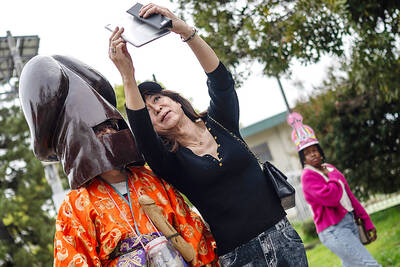
Showcasing phallus-shaped portable shrines and pink penis candies, Japan’s annual fertility festival yesterday teemed with tourists, couples and families elated by its open display of sex. The spring Kanamara Matsuri near Tokyo features colorfully dressed worshipers carrying a trio of giant phallic-shaped objects as they parade through the street with glee. The festival, as legend has it, honors a local blacksmith in the Edo Period (1603-1868) who forged an iron dildo to break the teeth of a sharp-toothed demon inhabiting a woman’s vagina that had been castrating young men on their wedding nights. A 1m black steel phallus sits in the courtyard of

HIGH HOPES: The power source is expected to have a future, as it is not dependent on the weather or light, and could be useful for places with large desalination facilities A Japanese water plant is harnessing the natural process of osmosis to generate renewable energy that could one day become a common power source. The possibility of generating power from osmosis — when water molecules pass from a less salty solution to a more salty one — has long been known. However, actually generating energy from that has proved more complicated, in part due the difficulty of designing the membrane through which the molecules pass. Engineers in Fukuoka, Japan, and their private partners think they might have cracked it, and have opened what is only the world’s second osmotic power plant. It generates

JAN. 1 CLAUSE: As military service is voluntary, applications for permission to stay abroad for over three months for men up to age 45 must, in principle, be granted A little-noticed clause in sweeping changes to Germany’s military service policy has triggered an uproar after it emerged that the law requires men aged up to 45 to get permission from the armed forces before any significant stay abroad, even in peacetime. The legislation, which went into effect on Jan. 1 aims to bolster the military and demands all 18-year-old men fill out a questionnaire to gauge their suitability to serve in the armed forces, but stops short of conscription. If the “modernized” model fails to pull in enough recruits, parliament will be compelled to discuss the reintroduction of compulsory service, German

Hundreds of Filipinos and tourists flocked to a sun-bleached field north of Manila yesterday, on Good Friday, to witness one of the country’s most blood-soaked displays of religious fervor, undeterred by rising fuel prices. Scores of bare-chested flagellants with covered faces walked barefoot through the dusty streets of Pampanga Province’s San Fernando as they flogged their backs with bamboo whips in the scorching heat. Agence France-Presse (AFP) journalists said they saw devotees deliberately puncturing their skin with glass shards attached to a small wooden paddle to ensure their bleeding during the ritual, a way to atone for sins and seek miracles from


 RSS
RSS