


Chinese Premier Li Qiang (李強) yesterday arrived in New Zealand’s northern hub of Auckland, stirring up hope of new trade avenues among the nation’s business leaders.
Li is on a six-day tour of New Zealand and Australia, the highest-ranking official to visit either nation since his predecessor in 2017.
China accounts for 30 percent of New Zealand’s export earnings, according to World Bank data, but there are fears this could evaporate if the world’s second-largest economy continues to slow.
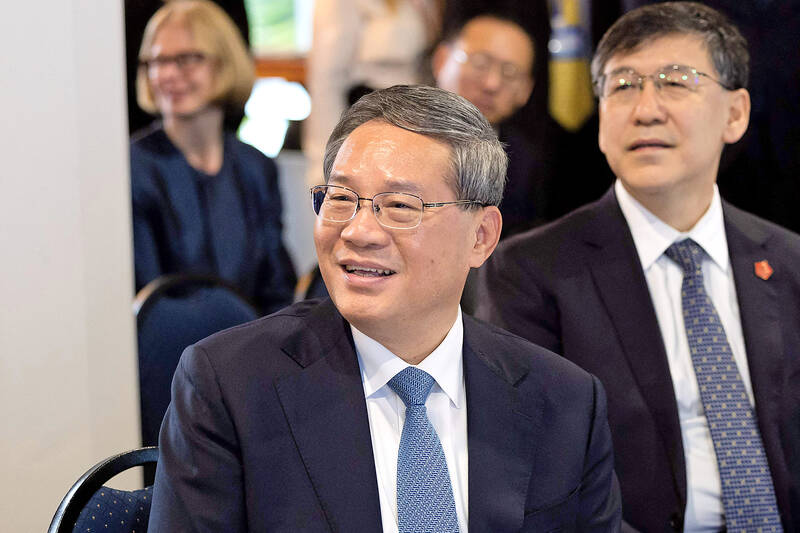
Photo: AFP
The New Zealand China Council — which represents some of the nation’s biggest exporters and most influential companies — was slated to meet with Li yesterday evening. A council spokesperson said they were enthusiastic about “hearing the premier’s views on potential new areas of growth for the bilateral relationship.”
Mark Piper, chief executive of a top New Zealand government science institute, met Li earlier during a tour of a research facility.
“He was talking about more research collaborations and more people exchanges, which is what we’re really interested in,” Piper said. “He was really big on collaboration, the value that New Zealand can bring to China and that China can bring to New Zealand.”
New Zealand was one of the first developed nations to ink a comprehensive free-trade deal with Beijing. Chinese consumers have a voracious appetite, in particular, for New Zealand’s premium meat, dairy and wine.
Li on Thursday touted opportunities for trade, tourism and investment as he started his tour in New Zealand’s capital, Wellington, but he warned that emerging differences between the two nations “should not become a chasm that blocks exchanges and cooperation between us.”
New Zealand, long seen as one of China’s closest partners in the region, has become increasingly bold in its criticism of Beijing’s role in the South Pacific.
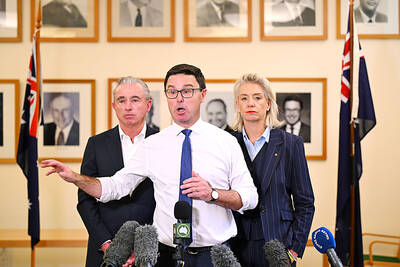
BACKLASH: The National Party quit its decades-long partnership with the Liberal Party after their election loss to center-left Labor, which won a historic third term Australia’s National Party has split from its conservative coalition partner of more than 60 years, the Liberal Party, citing policy differences over renewable energy and after a resounding loss at a national election this month. “Its time to have a break,” Nationals leader David Littleproud told reporters yesterday. The split shows the pressure on Australia’s conservative parties after Prime Minister Anthony Albanese’s center-left Labor party won a historic second term in the May 3 election, powered by a voter backlash against US President Donald Trump’s policies. Under the long-standing partnership in state and federal politics, the Liberal and National coalition had shared power
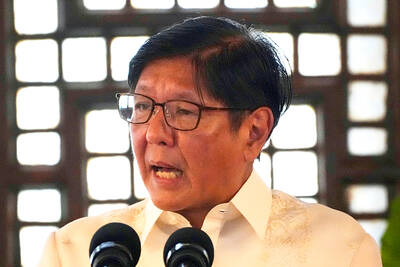
NO EXCUSES: Marcos said his administration was acting on voters’ demands, but an academic said the move was emotionally motivated after a poor midterm showing Philippine President Ferdinand Marcos Jr yesterday sought the resignation of all his Cabinet secretaries, in a move seen as an attempt to reset the political agenda and assert his authority over the second half of his single six-year term. The order came after the president’s allies failed to win a majority of Senate seats contested in the 12 polls on Monday last week, leaving Marcos facing a divided political and legislative landscape that could thwart his attempts to have an ally succeed him in 2028. “He’s talking to the people, trying to salvage whatever political capital he has left. I think it’s

CONTROVERSY: During the performance of Israel’s entrant Yuval Raphael’s song ‘New Day Will Rise,’ loud whistles were heard and two people tried to get on stage Austria’s JJ yesterday won the Eurovision Song Contest, with his operatic song Wasted Love triumphing at the world’s biggest live music television event. After votes from national juries around Europe and viewers from across the continent and beyond, JJ gave Austria its first victory since bearded drag performer Conchita Wurst’s 2014 triumph. After the nail-biting drama as the votes were revealed running into yesterday morning, Austria finished with 436 points, ahead of Israel — whose participation drew protests — on 357 and Estonia on 356. “Thank you to you, Europe, for making my dreams come true,” 24-year-old countertenor JJ, whose

Polish presidential candidates offered different visions of Poland and its relations with Ukraine in a televised debate ahead of next week’s run-off, which remains on a knife-edge. During a head-to-head debate lasting two hours, centrist Warsaw Mayor Rafal Trzaskowski, from Polish Prime Minister Donald Tusk’s governing pro-European coalition, faced the Eurosceptic historian Karol Nawrocki, backed by the right-wing populist Law and Justice party (PiS). The two candidates, who qualified for the second round after coming in the top two places in the first vote on Sunday last week, clashed over Poland’s relations with Ukraine, EU policy and the track records of their


 RSS
RSS